Knowledge What role does a high-temperature blast drying oven play in nanocomposite formation? Ensure Structural Stability
Author avatar

Tech Team · Kintek Furnace

Updated 23 hours ago

What role does a high-temperature blast drying oven play in nanocomposite formation? Ensure Structural Stability


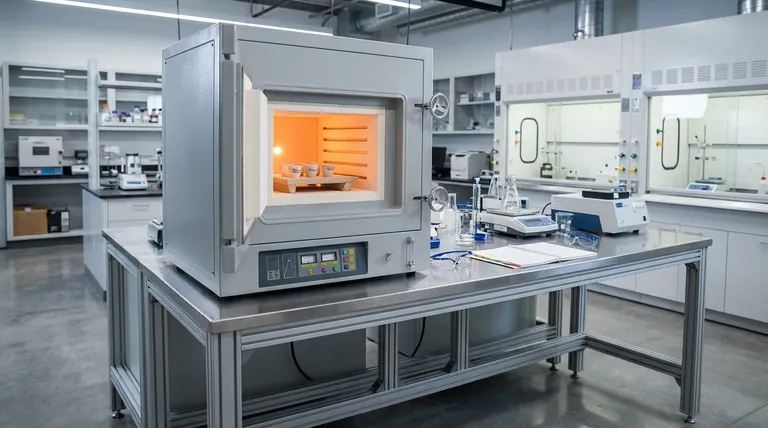
The high-temperature blast drying oven serves as a crucial stabilization tool in the post-formation of nanocomposites. It utilizes controlled hot air circulation to systematically remove residual moisture from composite precipitates, ensuring the physical solidification of nanostructures onto their substrates while preventing material degradation.

By effectively managing the thermal environment, this equipment bridges the gap between raw synthesis and a usable product. It secures the structural integrity of the material by eliminating the moisture that drives agglomeration and chemical instability.
What role does a high-temperature blast drying oven play in nanocomposite formation? Ensure Structural Stability

Mechanisms of Material Stabilization

Promoting Physical Solidification

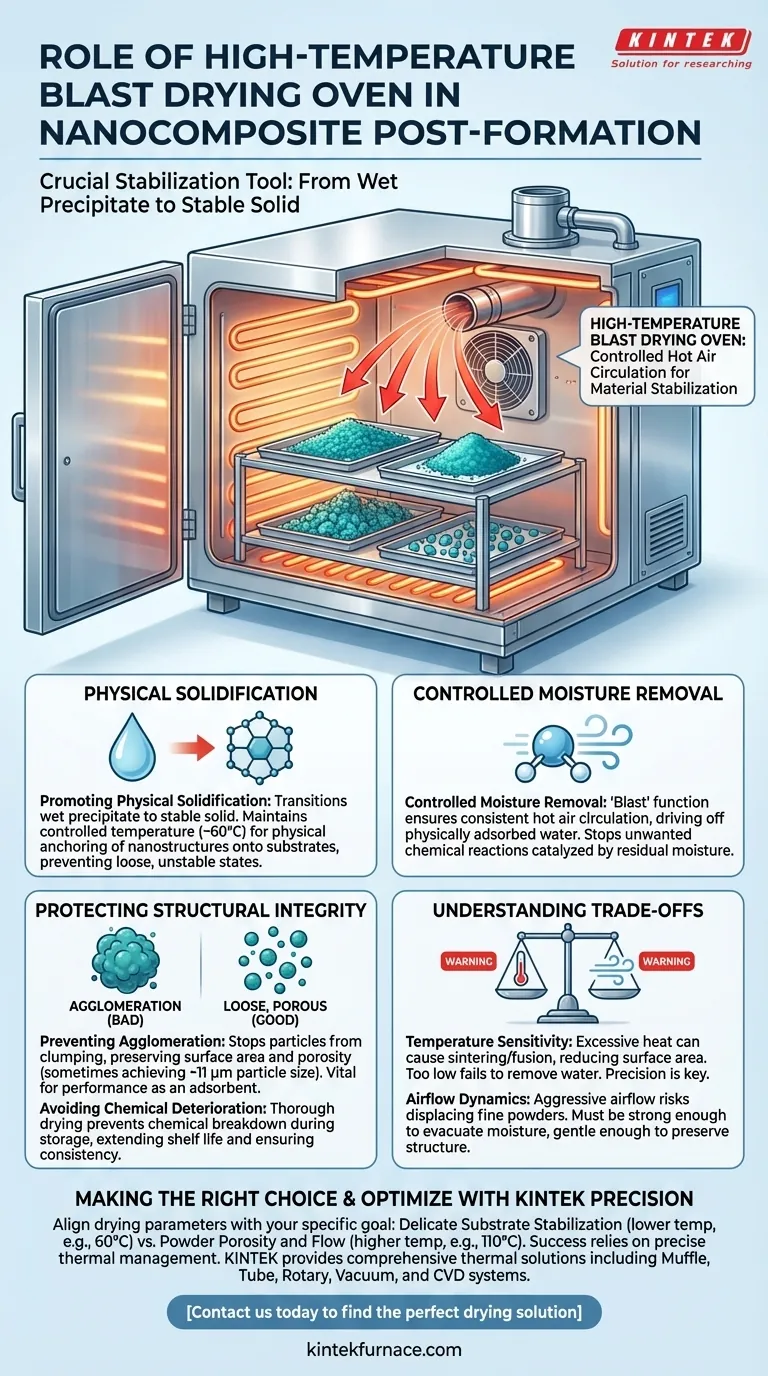
The primary function of the oven is to transition the material from a wet precipitate to a stable solid.

By maintaining a controlled temperature (often around 60°C for delicate precipitates), the oven facilitates the physical anchoring of nanostructures. This ensures they adhere properly to the substrate rather than remaining in a loose or unstable state.

Controlled Moisture Removal

Residual moisture is a significant threat to nanocomposite quality.

The "blast" function ensures consistent hot air circulation, which drives off physically adsorbed water. This dehydration is essential for stopping unwanted chemical reactions that water might catalyze after the initial formation.

Protecting Structural Integrity

Preventing Agglomeration

One of the most critical roles of the drying process is to stop particles from clumping together.

Without precise drying, nanoparticles tend to aggregate, destroying the desired surface area and porosity. Proper drying yields a loose, porous material—sometimes achieving specific particle sizes around 11 μm—which is vital for the material's performance as an adsorbent.

Avoiding Chemical Deterioration

Moisture trapped within a nanocomposite can lead to rapid degradation during storage.

By thoroughly drying the precipitates, the oven prevents chemical breakdown. This extends the shelf life of the material and ensures its properties remain consistent from the lab to the application site.

Understanding the Trade-offs

Temperature Sensitivity

While heat is necessary for drying, excessive temperatures can be detrimental.

If the temperature is set too high, it may cause the nanostructures to sinter or fuse, reducing their active surface area. Conversely, temperatures that are too low will fail to remove all adsorbed water, leading to instability.

Airflow Dynamics

The "blast" aspect refers to forced air circulation, which promotes uniformity but introduces physical force.

If the airflow is too aggressive, it risks displacing fine powders or creating inconsistencies in the drying bed. The circulation must be strong enough to evacuate moisture but gentle enough to preserve the physical structure of the precipitate.

Making the Right Choice for Your Goal

To maximize the effectiveness of your post-formation process, align your drying parameters with your specific material needs:

  • If your primary focus is Delicate Substrate Stabilization: Utilize lower controlled temperatures (e.g., 60°C) to slowly solidify nanostructures without thermal shock.
  • If your primary focus is Powder Porosity and Flow: Employ higher temperatures (e.g., 110°C) to ensure complete dehydration and prevent particle agglomeration.

Success in nanocomposite fabrication relies not just on synthesis, but on the precise thermal management that locks in your material's final properties.

Summary Table:

Process Function Impact on Nanocomposites Key Mechanism
Physical Solidification Anchors nanostructures to substrates Controlled thermal anchoring at ~60°C
Moisture Removal Prevents chemical degradation and instability Forced air circulation (blast function)
Agglomeration Control Maintains high surface area and porosity Uniform drying to prevent particle clumping
Thermal Optimization Prevents sintering or structural fusion Precision temperature management

Optimize Your Nanocomposite Synthesis with KINTEK Precision

Ensure the structural integrity and performance of your advanced materials with our high-performance thermal solutions. Backed by expert R&D and world-class manufacturing, KINTEK provides a comprehensive range of lab equipment—including Muffle, Tube, Rotary, Vacuum, and CVD systems—all customizable to meet your specific research or production needs.

Don't let improper drying compromise your lab's results. Contact us today to find the perfect drying solution for your unique application.

Visual Guide
What role does a high-temperature blast drying oven play in nanocomposite formation? Ensure Structural Stability Visual Guide

References

  1. Büşra Şensoy Gün, Belgin Tunalı. Biofilm-inhibiting ZnO@Eggshell nanocomposites: green synthesis, characterization, and biomedical potential. DOI: 10.1007/s10534-025-00711-8

This article is also based on technical information from Kintek Furnace Knowledge Base .

Related Products

People Also Ask

Related Products

High Temperature Muffle Oven Furnace for Laboratory Debinding and Pre Sintering

High Temperature Muffle Oven Furnace for Laboratory Debinding and Pre Sintering

KT-MD Debinding & Pre-Sintering Furnace for ceramics - precise temperature control, energy-efficient design, customizable sizes. Boost your lab efficiency today!

1200℃ Muffle Oven Furnace for Laboratory

1200℃ Muffle Oven Furnace for Laboratory

KINTEK KT-12M Muffle Furnace: Precision 1200°C heating with PID control. Ideal for labs needing rapid, uniform heat. Explore models & customization options.

Vacuum Heat Treat Furnace with Ceramic Fiber Liner

Vacuum Heat Treat Furnace with Ceramic Fiber Liner

KINTEK's Vacuum Furnace with Ceramic Fiber Lining offers precise high-temperature processing up to 1700°C, ensuring uniform heat distribution and energy efficiency. Ideal for labs and production.

Molybdenum Disilicide MoSi2 Thermal Heating Elements for Electric Furnace

Molybdenum Disilicide MoSi2 Thermal Heating Elements for Electric Furnace

High-performance MoSi2 heating elements for labs, reaching 1800°C with superior oxidation resistance. Customizable, durable, and reliable for high-temperature applications.

1400℃ Controlled Inert Nitrogen Atmosphere Furnace

1400℃ Controlled Inert Nitrogen Atmosphere Furnace

KT-14A Controlled Atmosphere Furnace for labs & industry. 1400°C max temp, vacuum sealing, inert gas control. Customizable solutions available.

1400℃ High Temperature Laboratory Tube Furnace with Quartz and Alumina Tube

1400℃ High Temperature Laboratory Tube Furnace with Quartz and Alumina Tube

KINTEK's Tube Furnace with Alumina Tube: Precision high-temperature processing up to 2000°C for labs. Ideal for material synthesis, CVD, and sintering. Customizable options available.

Vacuum Dental Porcelain Sintering Furnace for Dental Laboratories

Vacuum Dental Porcelain Sintering Furnace for Dental Laboratories

KinTek Vacuum Porcelain Furnace: Precision dental lab equipment for high-quality ceramic restorations. Advanced firing control & user-friendly operation.

Chairside Dental Porcelain Zirconia Sintering Furnace with Transformer for Ceramic Restorations

Chairside Dental Porcelain Zirconia Sintering Furnace with Transformer for Ceramic Restorations

Dental Porcelain Speedy Sintering Furnace: Fast 9-minute zirconia sintering, 1530°C precision, SiC heaters for dental labs. Boost productivity today!

Electric Rotary Kiln Continuous Working Small Rotary Furnace Kiln for Pyrolysis Plant Heating

Electric Rotary Kiln Continuous Working Small Rotary Furnace Kiln for Pyrolysis Plant Heating

KINTEK's electric rotary furnaces offer precision heating up to 1100°C for calcination, drying, and pyrolysis. Durable, efficient, and customizable for labs and production. Explore models now!

Silicon Carbide SiC Thermal Heating Elements for Electric Furnace

Silicon Carbide SiC Thermal Heating Elements for Electric Furnace

High-performance SiC heating elements for labs, offering 600-1600°C precision, energy efficiency, and long lifespan. Customizable solutions available.

1700℃ Controlled Inert Nitrogen Atmosphere Furnace

1700℃ Controlled Inert Nitrogen Atmosphere Furnace

KT-17A Controlled Atmosphere Furnace: Precise 1700°C heating with vacuum & gas control. Ideal for sintering, research & material processing. Explore now!

1200℃ Split Tube Furnace Laboratory Quartz Tube Furnace with Quartz Tube

1200℃ Split Tube Furnace Laboratory Quartz Tube Furnace with Quartz Tube

Discover KINTEK's 1200℃ Split Tube Furnace with quartz tube for precise high-temperature lab applications. Customizable, durable, and efficient. Get yours now!

Vacuum Heat Treat Sintering Furnace Molybdenum Wire Vacuum Sintering Furnace

Vacuum Heat Treat Sintering Furnace Molybdenum Wire Vacuum Sintering Furnace

KINTEK's Vacuum Molybdenum Wire Sintering Furnace excels in high-temperature, high-vacuum processes for sintering, annealing, and material research. Achieve precise 1700°C heating with uniform results. Custom solutions available.

Vacuum Hot Press Furnace Machine Heated Vacuum Press Tube Furnace

Vacuum Hot Press Furnace Machine Heated Vacuum Press Tube Furnace

Discover KINTEK's advanced Vacuum Tube Hot Press Furnace for precise high-temperature sintering, hot pressing, and material bonding. Customizable solutions for labs.

915MHz MPCVD Diamond Machine Microwave Plasma Chemical Vapor Deposition System Reactor

915MHz MPCVD Diamond Machine Microwave Plasma Chemical Vapor Deposition System Reactor

KINTEK MPCVD Diamond Machine: High-quality diamond synthesis with advanced MPCVD technology. Faster growth, superior purity, customizable options. Boost production now!

Split Chamber CVD Tube Furnace with Vacuum Station CVD Machine

Split Chamber CVD Tube Furnace with Vacuum Station CVD Machine

Split Chamber CVD Tube Furnace with Vacuum Station - High precision 1200°C lab furnace for advanced materials research. Customizable solutions available.

Vacuum Sealed Continuous Working Rotary Tube Furnace Rotating Tube Furnace

Vacuum Sealed Continuous Working Rotary Tube Furnace Rotating Tube Furnace

Precision rotary tube furnace for continuous vacuum processing. Ideal for calcination, sintering, and heat treatment. Customizable up to 1600℃.

Electric Rotary Kiln Small Rotary Furnace Biomass Pyrolysis Plant Rotating Furnace

Electric Rotary Kiln Small Rotary Furnace Biomass Pyrolysis Plant Rotating Furnace

KINTEK's Rotary Biomass Pyrolysis Furnace converts biomass to biochar, bio-oil, and syngas efficiently. Customizable for research or production. Get your solution now!

Electric Rotary Kiln Pyrolysis Furnace Plant Machine Small Rotary Kiln Calciner

Electric Rotary Kiln Pyrolysis Furnace Plant Machine Small Rotary Kiln Calciner

KINTEK Electric Rotary Kiln: Precise 1100℃ calcination, pyrolysis & drying. Eco-friendly, multi-zone heating, customizable for lab & industrial needs.

Vacuum Hot Press Furnace Machine for Lamination and Heating

Vacuum Hot Press Furnace Machine for Lamination and Heating

KINTEK Vacuum Lamination Press: Precision bonding for wafer, thin-film & LCP applications. 500°C max temp, 20-ton pressure, CE certified. Custom solutions available.


Leave Your Message









