
Products High Temperature Furnaces Thermal Elements

Thermal Elements


FAQ

What Are The Main Applications Of Heater Elements Like MoSi2 And SiC?

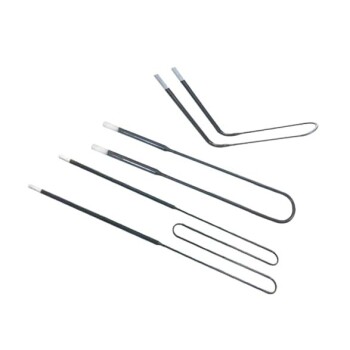
Heater elements such as Molybdenum Disilicide (MoSi2) and Silicon Carbide (SiC) are widely used in high-temperature applications including heat treatment furnaces, glass manufacturing, ceramic production, refractory materials, metallurgy, steel-making, crystal growth, electronic parts manufacturing, and semiconductor materials processing.

What Are The Advantages Of Using MoSi2 Heating Elements?

MoSi2 heating elements offer high-performance with the ability to reach temperatures up to 1800°C. They have superior oxidation resistance, are durable, reliable, and can be customized for specific high-temperature applications.

What Are The Benefits Of SiC Heating Elements?

Silicon Carbide (SiC) heating elements provide high-performance heating with a temperature range of 600-1600°C. They are known for their precision, energy efficiency, long lifespan, and the availability of customizable solutions for various industrial needs.

Why Are Ceramic And Semiconductor Heating Elements Like MoSi2 And SiC Suitable For High-temperature Environments?

Ceramic and semiconductor heating elements such as MoSi2 and SiC have moderate density and high melting points, making them ideal for high-temperature environments. They form protective silicon dioxide layers at high temperatures, which enhances their durability and resistance to oxidation.

Can MoSi2 And SiC Heating Elements Be Customized?

Yes, both MoSi2 and SiC heating elements can be customized to meet specific requirements of different high-temperature applications, ensuring optimal performance and efficiency for various industrial processes.
REQUEST A QUOTE

Our professional team will reply to you within one business day. Please feel free to contact us!


Related Articles

Why Your SiC Fiber Performance Hits a Ceiling—and How LCVD Breaks Through

Why Your SiC Fiber Performance Hits a Ceiling—and How LCVD Breaks Through

Discover how Laser Chemical Vapor Deposition (LCVD) overcomes the limitations of traditional SiC fiber synthesis by providing unmatched control over stoichiometry and crystallinity.

Read more
The Physics of Perfection: Why IGBT Control is Non-Negotiable in Magnesium Powder Production

The Physics of Perfection: Why IGBT Control is Non-Negotiable in Magnesium Powder Production

Discover how IGBT power supplies transform induction heating from a crude heat source into a precision tool for consistent magnesium powder quality.

Read more
The Unseen Battle: Containing Molten Magnesium and the Quest for Purity

The Unseen Battle: Containing Molten Magnesium and the Quest for Purity

Discover why corundum's inertness and thermal stability make it the only choice for preventing contamination in high-temperature metal experiments.

Read more
The Invisible Battle: Material Science in High-Temperature Magnesium Evaporation

The Invisible Battle: Material Science in High-Temperature Magnesium Evaporation

Molten magnesium's extreme reactivity demands chemically inert crucibles like high-purity alumina to prevent catastrophic contamination and ensure purity.

Read more
The Heart of the Void: Choosing the Right Heating Element for Your Vacuum Furnace

The Heart of the Void: Choosing the Right Heating Element for Your Vacuum Furnace

Learn the critical trade-offs between graphite and refractory metals when selecting a vacuum furnace heating element for temperature, purity, and cost.

Read more
Why Your High-Temperature Furnace Fails (Even When the Temperature Is Right)

Why Your High-Temperature Furnace Fails (Even When the Temperature Is Right)

Discover why your high-temp experiments fail despite correct settings. Learn how the heating element material—not just temperature—is the key to success.

Read more
Designing for the Void: The Counter-Intuitive Physics of Graphite in Vacuum Furnaces

Designing for the Void: The Counter-Intuitive Physics of Graphite in Vacuum Furnaces

Discover why graphite defies intuition by growing stronger under heat, making it the superior material for vacuum furnace fixturing and process efficiency.

Read more
Purity Under Pressure: The Materials Science of a Vacuum Furnace Hot Zone

Purity Under Pressure: The Materials Science of a Vacuum Furnace Hot Zone

Explore the engineering trade-offs between molybdenum and graphite in a vacuum furnace's hot zone, revealing how material choices dictate process purity and performance.

Read more