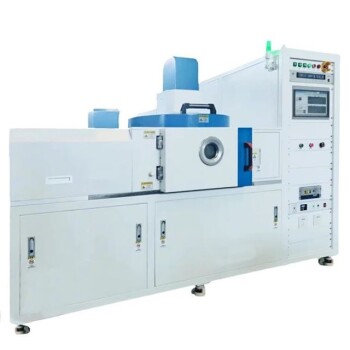
The distinct advantage of a microwave reaction system lies in its ability to generate heat internally through electromagnetic waves, rather than relying on external thermal conduction. This mechanism creates internal frictional heat among molecules, resulting in a holistic, non-contact, and uniform heating process. Consequently, this approach significantly accelerates reaction times while producing doped hydroxyapatite (HA) powders with superior structural characteristics compared to traditional methods.
By shifting from external conduction to internal molecular friction, microwave synthesis eliminates temperature gradients, allowing for the rapid production of nanoparticles with precise morphology and crystallinity.
The Mechanics of Microwave Heating
Internal Frictional Heat
Unlike traditional equipment that heats from the outside in, microwave systems utilize electromagnetic waves. These waves interact directly with the material, causing molecules to generate internal frictional heat. This ensures energy is transferred efficiently at the molecular level.
Holistic and Non-Contact
The heating process in a microwave system is holistic and non-contact. Because the heat is generated within the material itself, the system avoids the inefficiencies associated with physical heat transfer surfaces. This results in immediate and pervasive thermal energy distribution.
Superior Material Properties
Achieving Uniform Morphology
A critical challenge in synthesizing doped HA powders is maintaining particle consistency. Microwave synthesis addresses this by producing nanoparticles with more uniform morphology. The rapid and even heating prevents the irregular particle growth often seen with slower heating methods.
Controllable Crystallinity
The precise nature of microwave heating allows for better control over the final structure of the material. Researchers can achieve controllable crystallinity, ensuring the HA powders meet specific structural requirements for their intended application.
The Pitfalls of Traditional Heating
Uneven Temperature Distribution
Traditional heating relies on heat conduction, which inherently moves thermal energy from a source to the material. The primary text notes that this method can cause temperature gradients. These gradients lead to uneven reaction conditions, which compromise the quality of the final powder.
Slower Reaction Kinetics
Conventional equipment is limited by the speed of thermal conductivity. In contrast, the microwave system significantly reduces reaction time. Relying on traditional methods often results in prolonged synthesis cycles, which can be inefficient for high-throughput requirements.
Making the Right Choice for Your Synthesis
To determine if microwave-assisted synthesis is the correct approach for your project, consider your specific constraints:
- If your primary focus is Speed: Microwave systems offer a decisive advantage by generating rapid internal heat, significantly reducing overall reaction times.
- If your primary focus is Material Quality: The method enables the production of nanoparticles with uniform morphology and controllable crystallinity, essential for high-performance applications.
- If your primary focus is Process Consistency: By eliminating temperature gradients common in conduction heating, microwave systems ensure a holistic and uniform thermal environment.
Microwave synthesis transforms the production of doped HA powders from a slow, conductive process into a rapid, molecular-level interaction that yields superior nanomaterials.
Summary Table:
| Feature | Microwave Reaction System | Traditional Heating Equipment |
|---|---|---|
| Heating Mechanism | Internal molecular friction (Electromagnetic) | External thermal conduction |
| Temperature Distribution | Holistic and uniform; no gradients | Uneven; prone to temperature gradients |
| Reaction Speed | Significantly accelerated | Slower kinetics due to conduction limits |
| Material Morphology | Uniform nanoparticles | Often irregular particle growth |
| Crystallinity Control | High and precise control | Difficult to regulate consistently |
Elevate Your Material Synthesis with KINTEK
Don't let inefficient heating stall your research. KINTEK provides state-of-the-art laboratory solutions designed to optimize your synthesis workflows. Backed by expert R&D and precision manufacturing, we offer a comprehensive range of Muffle, Tube, Rotary, Vacuum, and CVD systems, as well as other lab high-temperature furnaces—all fully customizable to meet your unique experimental needs.
Whether you are synthesizing doped hydroxyapatite or advanced nanomaterials, our high-performance systems ensure the uniformity and crystallinity your project demands. Contact KINTEK today to discuss your custom furnace requirements and see how our expertise can drive your innovation forward.
References
- Liviu Duta, Valentina Grumezescu. The Effect of Doping on the Electrical and Dielectric Properties of Hydroxyapatite for Medical Applications: From Powders to Thin Films. DOI: 10.3390/ma17030640
This article is also based on technical information from Kintek Furnace Knowledge Base .
Related Products
- MPCVD Machine System Reactor Bell-jar Resonator for Lab and Diamond Growth
- 915MHz MPCVD Diamond Machine Microwave Plasma Chemical Vapor Deposition System Reactor
- Cylindrical Resonator MPCVD Machine System for Lab Diamond Growth
- RF PECVD System Radio Frequency Plasma Enhanced Chemical Vapor Deposition
People Also Ask
- What are the essential components of an MPCVD reactor system? Build a Pristine Environment for High-Purity Materials
- How does pressure affect the MPCVD growth process? Master Plasma Control for Superior Film Quality
- How do carbon-containing groups contribute to diamond growth in the MPCVD method? Unlock High-Quality Diamond Synthesis
- Why is temperature control important in the MPCVD growth process? Ensure High-Quality, Reliable Diamond Film Deposition
- What are the key components of an MPCVD system? Unlock High-Purity Crystal Growth