Knowledge Why is thermogravimetric analysis (TGA) necessary for modified hard carbon? Optimize Stability & Composition
Author avatar

Tech Team · Kintek Furnace

Updated 5 hours ago

Why is thermogravimetric analysis (TGA) necessary for modified hard carbon? Optimize Stability & Composition


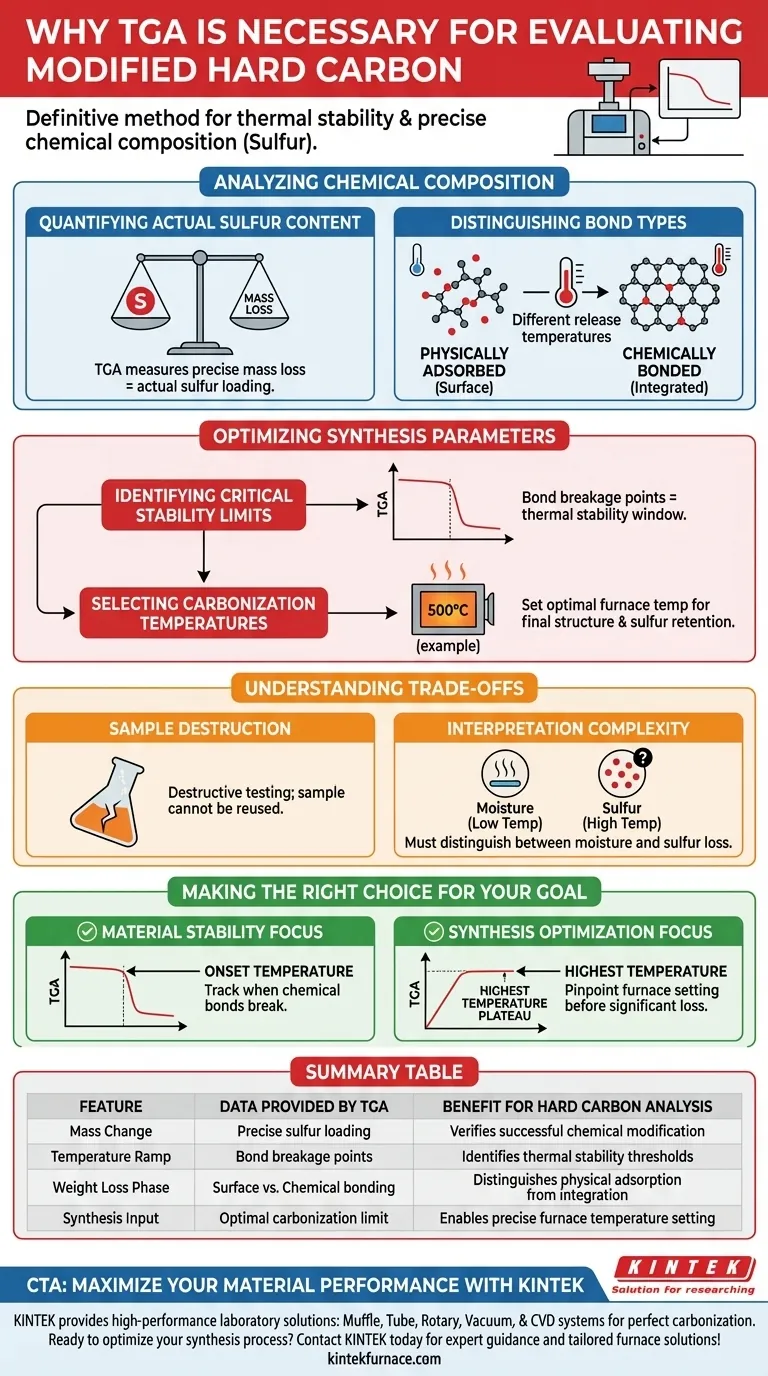
Thermogravimetric analysis (TGA) is the definitive method for determining the thermal stability and precise chemical composition of modified hard carbon. By continuously monitoring mass changes as the material is heated, TGA provides critical data on actual sulfur content, distinguishing between loose surface adsorption and robust chemical bonding.

TGA is essential for optimizing the synthesis of sulfur-modified hard carbon. It not only quantifies the actual sulfur loading but also identifies the specific temperature limits where chemical bonds break, enabling the selection of the ideal carbonization temperature to ensure material stability.
Why is thermogravimetric analysis (TGA) necessary for modified hard carbon? Optimize Stability & Composition

Analyzing Chemical Composition

Quantifying Actual Sulfur Content

To evaluate modified hard carbon effectively, you must know exactly how much sulfur has been successfully incorporated into the material.

TGA measures the precise mass loss during heating, which correlates directly to the actual sulfur content. This verifies whether the modification process achieved the desired chemical loading.

Distinguishing Bond Types

Not all sulfur within the hard carbon matrix behaves the same way.

TGA allows you to differentiate between physically adsorbed sulfur (trapped on the surface) and chemically bonded sulfur (integrated into the carbon structure). This distinction is made by observing the different temperatures at which these forms of sulfur are released.

Optimizing Synthesis Parameters

Identifying Critical Stability Limits

To prevent material degradation, you must identify the thermal limits of your modified carbon.

TGA identifies the critical temperatures responsible for carbon-sulfur bond breakage and subsequent sulfur loss. This data maps the thermal stability window of the material.

Selecting Carbonization Temperatures

The ultimate goal of TGA in this context is to inform the manufacturing process.

By analyzing the stability data, researchers can select the optimal carbonization temperature (such as 500 °C). This ensures the synthesis temperature is high enough to finalize the structure but low enough to prevent the loss of active sulfur components.

Understanding the Trade-offs

Sample Destruction

It is important to note that TGA is a destructive testing method. The heating process burns off the sulfur and modifies the carbon, meaning the specific sample used for analysis cannot be recovered or reused.

Interpretation Complexity

While TGA provides precise mass loss data, interpreting the cause of the loss requires context.

Users must be careful to distinguish between mass loss caused by moisture evaporation at lower temperatures and the loss of the target modifier (sulfur) at higher temperatures. Misinterpreting these signals can lead to incorrect calculations of sulfur content.

Making the Right Choice for Your Goal

To get the most out of your TGA data when evaluating modified hard carbon, align your analysis with your specific objective:

  • If your primary focus is Material Stability: Concentrate on the onset temperature of the second major weight loss event, as this indicates where chemical bonds begin to break.
  • If your primary focus is Synthesis Optimization: Use the TGA curve to pinpoint the highest temperature plateau before significant sulfur loss occurs to set your carbonization furnace (e.g., confirming the 500 °C target).

Use TGA not just to measure what you have, but to define how you make it.

Summary Table:

Feature Data Provided by TGA Benefit for Hard Carbon Analysis
Mass Change Precise sulfur loading Verifies successful chemical modification
Temperature Ramp Bond breakage points Identifies thermal stability thresholds
Weight Loss Phase Surface vs. Chemical bonding Distinguishes physical adsorption from integration
Synthesis Input Optimal carbonization limit Enables precise furnace temperature setting (e.g. 500°C)

Maximize Your Material Performance with KINTEK

Precise thermogravimetric analysis demands reliable heating environments. KINTEK provides high-performance laboratory solutions—including Muffle, Tube, Rotary, Vacuum, and CVD systems—engineered to help you achieve perfect carbonization and material stability. Backed by expert R&D and manufacturing, our equipment is fully customizable to meet the unique requirements of your hard carbon research.

Ready to optimize your synthesis process? Contact KINTEK today for expert guidance and tailored furnace solutions!

Visual Guide
Why is thermogravimetric analysis (TGA) necessary for modified hard carbon? Optimize Stability & Composition Visual Guide

References

  1. Yuanfeng Liu, Yong Wang. Shredded-Coconut-Derived Sulfur-Doped Hard Carbon via Hydrothermal Processing for High-Performance Sodium Ion Anodes. DOI: 10.3390/nano15100734

This article is also based on technical information from Kintek Furnace Knowledge Base .

Related Products

People Also Ask

Related Products

2200 ℃ Tungsten Vacuum Heat Treat and Sintering Furnace

2200 ℃ Tungsten Vacuum Heat Treat and Sintering Furnace

2200°C Tungsten Vacuum Furnace for high-temperature materials processing. Precise control, superior vacuum, customizable solutions. Ideal for research & industrial applications.

Small Vacuum Heat Treat and Tungsten Wire Sintering Furnace

Small Vacuum Heat Treat and Tungsten Wire Sintering Furnace

Compact vacuum tungsten wire sintering furnace for labs. Precise, mobile design with superior vacuum integrity. Ideal for advanced material research. Contact us!

2200 ℃ Graphite Vacuum Heat Treat Furnace

2200 ℃ Graphite Vacuum Heat Treat Furnace

2200℃ Graphite Vacuum Furnace for high-temperature sintering. Precise PID control, 6*10⁻³Pa vacuum, durable graphite heating. Ideal for research & production.

Vacuum Heat Treat Sintering and Brazing Furnace

Vacuum Heat Treat Sintering and Brazing Furnace

KINTEK Vacuum Brazing Furnaces deliver precision, clean joints with superior temperature control. Customizable for diverse metals, ideal for aerospace, medical, and thermal applications. Get a quote!

Molybdenum Vacuum Heat Treat Furnace

Molybdenum Vacuum Heat Treat Furnace

High-performance molybdenum vacuum furnace for precise 1400°C heat treatment. Ideal for sintering, brazing, and crystal growth. Durable, efficient, and customizable.

Vacuum Heat Treat Furnace with Ceramic Fiber Liner

Vacuum Heat Treat Furnace with Ceramic Fiber Liner

KINTEK's Vacuum Furnace with Ceramic Fiber Lining offers precise high-temperature processing up to 1700°C, ensuring uniform heat distribution and energy efficiency. Ideal for labs and production.

600T Vacuum Induction Hot Press Vacuum Heat Treat and Sintering Furnace

600T Vacuum Induction Hot Press Vacuum Heat Treat and Sintering Furnace

600T Vacuum Induction Hot Press Furnace for precise sintering. Advanced 600T pressure, 2200°C heating, vacuum/atmosphere control. Ideal for research & production.

Vacuum Heat Treat Sintering Furnace with Pressure for Vacuum Sintering

Vacuum Heat Treat Sintering Furnace with Pressure for Vacuum Sintering

KINTEK's Vacuum Pressure Sintering Furnace offers 2100℃ precision for ceramics, metals, and composites. Customizable, high-performance, and contamination-free. Get a quote now!

Vacuum Heat Treat Sintering Furnace Molybdenum Wire Vacuum Sintering Furnace

Vacuum Heat Treat Sintering Furnace Molybdenum Wire Vacuum Sintering Furnace

KINTEK's Vacuum Molybdenum Wire Sintering Furnace excels in high-temperature, high-vacuum processes for sintering, annealing, and material research. Achieve precise 1700°C heating with uniform results. Custom solutions available.

Vacuum Hot Press Furnace Machine for Lamination and Heating

Vacuum Hot Press Furnace Machine for Lamination and Heating

KINTEK Vacuum Lamination Press: Precision bonding for wafer, thin-film & LCP applications. 500°C max temp, 20-ton pressure, CE certified. Custom solutions available.

Ultra Vacuum Electrode Feedthrough Connector Flange Power Lead for High Precision Applications

Ultra Vacuum Electrode Feedthrough Connector Flange Power Lead for High Precision Applications

Ultra-Vacuum Electrode Feedthroughs for reliable UHV connections. High-sealing, customizable flange options, ideal for semiconductor & space applications.

Ultra High Vacuum Observation Window Stainless Steel Flange Sapphire Glass Sight Glass for KF

Ultra High Vacuum Observation Window Stainless Steel Flange Sapphire Glass Sight Glass for KF

KF flange observation window with sapphire glass for ultra-high vacuum. Durable 304 stainless steel, 350℃ max temperature. Ideal for semiconductor and aerospace.

1400℃ Controlled Inert Nitrogen Atmosphere Furnace

1400℃ Controlled Inert Nitrogen Atmosphere Furnace

KT-14A Controlled Atmosphere Furnace for labs & industry. 1400°C max temp, vacuum sealing, inert gas control. Customizable solutions available.

1700℃ Controlled Inert Nitrogen Atmosphere Furnace

1700℃ Controlled Inert Nitrogen Atmosphere Furnace

KT-17A Controlled Atmosphere Furnace: Precise 1700°C heating with vacuum & gas control. Ideal for sintering, research & material processing. Explore now!

Vacuum Hot Press Furnace Machine Heated Vacuum Press Tube Furnace

Vacuum Hot Press Furnace Machine Heated Vacuum Press Tube Furnace

Discover KINTEK's advanced Vacuum Tube Hot Press Furnace for precise high-temperature sintering, hot pressing, and material bonding. Customizable solutions for labs.

Laboratory Muffle Oven Furnace with Bottom Lifting

Laboratory Muffle Oven Furnace with Bottom Lifting

Boost lab efficiency with KT-BL Bottom Lifting Furnace: precise 1600℃ control, superior uniformity, and enhanced productivity for material science and R&D.

Ultra High Vacuum CF Flange Stainless Steel Sapphire Glass Observation Sight Window

Ultra High Vacuum CF Flange Stainless Steel Sapphire Glass Observation Sight Window

CF sapphire viewing window for ultra-high vacuum systems. Durable, clear, and precise for semiconductor and aerospace applications. Explore specs now!

1700℃ High Temperature Laboratory Tube Furnace with Quartz or Alumina Tube

1700℃ High Temperature Laboratory Tube Furnace with Quartz or Alumina Tube

KINTEK's Tube Furnace with Alumina Tube: Precision heating up to 1700°C for material synthesis, CVD, and sintering. Compact, customizable, and vacuum-ready. Explore now!

Ultra High Vacuum Observation Window KF Flange 304 Stainless Steel High Borosilicate Glass Sight Glass

Ultra High Vacuum Observation Window KF Flange 304 Stainless Steel High Borosilicate Glass Sight Glass

KF Ultra-High Vacuum Observation Window with borosilicate glass for clear viewing in demanding vacuum environments. Durable 304 stainless steel flange ensures reliable sealing.

Electric Rotary Kiln Small Rotary Furnace Biomass Pyrolysis Plant Rotating Furnace

Electric Rotary Kiln Small Rotary Furnace Biomass Pyrolysis Plant Rotating Furnace

KINTEK's Rotary Biomass Pyrolysis Furnace converts biomass to biochar, bio-oil, and syngas efficiently. Customizable for research or production. Get your solution now!


Leave Your Message