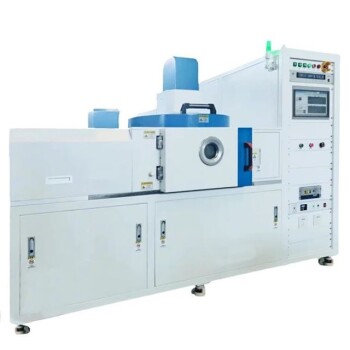
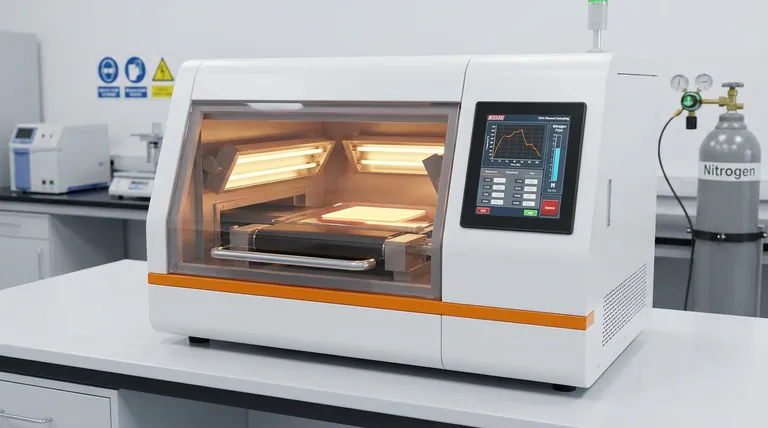
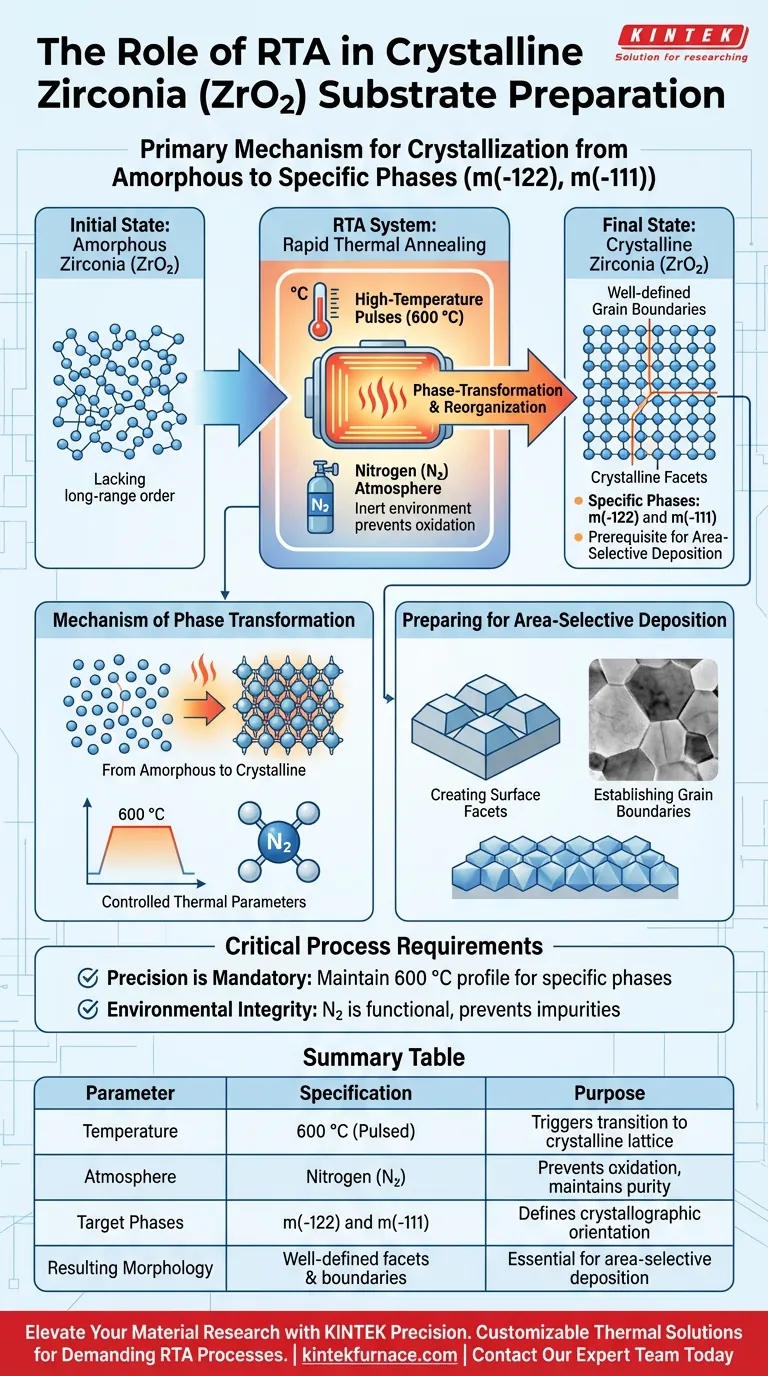
A Rapid Thermal Annealing (RTA) system serves as the primary mechanism for crystallizing Zirconia ($ZrO_2$) substrates. By utilizing high-temperature pulses, specifically at 600 °C in a nitrogen atmosphere, the system forces the material to transition from an amorphous structure to a specific crystalline state. This thermal treatment is not merely about heating; it is a precise engineering step required to prepare the surface for subsequent processing.
The RTA system functions as a phase-transformation tool, converting amorphous Zirconia into a crystalline form with well-defined grain boundaries and facets. This structural reorganization is a mandatory prerequisite for successful area-selective deposition experiments.
The Mechanism of Phase Transformation
From Amorphous to Crystalline
Initially, the Zirconia substrate exists in an amorphous state, lacking a defined long-range atomic order.
The RTA system applies thermal energy to reorganize this structure. This reorganization transforms the material into a rigid, crystalline lattice.
Controlled Thermal Parameters
The standard operating procedure involves high-temperature pulses of 600 °C.
To ensure the purity of the transformation, this process occurs within a nitrogen ($N_2$) atmosphere. This controlled environment prevents unwanted reactions with oxygen or moisture in the air during the heating cycle.
Achieving Specific Orientations
The crystallization process is not random; it drives the Zirconia toward specific crystallographic orientations.
According to standard protocols, the RTA treatment specifically targets the formation of m(-122) and m(-111) phases. These specific phases define the physical characteristics of the final substrate.
Preparing for Area-Selective Deposition
Creating Surface Facets
The transition to a crystalline state generates distinct crystalline facets on the surface of the Zirconia.
These facets provide the specific surface geometry required for advanced manufacturing techniques.
Establishing Grain Boundaries
Alongside facets, the thermal treatment develops well-defined grain boundaries.
These boundaries distinguish individual crystallites within the material. Without these distinct boundaries and facets, the substrate would lack the necessary morphology for effective area-selective deposition.
Critical Process Requirements
Precision is Mandatory
The effectiveness of the RTA process relies entirely on maintaining the specific 600 °C temperature profile.
Deviations in temperature could fail to produce the required m(-122) and m(-111) phases, rendering the substrate unsuitable for the next steps.
Environmental Integrity
The nitrogen atmosphere is not optional; it is a functional component of the system.
Compromising the inert environment during the thermal pulse can introduce impurities that alter surface chemistry and inhibit proper crystallization.
Making the Right Choice for Your Goal
When configuring an RTA system for Zirconia preparation, your specific objective dictates your quality control focus.
- If your primary focus is Crystallographic Accuracy: Verify that the thermal pulses remain stable at 600 °C to guarantee the formation of m(-122) and m(-111) phases.
- If your primary focus is Deposition Success: Inspect the substrate post-annealing to ensure well-defined grain boundaries and facets have formed before attempting area-selective deposition.
Mastering the thermal environment is the only way to ensure your substrate is truly ready for high-precision deposition.
Summary Table:
| Parameter | Specification | Purpose |
|---|---|---|
| Temperature | 600 °C (Pulsed) | Triggers transition from amorphous to crystalline lattice |
| Atmosphere | Nitrogen ($N_2$) | Prevents oxidation and maintains chemical purity |
| Target Phases | m(-122) and m(-111) | Defines the required crystallographic orientation |
| Resulting Morphology | Well-defined facets & boundaries | Essential for successful area-selective deposition |
Elevate Your Material Research with KINTEK Precision
Don't settle for inconsistent crystallization. KINTEK provides industry-leading thermal solutions, including Muffle, Tube, Rotary, and Vacuum furnaces, all customizable to your specific research requirements. Our systems ensure the rigid temperature control and environmental integrity necessary for the most demanding RTA processes and crystalline substrate preparation.
Ready to optimize your deposition results? Contact our expert team today to find the perfect high-temperature system for your laboratory.
Visual Guide
References
- Moo‐Yong Rhee, Il‐Kwon Oh. Area‐Selective Atomic Layer Deposition on Homogeneous Substrate for Next‐Generation Electronic Devices. DOI: 10.1002/advs.202414483
This article is also based on technical information from Kintek Furnace Knowledge Base .
Related Products
- Laboratory Quartz Tube Furnace RTP Heating Tubular Furnace
- RF PECVD System Radio Frequency Plasma Enhanced Chemical Vapor Deposition
- Controlled Inert Nitrogen Hydrogen Atmosphere Furnace
- Split Multi Heating Zone Rotary Tube Furnace Rotating Tube Furnace
People Also Ask
- What physical conditions does a laboratory Tube Furnace provide for SOEC? Precision Heat for Solid Oxide Characterization
- What are the main features and functions of a laboratory tube furnace? Unlock Precise High-Temp Control for Your Lab
- What conditions do tube furnaces provide for Au-Seeded TiO2 nanowires? Master Precision Thermal Synthesis
- What parameters must be controlled when calcining freeze-dried oxide precursors in a laboratory tube furnace? A Guide
- What role does a laboratory tube furnace play in geological and mineralogical research? Unlock Earth's Secrets with Precision