
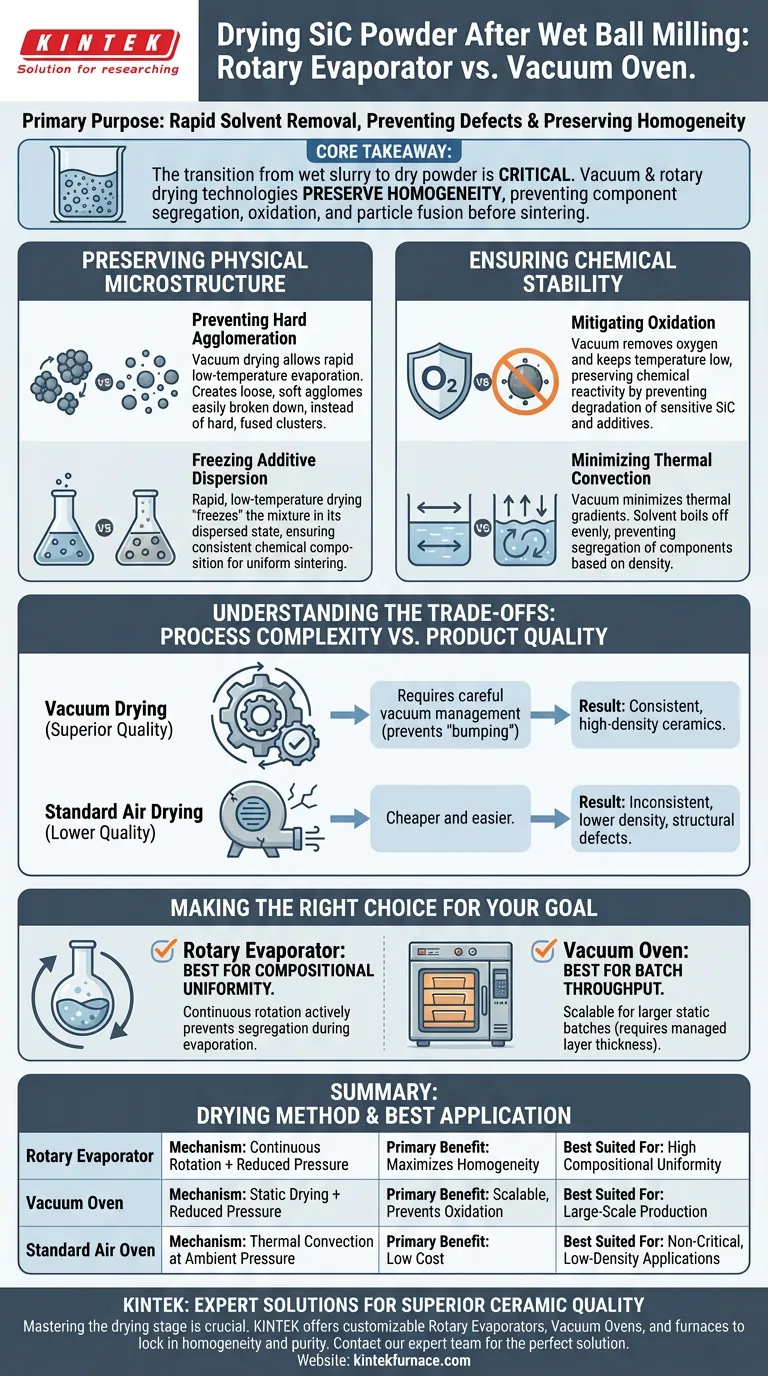
The primary purpose of using a rotary evaporator or vacuum drying oven is to rapidly remove solvents, such as ethanol, under controlled low-temperature and reduced-pressure conditions. This specific environment is essential to prevent the formation of severe hard agglomerates and to lock in the highly dispersed state of sintering additives achieved during the milling process.
Core Takeaway The transition from a wet slurry to a dry powder is the most critical point for defect introduction in ceramic processing. Vacuum and rotary drying technologies are not just about removing liquid; they are about preserving the homogeneity created during milling by preventing component segregation, oxidation, and particle fusion before the sintering stage.
Preserving Physical Microstructure
Preventing Hard Agglomeration
The most immediate physical risk during drying is the formation of "hard agglomerates."
When solvents evaporate slowly at high temperatures or ambient pressure, particles tend to pack tightly together.
Vacuum drying lowers the boiling point of the solvent, allowing for rapid evaporation without high heat. This creates loose, soft agglomerates that are easily broken down, rather than hard, fused clusters that ruin moldability.
Freezing Additive Dispersion
Wet ball milling is used to achieve a perfect mixture of Silicon Carbide (SiC) and sintering additives.
If the drying process is slow or involves uneven thermal convection, these additives can separate or segregate from the SiC matrix.
Rapid, low-temperature drying effectively "freezes" the mixture in its dispersed state. This ensures that the chemical composition remains consistent throughout the entire batch, which is vital for uniform sintering later.
Ensuring Chemical Stability
Mitigating Oxidation
Silicon Carbide and its metallic sintering additives are sensitive to oxidation, particularly when heated in air.
Standard oven drying exposes the fine powder to oxygen at elevated temperatures, which can degrade the particle surfaces.
By operating in a vacuum, you remove the oxygen source. By lowering the boiling point, you keep the temperature below the threshold where rapid oxidation occurs. This preserves the chemical reactivity required for high-density sintering.
Minimizing Thermal Convection
In standard drying, heat often creates strong convection currents within the liquid slurry.
These currents can cause heavier particles to settle or lighter particles to float, undoing the mixing work done by the ball mill.
Vacuum drying minimizes these thermal gradients. The solvent boils off evenly and quickly, preventing the segregation of components based on density.
Understanding the Trade-offs
Process Complexity vs. Product Quality
While vacuum drying yields superior powder quality, it introduces complexity compared to standard air drying.
You must carefully manage vacuum levels to prevent "bumping" (violent boiling that can eject powder).
However, this complexity is a necessary trade-off. Simple air drying is cheaper and easier, but it frequently results in inconsistent ceramics with lower density and structural defects.
Making the Right Choice for Your Goal
The specific equipment you choose—rotary evaporator vs. static vacuum oven—depends on your specific processing scale and priority.
- If your primary focus is Compositional Uniformity: The rotary evaporator is superior because the continuous rotation actively prevents segregation while the solvent evaporates.
- If your primary focus is Batch Throughput: A vacuum drying oven is often more scalable for larger static batches, provided the layer thickness is managed to ensure even drying.
Ultimately, the goal is to produce a loose, homogeneous precursor powder that retains its chemical purity for the sintering furnace.
Summary Table:
| Drying Method | Mechanism | Primary Benefit | Best Suited For |
|---|---|---|---|
| Rotary Evaporator | Continuous rotation + reduced pressure | Maximizes homogeneity; prevents component segregation | High compositional uniformity |
| Vacuum Oven | Static drying + reduced pressure | Scalable batch processing; prevents oxidation | Large-scale production & throughput |
| Standard Air Oven | Thermal convection at ambient pressure | Low cost; simple operation | Non-critical, low-density applications |
Achieve superior ceramic quality by mastering the drying stage. At KINTEK, we understand that high-performance materials like Silicon Carbide require precision equipment to prevent defects. Backed by expert R&D and manufacturing, we offer customizable Rotary Evaporators, Vacuum Drying Ovens, and high-temp furnaces designed to lock in your powder's homogeneity and chemical purity. Don't let improper drying compromise your sintering results—contact our technical team today to find the perfect solution for your lab's unique needs.
Visual Guide
References
- Zipeng Li, Zhiqing Liang. Preparation of Aluminum Matrix Composites Reinforced with Hybrid MAX–MXene Particles for Enhancing Mechanical Properties and Tribological Performance. DOI: 10.3390/jcs9100552
This article is also based on technical information from Kintek Furnace Knowledge Base .
Related Products
- Electric Rotary Kiln Small Rotary Furnace Biomass Pyrolysis Plant Rotating Furnace
- Electric Rotary Kiln Continuous Working Small Rotary Furnace Kiln for Pyrolysis Plant Heating
- Inclined Rotary Plasma Enhanced Chemical Deposition PECVD Tube Furnace Machine
- Electric Rotary Kiln Pyrolysis Furnace Plant Machine Small Rotary Kiln Calciner
- Electric Rotary Kiln Small Rotary Furnace for Activated Carbon Regeneration
People Also Ask
- What are the main applications of a rotary kiln electric furnace? Achieve Uniform Heat Treatment for Powders
- What are the key components of a rotary kiln electric furnace? Unlock Efficient Thermal Processing
- What is the significance of the refractory lining in a rotary kiln electric furnace? Unlock Efficiency and Longevity
- What is the benefit of adjustable speed control in rotary kilns? Optimize Efficiency and Quality
- What are the main advantages of using rotary kilns for bulk solids processing? Achieve High-Volume, Uniform Thermal Processing









