
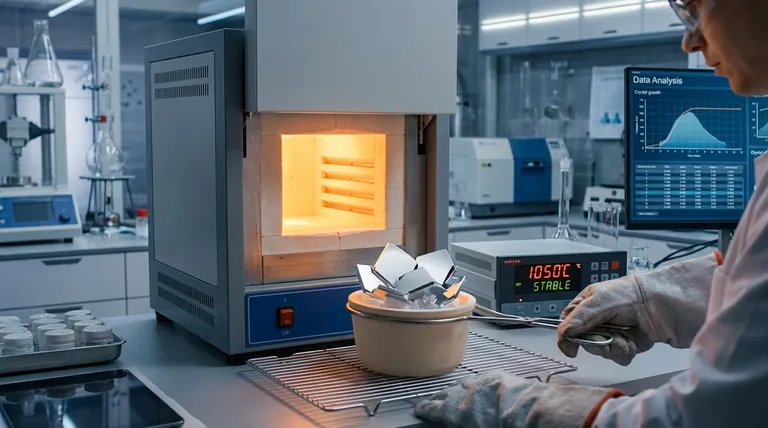
Precise temperature control is the determinant factor regarding the final shape and quality of SC-NMNO crystals. By strictly maintaining a constant high temperature (specifically 1050°C), the furnace regulates growth kinetics to produce plate-like single crystals with smooth surfaces and sharp edges, rather than irregular or defective structures.
Stability is the catalyst for orderly growth. Precise thermal regulation provides the specific ionic migration energy required for grains to minimize surface energy, ensuring the formation of distinct, high-quality single crystals while preventing phase impurities.
How Thermal Precision Drives Morphology
Regulating Growth Kinetics
The primary role of the furnace is to strictly regulate the growth kinetics of the crystal after nucleation has occurred.
At a stable 1050°C, the thermal environment provides sufficient energy for ionic migration. This movement is essential for the material to arrange itself into an ordered lattice structure rather than a chaotic amorphous mass.
Reducing Surface Energy
The morphology of SC-NMNO is defined by a process where larger grains consume surrounding smaller grains.
This occurs because the system seeks to reduce overall surface energy. Precision heating ensures this consumption process happens uniformly, resulting in the characteristic plate-like morphology.
Achieving Surface Smoothness
Temperature stability is directly responsible for the surface quality of the final crystal.
When the furnace maintains a constant temperature without fluctuation, the crystal faces grow evenly. This produces smooth surfaces and sharp edges, free from the roughness associated with thermal cycling.
The Risks of Thermal Instability
Phase Impurities and Defects
The most significant trade-off in crystal growth is the intolerance for error; even minor temperature fluctuations can stop or reverse crystal formation.
If the temperature deviates from the set point (e.g., 1050°C), the ionic migration energy becomes inconsistent. This leads to phase impurities or crystal defects, compromising the structural integrity of the SC-NMNO.
Incomplete Reactions
While the primary focus is on the 1050°C growth phase, the ramp-up and soaking periods are equally critical.
Failing to maintain precision during the initial heating (e.g., during pre-reaction or melting phases) can result in unreacted raw materials. This creates a heterogeneous environment that creates polycrystalline or amorphous products rather than a single crystal.
Optimizing Your Crystal Growth Strategy
To ensure high-quality SC-NMNO morphology, align your furnace protocols with your specific quality targets.
- If your primary focus is Perfect Morphology: Prioritize a furnace with exceptional stability at 1050°C to ensure the ionic migration necessary for plate-like formation.
- If your primary focus is Material Purity: Focus on eliminating thermal fluctuations to prevent phase impurities and lattice defects during the growth cycle.
Mastering the thermal field is not just about reaching a temperature, but holding it with absolute rigidity to dictate the destiny of the crystal lattice.
Summary Table:
| Parameter | Impact on SC-NMNO Morphology | Result of Thermal Instability |
|---|---|---|
| Growth Kinetics | Regulates ionic migration for lattice order | Chaotic amorphous structures |
| Surface Energy | Facilitates uniform grain consumption | Irregular grain size & defective edges |
| Surface Quality | Produces smooth faces and sharp edges | Rough surfaces and thermal cycling cracks |
| Phase Purity | Ensures consistent chemical environment | High concentration of phase impurities |
| Crystallinity | Promotes single crystal (SC) formation | Polycrystalline or unreacted material |
Elevate Your Material Synthesis with KINTEK Precision
Achieving the perfect plate-like morphology for SC-NMNO crystals requires absolute thermal rigidity. KINTEK provides industry-leading laboratory high-temperature furnaces designed to eliminate fluctuations and ensure phase purity.
Backed by expert R&D and manufacturing, KINTEK offers Muffle, Tube, Rotary, Vacuum, and CVD systems, all fully customizable to meet your specific research or production needs. Don't let thermal instability compromise your crystal quality—leverage our expertise to optimize your growth strategy.
Contact KINTEK Today for a Specialized Consultation
Visual Guide

References
- Venkat Pamidi, Maximilian Fichtner. Single-Crystal P2–Na<sub>0.67</sub>Mn<sub>0.67</sub>Ni<sub>0.33</sub>O<sub>2</sub> Cathode Material with Improved Cycling Stability for Sodium-Ion Batteries. DOI: 10.1021/acsami.3c15348
This article is also based on technical information from Kintek Furnace Knowledge Base .
Related Products
- 1400℃ Controlled Inert Nitrogen Atmosphere Furnace
- 1700℃ Controlled Inert Nitrogen Atmosphere Furnace
- 1800℃ High Temperature Muffle Oven Furnace for Laboratory
- 1400℃ High Temperature Laboratory Tube Furnace with Alumina Tube
- 1700℃ High Temperature Muffle Oven Furnace for Laboratory
People Also Ask
- How does oxygen partial pressure control affect ceramic sintering? Master Defect Chemistry
- How do controlled-atmosphere furnaces support polymer pyrolysis? Master SiC & Si3N4 Ceramic Conversion
- Why is thorough binder burnout necessary before sintering advanced ceramics? Ensure Peak Density & Zero Defects
- Why is controlled-atmosphere heating required for functional ceramics and sensors? Master Defect Engineering
- How does real-time dilatometric analysis in a controlled-atmosphere furnace optimize PZT ceramic sintering?



















