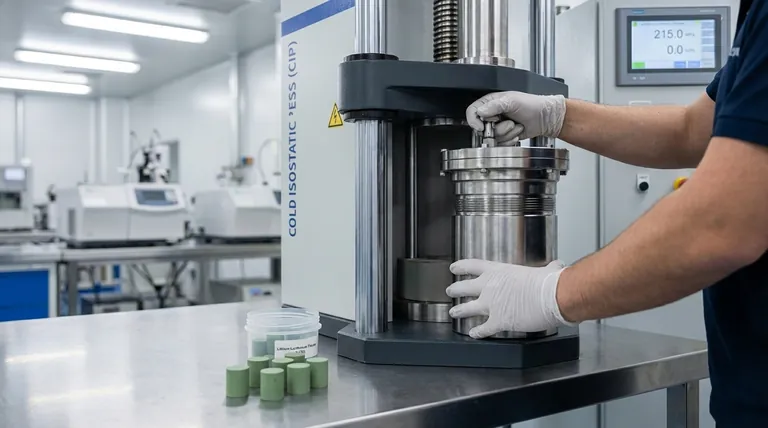
A Cold Isostatic Press (CIP) is utilized to apply uniform liquid pressure from all directions to Lithium Lanthanum Titanate (LLTO) samples prior to sintering. This secondary densification step is essential for neutralizing internal stress gradients and density variations that are often introduced during the initial mechanical mold pressing.
By significantly increasing the density of green pellets, CIP ensures uniform shrinkage during the 1200 °C sintering process, preventing the ceramic from cracking and enabling the final product to achieve a relative density as high as 98%.
The Role of Preliminary Forming
Before understanding the necessity of the CIP, it is important to recognize the limitations of the step preceding it.
The Initial Mechanical Press
The fabrication of LLTO begins with a preliminary forming stage. Loose powder is placed into high-precision steel molds (e.g., 12 mm diameter) and compressed using a laboratory press.
Establishing the "Green" Shape
Typical parameters involves applying approximately 4 metric tons of constant pressure for one minute. This compresses the loose powder into a "green pellet" with sufficient mechanical strength to be handled.
The Hidden Inconsistency
While this creates a solid foundation, uniaxial pressing in a steel mold often results in uneven density distribution within the pellet. These inconsistencies create weak points that become critical liabilities during high-temperature treatment.
Correcting Structural Flaws via CIP
The Cold Isostatic Press acts as a corrective measure to the limitations of the initial mold press.
Application of Uniform Pressure
Unlike the uniaxial force of a mold press, the CIP applies uniform liquid pressure from every direction simultaneously. This omnidirectional force creates a more homogeneous internal structure.
Elimination of Stress Gradients
The isostatic pressure effectively eliminates the internal stress gradients left behind by the mechanical mold. It resolves density inconsistencies, ensuring the material is packed as tightly and evenly as possible.
Securing Success at High Temperatures
The true value of the CIP process is realized during the final heating stage, where the material properties are locked in.
Controlling Shrinkage at 1200 °C
Sintering LLTO requires temperatures reaching 1200 °C. During this phase, the material shrinks; if the green density is uneven, the shrinkage will be uneven, leading to warping or failure.
Preventing Structural Failure
By ensuring the green pellet has a high, uniform density before it enters the furnace, the CIP process prevents the ceramic from cracking under thermal stress.
Maximizing Relative Density
The ultimate goal of this treatment is material performance. The CIP process allows the final sintered LLTO product to achieve a relative density as high as 98%, a metric directly correlated with the quality of the ceramic.
Understanding the Process Implications
While CIP is beneficial, it introduces specific considerations into the fabrication workflow.
Increased Process Complexity
CIP represents a secondary densification stage. It adds a distinct step between the initial forming and the final sintering, requiring additional equipment and handling time.
Dependency on Pre-forming
The CIP cannot form loose powder into a shape on its own in this context. It relies on the initial steel mold process to create a cohesive pellet that can withstand the liquid pressure environment.
Optimizing Your LLTO Fabrication Protocol
Incorporating a Cold Isostatic Press is not merely an optional step; it is a quality assurance measure for high-performance ceramics.
- If your primary focus is structural integrity: Rely on CIP to homogenize the pellet's internal structure, ensuring it survives the 1200 °C sintering process without cracking.
- If your primary focus is material density: Utilize CIP to maximize particle packing, which is the only reliable path to achieving 98% relative density.
By bridging the gap between a fragile green pellet and a robust final ceramic, CIP serves as the critical stabilizer in LLTO production.
Summary Table:
| Feature | Initial Mechanical Press | Cold Isostatic Press (CIP) |
|---|---|---|
| Pressure Direction | Uniaxial (Single Direction) | Omnidirectional (Liquid Pressure) |
| Material Density | Non-uniform / Internal Stress | High Homogeneity / Stress-free |
| Primary Role | Establishing "Green" Shape | Secondary Densification & Correction |
| Sintering Result | Risk of Cracking/Warping | Uniform Shrinkage & 98% Density |
Elevate Your Ceramic Performance with KINTEK
Don't let internal stress gradients compromise your material research. Backed by expert R&D and manufacturing, KINTEK offers high-performance Cold Isostatic Presses and a full suite of lab high-temp furnaces—including Muffle, Tube, Rotary, Vacuum, and CVD systems—all customizable for your unique LLTO or advanced material needs.
Ready to achieve 98% relative density? Contact our experts today to find the perfect solution for your lab
References
- Pei‐Yin Chen, Sheng‐Heng Chung. A solid-state electrolyte for electrochemical lithium–sulfur cells. DOI: 10.1039/d3ra05937e
This article is also based on technical information from Kintek Furnace Knowledge Base .
Related Products
- Vacuum Hot Press Furnace Machine Heated Vacuum Press
- Vacuum Hot Press Furnace Machine for Lamination and Heating
- Multi Heating Zones CVD Tube Furnace Machine for Chemical Vapor Deposition Equipment
- Cylindrical Resonator MPCVD Machine System for Lab Diamond Growth
- 600T Vacuum Induction Hot Press Vacuum Heat Treat and Sintering Furnace
People Also Ask
- What are the primary components of a vacuum hot press furnace? Master the Core Systems for Precise Material Processing
- What are the benefits of the vacuum environment system in a vacuum hot press furnace? Unlock High-Density Sintering
- What safety features are incorporated in vacuum hot press furnaces? Ensure Operator and Equipment Protection
- What types of heating elements are used in vacuum hot press furnaces? Optimize for High-Temp Performance
- What are the core advantages of using a vacuum hot press furnace? Achieve Near-Forged Density for Ti-6Al-4V Alloys