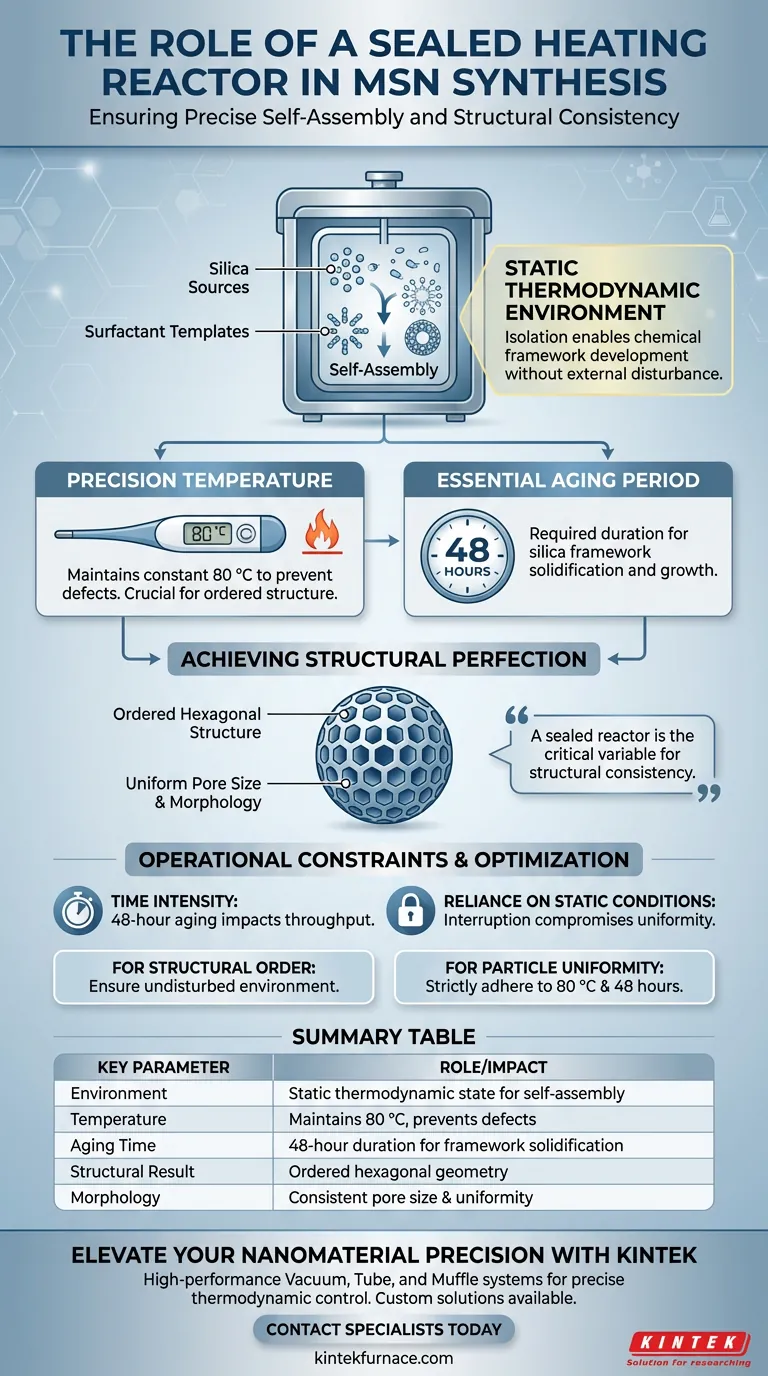
The role of a sealed heating reactor in the synthesis of mesoporous silica nanoparticles (MSNs) is to provide a strictly controlled, static thermodynamic environment. This isolation enables the precise self-assembly of silica sources around surfactant templates, ensuring the chemical framework develops without external disturbance.
A sealed reactor is the critical variable for structural consistency; by maintaining a constant temperature of 80 °C for 48 hours, it guarantees the formation of an ordered hexagonal structure with uniform pore size and morphology.
Establishing the Thermodynamic Environment
Creating Static Conditions
The synthesis of MSNs is a delicate process that requires stability. A sealed heating reactor eliminates external fluctuations, providing a static thermodynamic environment.
Facilitating Self-Assembly
This controlled environment is essential for the chemical mechanism at play. It facilitates the self-assembly of silica sources around surfactant templates, which serves as the blueprint for the nanoparticle's structure.
The Role of Aging and Temperature
Precision Temperature Maintenance
Temperature fluctuations can lead to defects in the material. The reactor maintains a precise, constant temperature of 80 °C.
Essential Aging Period
Time is as critical as temperature. The reactor preserves these conditions for a 48-hour aging period, which is necessary for the silica framework to grow adequately and solidify its structure.
Achieving Structural Perfection
Ordered Hexagonal Structure
The ultimate goal of using this specific apparatus is geometric order. The stability provided by the reactor results in the formation of a distinct ordered hexagonal structure.
Uniformity in Pores and Morphology
Quality in nanoparticle synthesis is defined by consistency. The controlled environment ensures that the resulting particles exhibit uniform pore size and consistent morphology across the entire batch.
Understanding the Operational Constraints
Time Intensity
The requirement for a 48-hour aging period is a significant constraint. This extended duration means the synthesis process is time-intensive, which impacts production throughput.
Reliance on Static Conditions
The process relies heavily on the environment remaining static. Any interruption to the seal or failure to maintain the 80 °C set point during the two-day period can compromise the uniformity of the final product.
Optimizing for Consistency
To ensure the successful synthesis of high-quality MSNs, you must respect the strict parameters of the reaction environment.
- If your primary focus is structural order: Ensure the reactor remains completely undisturbed to allow the hexagonal structure to form correctly.
- If your primary focus is particle uniformity: Strictly adhere to the 80 °C temperature and the full 48-hour duration to guarantee consistent pore size and morphology.
Control the environment precisely, and the self-assembly process will yield a predictable, high-quality material.
Summary Table:
| Key Parameter | Role/Impact in MSN Synthesis |
|---|---|
| Environment | Provides a static thermodynamic state for silica self-assembly |
| Temperature | Maintains a precise 80 °C to prevent structural defects |
| Aging Time | 48-hour duration required for solidifying the silica framework |
| Structural Result | Formation of a distinct, ordered hexagonal geometry |
| Morphology | Guarantees consistent pore size and particle uniformity |
Elevate Your Nanomaterial Precision with KINTEK
Achieving the perfect ordered hexagonal structure in MSNs requires unwavering environmental control. Backed by expert R&D and world-class manufacturing, KINTEK provides high-performance Vacuum, Tube, and Muffle systems designed to maintain precise thermodynamic conditions for extended aging periods. Whether you need a standard setup or a customizable lab furnace tailored to your unique synthesis protocols, our equipment ensures the stability your research demands.
Ready to optimize your nanoparticle yields? Contact our specialists today to find the ideal high-temperature solution for your laboratory.
Visual Guide
References
- Mesoporous Silica-Loaded PCL-CHT Hybrid Membranes for Skin Regeneration. DOI: 10.1021/acsami.5c09164
This article is also based on technical information from Kintek Furnace Knowledge Base .
Related Products
- Laboratory Quartz Tube Furnace RTP Heating Tubular Furnace
- 1400℃ Controlled Inert Nitrogen Atmosphere Furnace
- Custom Made Versatile CVD Tube Furnace Chemical Vapor Deposition CVD Equipment Machine
- MPCVD Machine System Reactor Bell-jar Resonator for Lab and Diamond Growth
- Slide PECVD Tube Furnace with Liquid Gasifier PECVD Machine
People Also Ask
- What physical conditions does a laboratory Tube Furnace provide for SOEC? Precision Heat for Solid Oxide Characterization
- What are the main features and functions of a laboratory tube furnace? Unlock Precise High-Temp Control for Your Lab
- What parameters must be controlled when calcining freeze-dried oxide precursors in a laboratory tube furnace? A Guide
- What conditions do tube furnaces provide for Au-Seeded TiO2 nanowires? Master Precision Thermal Synthesis
- What role does a laboratory tube furnace play in geological and mineralogical research? Unlock Earth's Secrets with Precision