Knowledge Why is substrate preheating typically employed during the LPBF process? Minimize Stress & Prevent Cracks in 3D Printing
Author avatar

Tech Team · Kintek Furnace

Updated 2 days ago

Why is substrate preheating typically employed during the LPBF process? Minimize Stress & Prevent Cracks in 3D Printing


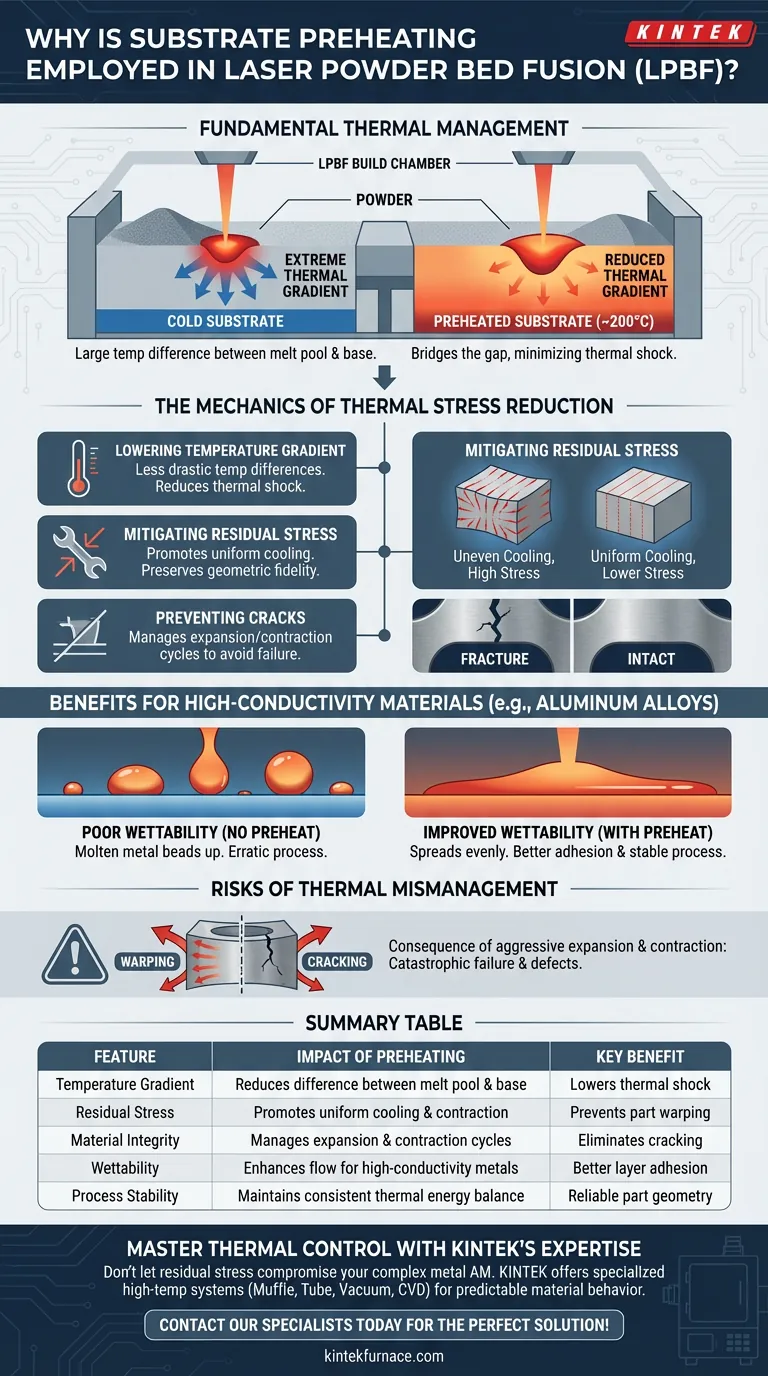
Substrate preheating is a fundamental thermal management strategy in Laser Powder Bed Fusion (LPBF) used to stabilize the printing environment. By raising the temperature of the build plate—often to around 200 degrees Celsius—operators can significantly minimize the drastic temperature differences that occur when the laser melts the powder. This process is essential for preventing structural failures and ensuring the material behaves predictably during deposition.

The primary function of substrate preheating is to reduce the temperature gradient between the molten pool and the solid base. This reduction lowers residual stress, prevents cracking caused by thermal expansion, and improves the flow of specific materials like aluminum alloys.

The Mechanics of Thermal Stress Reduction

Lowering the Temperature Gradient

During LPBF, the laser introduces intense localized heat. If the substrate is cold, the temperature difference (gradient) between the melt pool and the base is extreme.

Preheating the substrate bridges this gap. By starting at an elevated temperature, the thermal shock experienced by the material is significantly reduced.

Mitigating Residual Stress

When metal heats and cools rapidly, it expands and contracts. In LPBF, uneven cooling leads to internal forces known as residual stress.

Preheating ensures the part cools more uniformly. This keeps internal stresses lower, preserving the geometric fidelity of the component.

Preventing Cracks

High residual stress often exceeds the strength of the material, leading to fractures.

By managing the thermal expansion and contraction cycles through preheating, the tendency for the part to crack during formation is effectively mitigated.

Benefits for High-Conductivity Materials

Improving Wettability

For materials with high thermal conductivity, such as aluminum alloys, how the molten metal interacts with the underlying layer is critical.

Preheating improves wettability, allowing the molten pool to spread more evenly across the surface rather than beading up.

Stabilizing the Process

Aluminum dissipates heat very quickly, which can make the welding process erratic.

Adding heat to the substrate helps maintain a stable thermal energy balance. This ensures the molding process remains consistent layer after layer.

The Risks of Thermal Mismanagement

The Consequence of Expansion and Contraction

The primary "trade-off" in LPBF is the battle against physics. If preheating is ignored or insufficient, the rapid thermal cycles force the material to expand and contract aggressively.

The Threat to Structural Integrity

This physical movement translates directly into defects. Without adequate heat in the substrate, the likelihood of catastrophic failure—specifically cracking and warping—increases drastically.

Applying Thermal Control to Your Build

Understanding why you are heating the plate helps you prioritize process parameters based on your material and geometry.

  • If your primary focus is Defect Prevention: Ensure the preheat temperature is sufficient to lower the thermal gradient, thereby reducing the risk of cracking from residual stress.
  • If your primary focus is Aluminum Alloys: Utilize preheating specifically to enhance wettability and maintain a stable molten pool against high thermal conductivity.

mastering substrate temperature is not merely a setup step; it is a critical control lever for ensuring the viability and quality of the final metal part.

Summary Table:

Feature Impact of Preheating Key Benefit
Temperature Gradient Reduces difference between melt pool and base Lowers thermal shock
Residual Stress Promotes uniform cooling and contraction Prevents part warping
Material Integrity Manages expansion and contraction cycles Eliminates cracking
Wettability Enhances flow for high-conductivity metals Better layer adhesion
Process Stability Maintains consistent thermal energy balance Reliable part geometry

Master Thermal Control with KINTEK’s High-Temp Expertise

Don't let residual stress or cracking compromise your complex metal additive manufacturing. Backed by expert R&D and manufacturing, KINTEK offers specialized Muffle, Tube, Rotary, Vacuum, and CVD systems—all customizable for your unique lab and production needs. Whether you are optimizing LPBF substrate temperatures or requiring precision high-temp furnaces, our equipment ensures predictable material behavior and superior structural integrity.

Ready to elevate your material processing? Contact our technical specialists today to find the perfect solution for your thermal management challenges!

Visual Guide
Why is substrate preheating typically employed during the LPBF process? Minimize Stress & Prevent Cracks in 3D Printing Visual Guide

References

  1. Zhiheng Shu, Yunzhong Liu. Microstructure and Mechanical Properties of a Novel Al-Mg-Sc-Ti Alloy Fabricated by Laser Powder Bed Fusion. DOI: 10.3390/ma17030686

This article is also based on technical information from Kintek Furnace Knowledge Base .

Related Products

People Also Ask

Related Products

2200 ℃ Tungsten Vacuum Heat Treat and Sintering Furnace

2200 ℃ Tungsten Vacuum Heat Treat and Sintering Furnace

2200°C Tungsten Vacuum Furnace for high-temperature materials processing. Precise control, superior vacuum, customizable solutions. Ideal for research & industrial applications.

1700℃ High Temperature Laboratory Tube Furnace with Quartz or Alumina Tube

1700℃ High Temperature Laboratory Tube Furnace with Quartz or Alumina Tube

KINTEK's Tube Furnace with Alumina Tube: Precision heating up to 1700°C for material synthesis, CVD, and sintering. Compact, customizable, and vacuum-ready. Explore now!

Multi Heating Zones CVD Tube Furnace Machine for Chemical Vapor Deposition Equipment

Multi Heating Zones CVD Tube Furnace Machine for Chemical Vapor Deposition Equipment

KINTEK's Multi-Zone CVD Tube Furnaces offer precision temperature control for advanced thin film deposition. Ideal for research and production, customizable for your lab needs.

1400℃ Controlled Inert Nitrogen Atmosphere Furnace

1400℃ Controlled Inert Nitrogen Atmosphere Furnace

KT-14A Controlled Atmosphere Furnace for labs & industry. 1400°C max temp, vacuum sealing, inert gas control. Customizable solutions available.

Custom Made Versatile CVD Tube Furnace Chemical Vapor Deposition CVD Equipment Machine

Custom Made Versatile CVD Tube Furnace Chemical Vapor Deposition CVD Equipment Machine

KINTEK's CVD Tube Furnace offers precision temperature control up to 1600°C, ideal for thin film deposition. Customizable for research and industrial needs.

Vacuum Heat Treat Sintering and Brazing Furnace

Vacuum Heat Treat Sintering and Brazing Furnace

KINTEK Vacuum Brazing Furnaces deliver precision, clean joints with superior temperature control. Customizable for diverse metals, ideal for aerospace, medical, and thermal applications. Get a quote!

1700℃ Controlled Inert Nitrogen Atmosphere Furnace

1700℃ Controlled Inert Nitrogen Atmosphere Furnace

KT-17A Controlled Atmosphere Furnace: Precise 1700°C heating with vacuum & gas control. Ideal for sintering, research & material processing. Explore now!

1200℃ Controlled Inert Nitrogen Atmosphere Furnace

1200℃ Controlled Inert Nitrogen Atmosphere Furnace

KINTEK 1200℃ Controlled Atmosphere Furnace: Precision heating with gas control for labs. Ideal for sintering, annealing, and material research. Customizable sizes available.

1400℃ High Temperature Laboratory Tube Furnace with Quartz and Alumina Tube

1400℃ High Temperature Laboratory Tube Furnace with Quartz and Alumina Tube

KINTEK's Tube Furnace with Alumina Tube: Precision high-temperature processing up to 2000°C for labs. Ideal for material synthesis, CVD, and sintering. Customizable options available.

2200 ℃ Graphite Vacuum Heat Treat Furnace

2200 ℃ Graphite Vacuum Heat Treat Furnace

2200℃ Graphite Vacuum Furnace for high-temperature sintering. Precise PID control, 6*10⁻³Pa vacuum, durable graphite heating. Ideal for research & production.

Vacuum Heat Treat Sintering Furnace with Pressure for Vacuum Sintering

Vacuum Heat Treat Sintering Furnace with Pressure for Vacuum Sintering

KINTEK's Vacuum Pressure Sintering Furnace offers 2100℃ precision for ceramics, metals, and composites. Customizable, high-performance, and contamination-free. Get a quote now!

Split Chamber CVD Tube Furnace with Vacuum Station CVD Machine

Split Chamber CVD Tube Furnace with Vacuum Station CVD Machine

Split Chamber CVD Tube Furnace with Vacuum Station - High precision 1200°C lab furnace for advanced materials research. Customizable solutions available.

Vacuum Heat Treat Sintering Furnace Molybdenum Wire Vacuum Sintering Furnace

Vacuum Heat Treat Sintering Furnace Molybdenum Wire Vacuum Sintering Furnace

KINTEK's Vacuum Molybdenum Wire Sintering Furnace excels in high-temperature, high-vacuum processes for sintering, annealing, and material research. Achieve precise 1700°C heating with uniform results. Custom solutions available.

Mesh Belt Controlled Atmosphere Furnace Inert Nitrogen Atmosphere Furnace

Mesh Belt Controlled Atmosphere Furnace Inert Nitrogen Atmosphere Furnace

KINTEK Mesh Belt Furnace: High-performance controlled atmosphere furnace for sintering, hardening & heat treatment. Customizable, energy-efficient, precise temperature control. Get a quote now!

Small Vacuum Heat Treat and Tungsten Wire Sintering Furnace

Small Vacuum Heat Treat and Tungsten Wire Sintering Furnace

Compact vacuum tungsten wire sintering furnace for labs. Precise, mobile design with superior vacuum integrity. Ideal for advanced material research. Contact us!

9MPa Air Pressure Vacuum Heat Treat and Sintering Furnace

9MPa Air Pressure Vacuum Heat Treat and Sintering Furnace

Achieve superior ceramic densification with KINTEK's advanced air pressure sintering furnace. High-pressure up to 9MPa, precise 2200℃ control.

Vertical Laboratory Quartz Tube Furnace Tubular Furnace

Vertical Laboratory Quartz Tube Furnace Tubular Furnace

Precision KINTEK Vertical Tube Furnace: 1800℃ heating, PID control, customizable for labs. Ideal for CVD, crystal growth & materials testing.

600T Vacuum Induction Hot Press Vacuum Heat Treat and Sintering Furnace

600T Vacuum Induction Hot Press Vacuum Heat Treat and Sintering Furnace

600T Vacuum Induction Hot Press Furnace for precise sintering. Advanced 600T pressure, 2200°C heating, vacuum/atmosphere control. Ideal for research & production.

Controlled Inert Nitrogen Hydrogen Atmosphere Furnace

Controlled Inert Nitrogen Hydrogen Atmosphere Furnace

Discover KINTEK's Hydrogen Atmosphere Furnace for precise sintering & annealing in controlled environments. Up to 1600°C, safety features, customizable.

Inclined Rotary Plasma Enhanced Chemical Deposition PECVD Tube Furnace Machine

Inclined Rotary Plasma Enhanced Chemical Deposition PECVD Tube Furnace Machine

KINTEK's PECVD coating machine delivers precision thin films at low temperatures for LEDs, solar cells & MEMS. Customizable, high-performance solutions.


Leave Your Message