
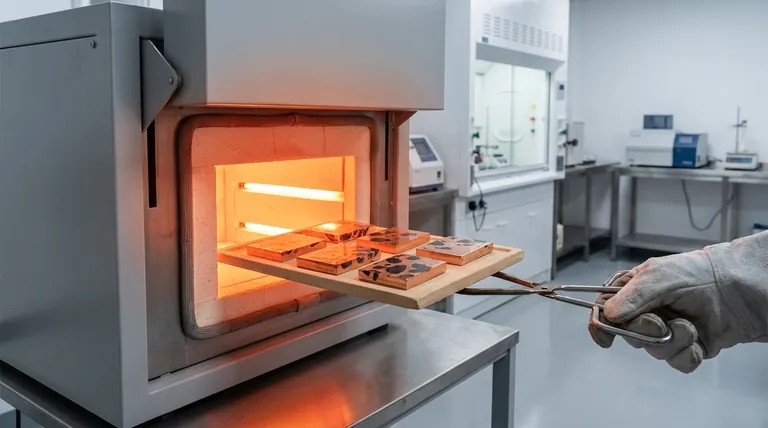
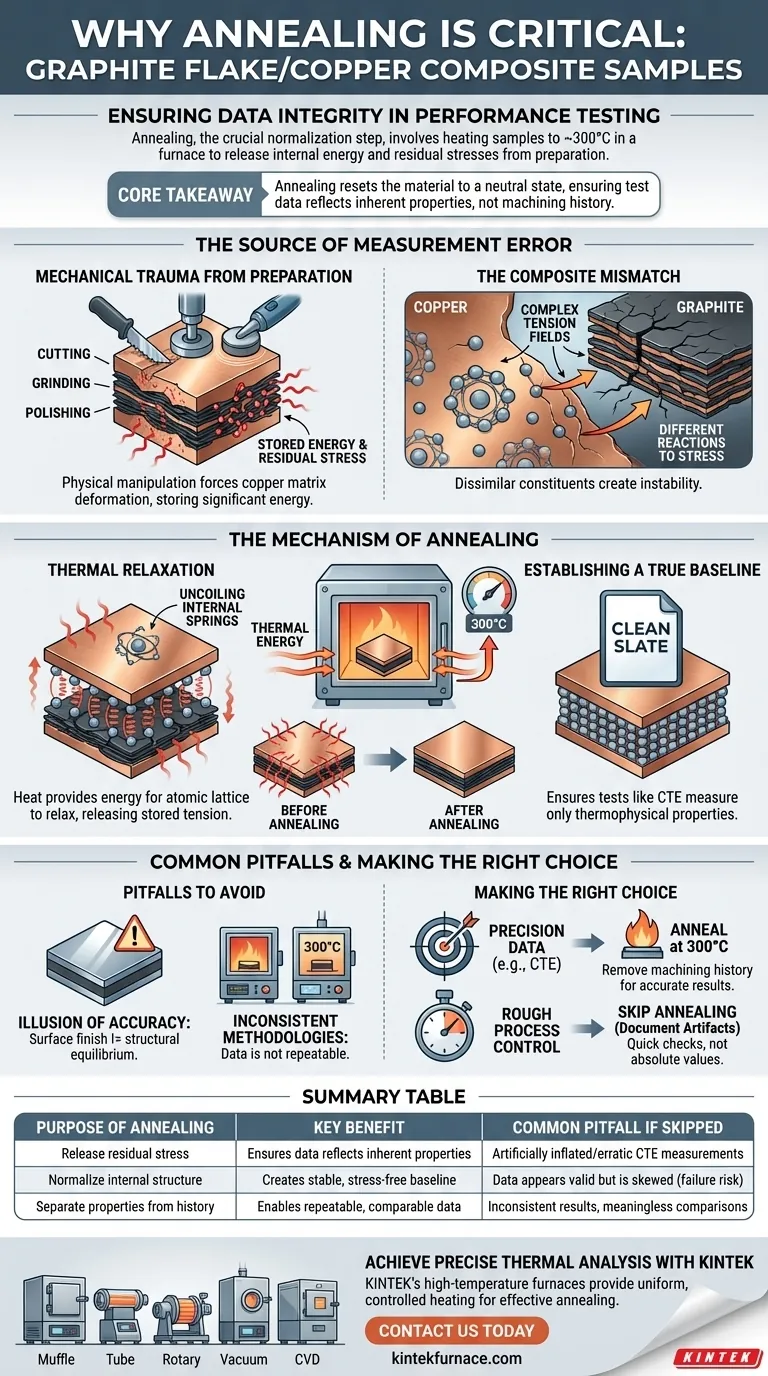
Annealing is the critical normalization step required to ensure data integrity in composite materials. For graphite flake/copper composites, this process involves heating the sample to approximately 300°C in a heat treatment furnace to release internal energy. This eliminates the residual stresses caused by cutting and polishing, preventing them from skewing the results of sensitive performance tests like thermal expansion measurements.
Core Takeaway: The mechanical preparation of a sample creates invisible internal tension. Annealing resets the material to a neutral state, ensuring that subsequent test data reflects the material's inherent properties rather than the history of how it was machined.
The Source of Measurement Error
Mechanical Trauma from Preparation
Preparing a composite sample for testing is a violent process at the microscopic level. Techniques like cutting, grinding, and polishing apply significant mechanical force to the material.
This physical manipulation forces the copper matrix to deform plastically. While the sample may look smooth to the naked eye, the atomic structure holds significant stored energy in the form of residual stress.
The Composite Mismatch
Graphite flake/copper composites face a unique challenge due to the dissimilarity of their constituents. Copper is ductile and metallic, while graphite is brittle and layered.
When machined, these materials react differently to physical stress. This creates complex tension fields at the interface where the copper meets the graphite flakes, making the material unstable for precision testing.
The Mechanism of Annealing
Thermal Relaxation
Annealing addresses this instability by introducing controlled thermal energy. By heating the sample to 300°C in a muffle or atmosphere furnace, you provide the energy necessary for the atomic lattice to relax.
This process allows the material to release the tension stored during machining. It effectively "uncoils" the internal springs created by mechanical deformation without altering the material's composition.
Establishing a True Baseline
The ultimate goal of this thermal treatment is to create a "clean slate." Precision tests, particularly those measuring the coefficient of thermal expansion (CTE), rely on a stable starting point.
If a sample is not annealed, the initial heating phase of the test will measure both the material's natural expansion and the release of manufacturing stress. Annealing separates these variables, ensuring the test measures only the thermophysical properties.
Common Pitfalls to Avoid
The Illusion of Accuracy
A common mistake is assuming that a highly polished sample is ready for testing. Surface finish does not equate to structural equilibrium.
Skipping the annealing step often results in data that looks valid but is actually skewed. This is particularly dangerous in high-precision applications where even minor deviations in thermal expansion data can lead to component failure.
Inconsistent Methodologies
Data is only valuable if it is repeatable. If samples are annealed at different temperatures or skipped entirely, comparisons between batches become meaningless.
Standardizing the annealing temperature (typically 300°C for this specific composite) is just as important as the testing method itself. It ensures that every sample starts from the same stress-free state.
Making the Right Choice for Your Goal
To obtain reliable data, you must align your preparation steps with your measurement objectives.
- If your primary focus is Precision Data (e.g., CTE): You must anneal the sample at 300°C to remove machining history; otherwise, your thermal expansion coefficients will be artificially inflated or erratic.
- If your primary focus is Rough Process Control: You might skip annealing for quick checks, but you must document that the results include residual stress artifacts and are not absolute values.
Annealing is not merely a preparation step; it is the prerequisite for scientific truth in material characterization.
Summary Table:
| Purpose of Annealing | Key Benefit | Common Pitfall if Skipped |
|---|---|---|
| Release residual stress from cutting/polishing | Ensures test data reflects inherent material properties | Artificially inflated or erratic CTE measurements |
| Normalize the composite's internal structure | Creates a stable, stress-free baseline for testing | Data appears valid but is skewed, risking component failure |
| Separate material properties from machining history | Enables repeatable, comparable, and precise data | Inconsistent results make batch comparisons meaningless |
Achieve precise and reliable thermal analysis data with the right laboratory furnace.
The integrity of your material testing starts with precise sample preparation. KINTEK's high-temperature furnaces, including Muffle and Tube furnaces, provide the uniform, controlled heating essential for effective annealing processes.
Backed by expert R&D and manufacturing, KINTEK offers Muffle, Tube, Rotary, Vacuum, and CVD systems, all customizable for your unique lab needs. Ensure your graphite/copper composite samples are perfectly prepared for accurate CTE and performance testing.
Contact us today to discuss how our furnaces can enhance your lab's capabilities and data integrity. Get in Touch
Visual Guide
Related Products
- 2200 ℃ Graphite Vacuum Heat Treat Furnace
- Vacuum Heat Treat Sintering and Brazing Furnace
- Vacuum Heat Treat Sintering Furnace with Pressure for Vacuum Sintering
- Vacuum Heat Treat Sintering Furnace Molybdenum Wire Vacuum Sintering Furnace
- Small Vacuum Heat Treat and Tungsten Wire Sintering Furnace
People Also Ask
- Why are vacuum heat treating furnaces essential for aerospace? Ensure Superior Material Integrity for High-Stakes Applications
- What is the primary application of vacuum heat treating furnaces in aerospace? Enhance Component Performance with Precision
- How does a vacuum heat treating furnace improve the condition of metal alloys? Achieve Superior Metal Performance
- What is the process of vacuum heat treating? Achieve Superior Metallurgical Properties
- How does vacuum heat treating work in terms of temperature and time control? Master Precise Material Transformations



















