
The primary objective of performing an annealing treatment in a box resistance furnace is to eliminate residual internal stresses accumulated during vacuum hot-press sintering. By subjecting the aluminum composite to a stable, constant-temperature environment—typically around 440 °C for one hour—this process regulates the distribution of solute atoms to optimize the material for further processing.
Annealing serves as the critical "conditioning" phase between sintering and deformation. It transforms a composite with high internal tension into a material with sufficient plasticity to undergo multi-pass hot rolling without cracking.
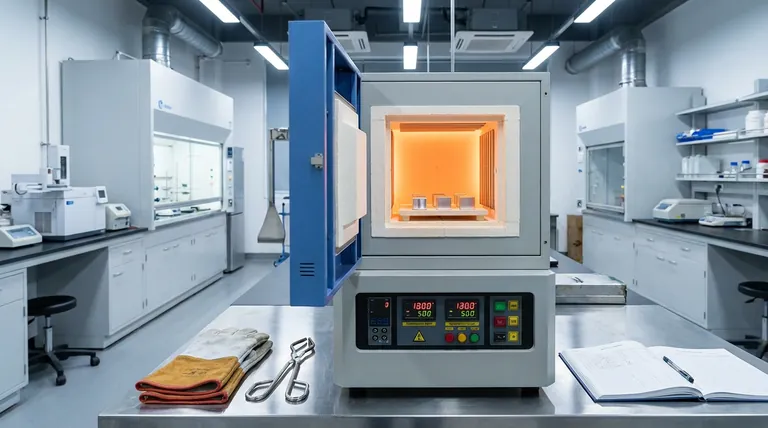
Stress Relief and Material Conditioning
Eliminating Sintering Side Effects
The vacuum hot-press sintering process is effective for densification but inherently generates significant residual internal stresses.
If left untreated, these stresses compromise the structural integrity of the composite. Annealing provides the thermal energy required to relax these internal forces before the material is subjected to external loads.
Ensuring Thermal Stability
A box resistance furnace is specifically chosen for its ability to maintain an exceptionally stable temperature environment.
This stability ensures that every part of the composite reaches the target temperature (e.g., 440 °C) uniformly. Consistent thermal exposure is non-negotiable for effective stress relief across the entire workpiece.
Microstructural Optimization for Processing
Regulating Solute Atoms
Beyond simple stress relief, annealing actively modifies the microstructure by regulating the distribution of solute atoms within the matrix.
This redistribution creates a more homogeneous internal structure. A uniform matrix is essential for predictable mechanical behavior during subsequent manufacturing steps.
Preparing for Hot Rolling
The ultimate practical goal of this treatment is to endow the material with sufficient plasticity.
The composite is destined for multi-pass hot rolling, a rigorous process that involves significant deformation. Without the ductility gained through annealing, the material would be brittle and prone to fracture or crack formation during rolling.
Managing Process Variables and Trade-offs
The Importance of Uniformity
While the furnace provides heat, the quality of the annealing depends on temperature uniformity within the chamber.
High-quality insulation, such as aluminum oxide fiber, is critical to prevent heat loss and ensure the temperature is even throughout the chamber. Poor uniformity leads to inconsistent mechanical properties, where some sections may remain brittle while others are ductile.
Control Over Cooling Rates
It is not enough to simply heat the material; the cooling curve must also be precisely controlled.
As noted in supplementary data regarding muffle furnaces, programmable cooling prevents the re-introduction of thermal shock stresses. Rapid or uncontrolled cooling can negate the benefits of the annealing phase, leading to poor dimensional stability.
Making the Right Choice for Your Goal
To maximize the success of your post-sintering processing, align your annealing parameters with your specific manufacturing targets:
- If your primary focus is preventing processing defects: Prioritize sufficient soak times (like 1 hour at 440 °C) to maximize plasticity and prevent cracking during hot rolling.
- If your primary focus is dimensional stability: Utilize a furnace with programmable controls to manage the cooling rate, ensuring the crystal structure is optimized and locked in without thermal shock.
Effective annealing turns a fragile sintered part into a robust, workable composite ready for industrial application.
Summary Table:
| Process Parameter | Target/Requirement | Objective |
|---|---|---|
| Annealing Temperature | ~440 °C | Ensure thermal stability and stress relaxation |
| Soak Time | 1 Hour | Uniform redistribution of solute atoms |
| Heating Equipment | Box Resistance Furnace | High temperature uniformity and stability |
| Outcome | Increased Plasticity | Prevents cracking during multi-pass hot rolling |
Unlock the Full Potential of Your Materials with KINTEK
Transitioning from sintered composites to high-performance components requires precision thermal conditioning. Backed by expert R&D and manufacturing, KINTEK offers high-performance Muffle, Tube, Rotary, Vacuum, and CVD systems, along with customizable Box Resistance Furnaces designed to ensure the temperature uniformity your annealing processes demand.
Whether you are looking to eliminate residual stress or optimize microstructures for industrial hot rolling, our lab-grade high-temp furnaces provide the programmable control needed for predictable material behavior.
Ready to enhance your lab’s efficiency and material ductility? Contact us today to discuss your unique heating needs!
References
- Yuan Li, Changsheng Lou. Improving mechanical properties and electrical conductivity of Al-Cu-Mg matrix composites by GNPs and sc additions. DOI: 10.1038/s41598-025-86744-y
This article is also based on technical information from Kintek Furnace Knowledge Base .
Related Products
- Controlled Inert Nitrogen Hydrogen Atmosphere Furnace
- 1700℃ High Temperature Laboratory Tube Furnace with Alumina Tube
- Mesh Belt Controlled Atmosphere Furnace Inert Nitrogen Atmosphere Furnace
- 1400℃ High Temperature Laboratory Tube Furnace with Alumina Tube
People Also Ask
- How does hydrogen furnace annealing assist in preparing mechanically alloyed powders for compaction?
- How does atmospheric annealing in a controlled hydrogen furnace affect the cold compaction behavior of metal powders?
- What are the characteristics and uses of hydrogen atmospheres in furnaces? Unlock Clean Metal Processing
- What are the characteristics and uses of hydrogen atmosphere in furnaces? Achieve Superior Surface Purity and Bonding
- What controlled-atmosphere furnace conditions are required for sintering powder metallurgy copper alloy compacts? Ideal Setup



