
The intervention of precision heat treatment is critical because the Laser Powder Bed Fusion (LPBF) process subjects AlSi10Mg to extreme thermal conditions that compromise the part's internal stability. Although industrial-grade LPBF equipment achieves nearly 100% relative density using high-power lasers, the resulting rapid cooling rates generate significant internal residual stresses that must be neutralized.
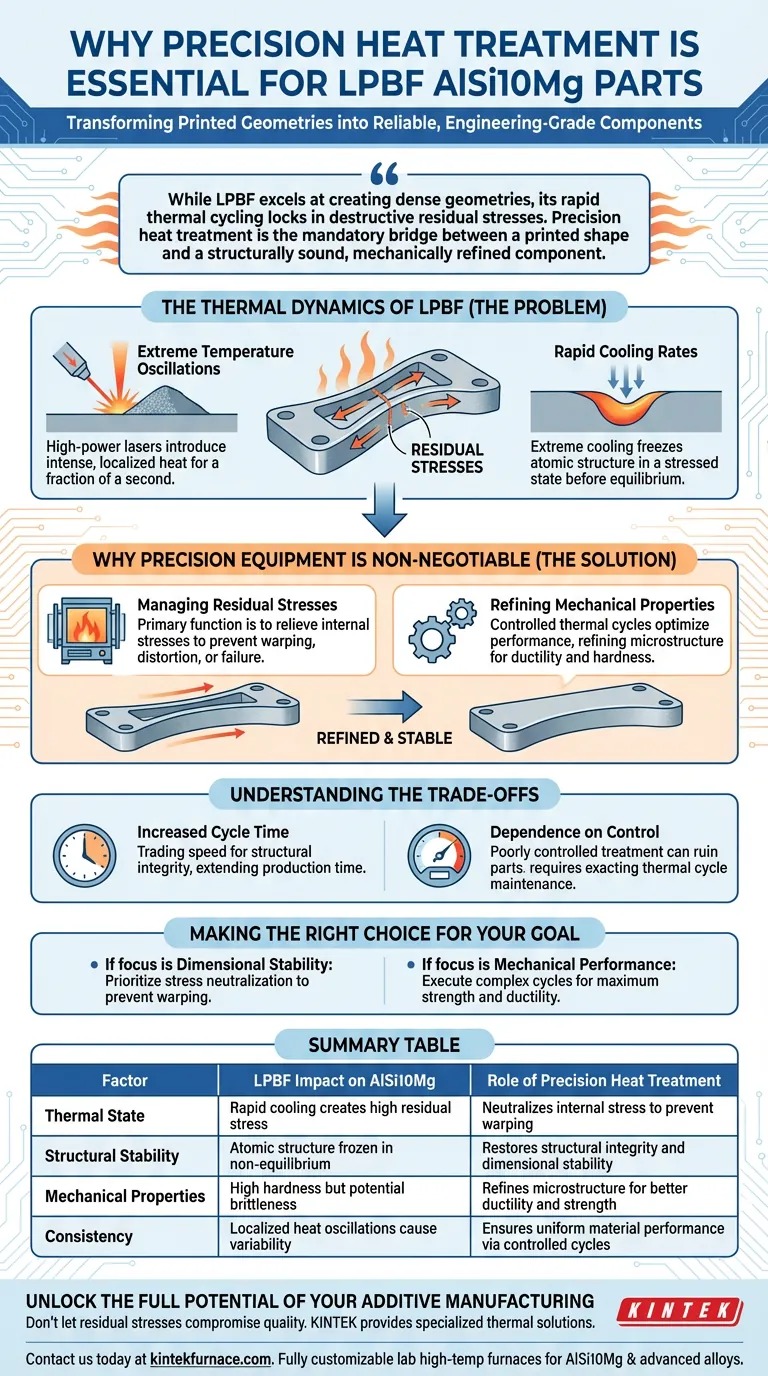
While LPBF excels at creating dense geometries, its rapid thermal cycling locks in destructive residual stresses. Precision heat treatment is the mandatory bridge between a printed shape and a structurally sound, mechanically refined component.
The Thermal Dynamics of LPBF
The root cause of the need for heat treatment lies in the physics of the printing process itself. It is not a flaw in the manufacturing, but a byproduct of how the material is formed.
Extreme Temperature Oscillations
LPBF utilizes high-power lasers to melt fine layers of powder. This introduces intense, localized heat into the material for a fraction of a second.
Rapid Cooling Rates
As the laser moves away, the molten metal solidifies almost instantly. This extreme cooling rate freezes the atomic structure in a stressed state before it can naturally reach equilibrium.
Why Precision Equipment is Non-Negotiable
Standard heating methods are often insufficient for additive manufacturing applications. The specific needs of AlSi10Mg parts produced via LPBF require equipment capable of exacting control.
Managing Residual Stresses
The primary function of this equipment is to relieve the internal residual stresses caused by the printing process. Without this intervention, parts may warp, distort, or fail prematurely under load.
Refining Mechanical Properties
Beyond stress relief, the material requires controlled thermal cycles to optimize its performance. Precision equipment ensures the alloy reaches the exact temperatures needed to refine its final mechanical properties, such as ductility and hardness.
Understanding the Trade-offs
While heat treatment is essential, it introduces additional variables into the manufacturing chain that must be managed.
Increased Cycle Time
Implementing a precision heat treatment step inevitably extends the total production time. You are trading speed for structural integrity, a necessary cost for functional parts.
Dependence on Control
The term "precision" is operative here; poorly controlled heat treatment can ruin a perfectly printed part. If the thermal cycle is not maintained accurately, you risk altering the material properties beyond the desired specification.
Making the Right Choice for Your Goal
To maximize the utility of your AlSi10Mg components, you must align your post-processing strategy with your performance requirements.
- If your primary focus is Dimensional Stability: Prioritize heat treatment cycles designed specifically to neutralize internal residual stresses to prevent warping.
- If your primary focus is Mechanical Performance: Ensure your equipment can execute complex, controlled thermal cycles to refine the alloy's microstructure for maximum strength.
Precision heat treatment transforms a printed geometry into a reliable, engineering-grade component.
Summary Table:
| Factor | LPBF Impact on AlSi10Mg | Role of Precision Heat Treatment |
|---|---|---|
| Thermal State | Rapid cooling creates high residual stress | Neutralizes internal stress to prevent warping |
| Structural Stability | Atomic structure frozen in non-equilibrium | Restores structural integrity and dimensional stability |
| Mechanical Properties | High hardness but potential brittleness | Refines microstructure for better ductility and strength |
| Consistency | Localized heat oscillations cause variability | Ensures uniform material performance via controlled cycles |
Unlock the Full Potential of Your Additive Manufacturing
Don't let residual stresses compromise the quality of your 3D-printed components. KINTEK provides the specialized thermal solutions necessary to transform raw LPBF geometries into high-performance, engineering-grade parts.
Backed by expert R&D and world-class manufacturing, KINTEK offers a comprehensive range of Muffle, Tube, Rotary, Vacuum, and CVD systems. Our lab high-temp furnaces are fully customizable to meet the exacting thermal cycle requirements of AlSi10Mg and other advanced alloys.
Ready to refine your post-processing? Contact us today to discuss your unique needs with our technical team.
Visual Guide
References
- Busisiwe J. Mfusi, Ntombi Mathe. Optimisation of the Heat Treatment Profile for Powder-Bed Fusion Built AlSi10Mg by Age Hardening and Ice-Water Quenching. DOI: 10.3390/met14030292
This article is also based on technical information from Kintek Furnace Knowledge Base .
Related Products
- Vacuum Heat Treat Furnace with Ceramic Fiber Liner
- 2200 ℃ Graphite Vacuum Heat Treat Furnace
- Vacuum Heat Treat Sintering and Brazing Furnace
- 9MPa Air Pressure Vacuum Heat Treat and Sintering Furnace
- 600T Vacuum Induction Hot Press Vacuum Heat Treat and Sintering Furnace
People Also Ask
- How does vacuum heat treating affect the grain structure of metal alloys? Achieve Precise Microstructure Control
- What are the benefits of using vacuum heat treating furnaces for metal alloys? Achieve Superior Metal Properties and Performance
- What is one of the most important uses of vacuum heat treating furnaces in aerospace? Achieve Superior Strength in Aircraft Alloys
- How does a vacuum heat treat furnace work? Achieve Pristine, High-Performance Results
- What is the difference between heat treat and vacuum heat treat? Achieve Superior Metal Properties with Pristine Finishes











