
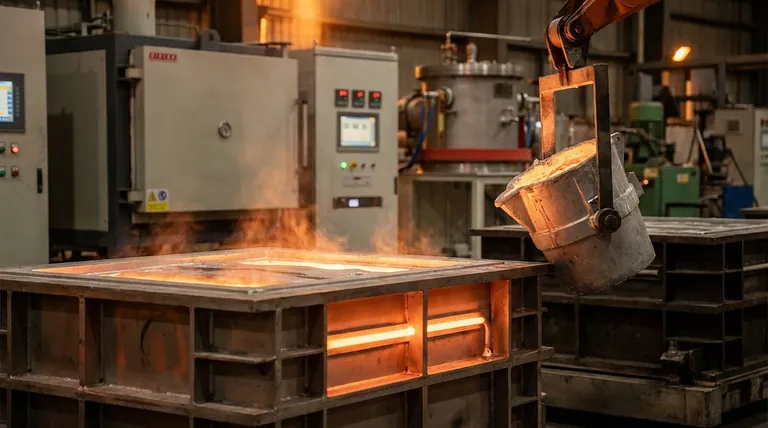
The primary purpose of preheating metal molds is to drastically reduce the thermal shock between the high-temperature molten aluminum-lithium alloy and the casting interface. By elevating the mold temperature to a specific target, such as 200°C, you effectively maintain the melt's fluidity throughout the filling process. This critical step prevents premature solidification, ensuring the metal completely fills the mold cavity before it begins to set.
Core Takeaway Preheating is not just about temperature; it is a flow control mechanism. It extends the window of fluidity to prevent casting defects while regulating the solidification rate to ensure a uniform, high-performance microstructure.
Managing Thermal Dynamics
Reducing the Thermal Gradient
When molten metal contacts a cold mold, the temperature drops instantly at the interface. This rapid cooling can freeze the metal before the mold is fully filled.
Preheating the mold minimizes this instantaneous temperature difference. By narrowing the gap between the melt and the mold, you ensure the energy transfer is controlled rather than chaotic.
Maintaining Melt Fluidity
For squeeze casting to be effective, the alloy must remain fluid during the entire filling phase.
A preheated mold acts as a thermal buffer. It prevents the melt from losing heat too quickly, allowing it to flow into complex geometries without stalling.
Defect Prevention and Structural Integrity
Eliminating Filling Defects
If the alloy solidifies while it is still flowing, it creates structural discontinuities.
The primary reference highlights that proper preheating prevents specific defects such as misruns (incomplete filling) and cold shuts (where two streams of metal meet but fail to fuse). These issues are directly caused by premature solidification.
Controlling Microstructure Evolution
Beyond mere filling, the cooling rate dictates the final properties of the metal.
Preheating allows for precise control over the solidification rate. This control is essential for achieving a uniform evolution of the alloy's microstructure, which directly impacts the mechanical strength and reliability of the final part.
Understanding the Risks of Improper Temperature
The Consequence of Cold Molds
Omitting the preheat step or heating the mold insufficiently is a primary cause of process failure.
Without this thermal management, the outer skin of the casting creates a shell too early. This restricts the pressure application inherent to squeeze casting, negating the benefits of the process and leading to inconsistent material properties.
Optimizing the Squeeze Casting Process
To maximize the quality of your aluminum-lithium components, align your temperature strategy with your specific quality targets.
- If your primary focus is Defect Reduction: Ensure the mold reaches at least 200°C to guarantee sufficient fluidity and prevent cold shuts.
- If your primary focus is Material Performance: Prioritize temperature stability to enforce a consistent solidification rate for a uniform microstructure.
Mastering the thermal relationship between the mold and the melt is the first step toward casting consistency.
Summary Table:
| Feature | Impact of Preheating | Benefit to Casting |
|---|---|---|
| Thermal Gradient | Reduces temperature gap between melt and mold | Prevents premature solidification |
| Melt Fluidity | Extends the liquid phase during mold filling | Ensures complete filling of complex geometries |
| Defect Control | Eliminates misruns and cold shuts | Enhances structural integrity and fusion |
| Microstructure | Regulates the cooling/solidification rate | Produces a uniform, high-performance grain structure |
Optimize Your Casting Precision with KINTEK
Achieving the perfect thermal balance is essential for high-performance aluminum-lithium components. Backed by expert R&D and manufacturing, KINTEK provides industry-leading Muffle, Tube, Rotary, Vacuum, and CVD systems, along with other lab high-temperature furnaces. Whether you need standard equipment or fully customizable solutions tailored to your unique squeeze casting needs, our thermal experts are here to help.
Ready to eliminate casting defects and improve material performance?
Contact KINTEK Today for a Specialized Consultation
Visual Guide

References
- Shulin Lü, Wei Guo. Enhancement of Strength–Ductility Synergy of Al-Li Cast Alloy via New Forming Processes and Sc Addition. DOI: 10.3390/ma17071558
This article is also based on technical information from Kintek Furnace Knowledge Base .
Related Products
People Also Ask
- What thermal phenomena occur during polymer binder burnout in ceramic green bodies? Lab Furnace Guide
- Why is controlled heat treatment in a muffle furnace necessary for calcined clay? Achieve Optimal Pozzolanic Activity
- What role does a high-temperature muffle furnace play in STFO synthesis? Achieve Pure Perovskite Results
- How does a high-temperature muffle furnace facilitate the formation of LaNbxAl1−xO3+δ perovskite structures? Key Roles
- What role does a high-temperature muffle furnace play in the multi-stage synthesis of Li0.5MnFe1.5O4? Key to Pure Spinel
