
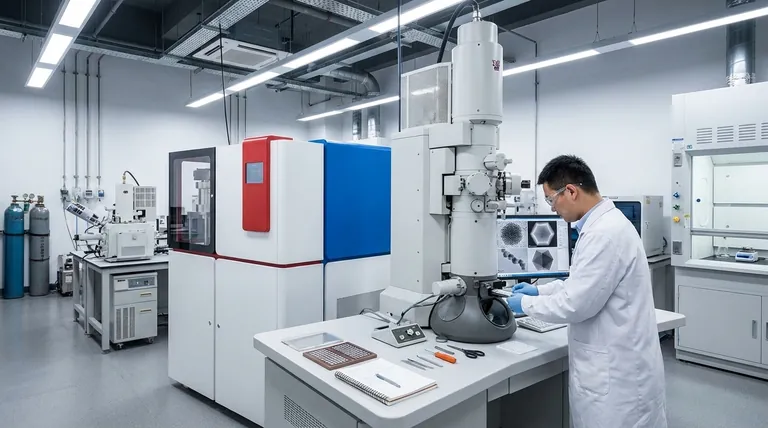
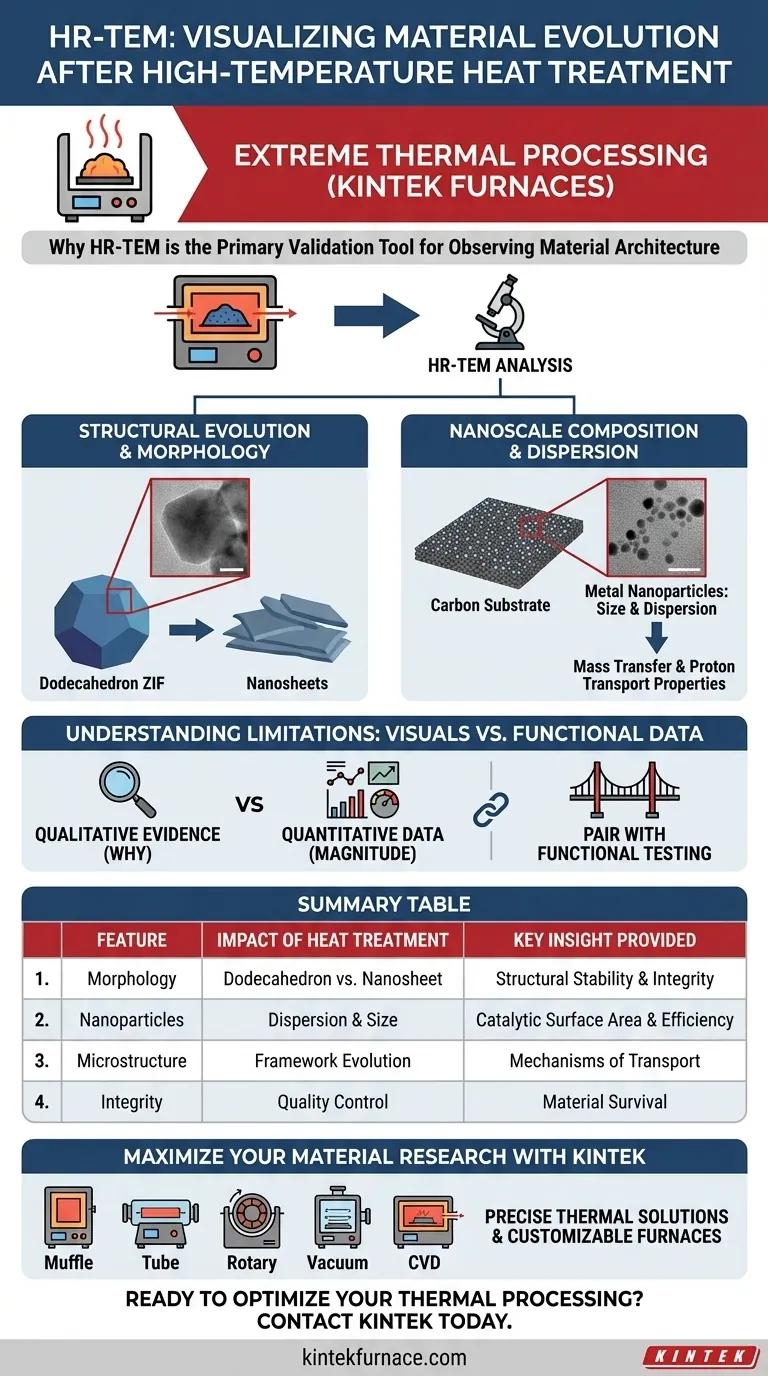
High-resolution transmission electron microscopy (HR-TEM) serves as the primary validation tool for visualizing how extreme thermal processing alters the fundamental architecture of a material. It allows researchers to directly observe "morphology evolution," confirming whether complex structures retain their original geometric shape or collapse into new forms following heat treatment in a high-temperature furnace.
Core Takeaway HR-TEM bridges the gap between thermal processing and material performance. By providing sub-micron visualization of structural changes—such as the collapse of frameworks or the dispersion of nanoparticles—it reveals the physical mechanisms responsible for shifts in mass transfer and proton transport properties.
Analyzing Structural Evolution
Visualizing Morphology Changes
Heat treatment significantly impacts the physical form of materials. HR-TEM is utilized to capture high-fidelity images that demonstrate exactly how the material's morphology evolves under specific thermal conditions.
Verifying Structural Integrity
For advanced materials like Zeolitic Imidazolate Frameworks (ZIFs), this imaging is essential for quality control. It reveals whether the material maintains its intended original structure, such as a dodecahedron, or if the thermal stress has caused it to collapse into nanosheets.
Assessing Material Composition at the Nanoscale
Tracking Metal Nanoparticles
Beyond the overall shape, HR-TEM provides critical data on the material's surface composition. It produces sub-micron images that display the dispersion and size of metal nanoparticles across the carbon substrate.
Linking Structure to Performance
The distribution of these particles is not just a visual detail; it is a performance indicator. By observing these nanoscale features, researchers can deduce how the furnace's heat affected the material's functional capabilities, specifically regarding mass transfer and proton transport properties.
Understanding the Limitations
Visuals vs. Functional Data
While HR-TEM provides exceptional visual evidence of morphology and dispersion, it is primarily a qualitative imaging tool.
It effectively shows why a material's properties might have changed (e.g., structure collapse), but it does not directly measure the magnitude of those property changes (e.g., the exact rate of proton transport). It must be paired with functional testing for a complete analysis.
Making the Right Choice for Your Goal
HR-TEM is the definitive choice when you need to correlate physical structure with thermal history.
- If your primary focus is Structural Stability: Use HR-TEM to verify if your ZIFs retained their dodecahedron geometry or collapsed into nanosheets.
- If your primary focus is Catalytic or Transport Efficiency: Use HR-TEM to assess the uniformity and size of metal nanoparticles dispersed on the carbon substrate.
By leveraging HR-TEM, you move beyond guessing how heat affected your material and gain the visual proof needed to optimize your thermal processing parameters.
Summary Table:
| Feature Observed | Impact of Heat Treatment | Key Insight Provided |
|---|---|---|
| Morphology | Dodecahedron vs. Nanosheet collapse | Structural stability & geometric integrity |
| Nanoparticles | Dispersion & size on carbon substrate | Catalytic surface area & efficiency |
| Microstructure | Framework evolution | Mechanisms of mass & proton transport |
| Integrity | Quality control post-thermal stress | Verification of material survival |
Maximize Your Material Research with KINTEK
Precise heat treatment is the foundation of high-performance materials. At KINTEK, we provide the advanced thermal solutions necessary to achieve the specific morphology and nanoparticle dispersion required for your most demanding applications.
Whether you are synthesizing ZIFs, carbon substrates, or complex catalysts, our expert-engineered Muffle, Tube, Rotary, Vacuum, and CVD systems offer the thermal precision needed to ensure your materials stand up to HR-TEM scrutiny. All our laboratory high-temperature furnaces are fully customizable to meet your unique research specifications.
Ready to optimize your thermal processing? Contact KINTEK today to discuss your custom furnace needs with our R&D experts.
Visual Guide
References
- Yan Yang, Gai Zhang. Enhanced Electrocatalytic Activity for ORR Based on Synergistic Effect of Hierarchical Porosity and Co-Nx Sites in ZIF-Derived Heteroatom-Doped Carbon Materials. DOI: 10.3390/c11030070
This article is also based on technical information from Kintek Furnace Knowledge Base .
Related Products
- 1400℃ High Temperature Laboratory Tube Furnace with Alumina Tube
- 1800℃ High Temperature Muffle Oven Furnace for Laboratory
- 1700℃ High Temperature Laboratory Tube Furnace with Alumina Tube
- 1700℃ High Temperature Muffle Oven Furnace for Laboratory
- 1700℃ Controlled Inert Nitrogen Atmosphere Furnace
People Also Ask
- How does zone-melting in tube furnaces synthesize bismuth micro-wires? Master Single-Crystal Thermoelectric Growth
- How do high-temperature laboratory tube furnaces ensure environmental stability? Precision Thermal Reduction Tips
- How are high-temperature laboratory tube furnaces applied in long-term vacuum homogenization heat treatments for intermetallic samples?
- How are high-temp tube furnaces used to measure diffusion coefficients per Fick's law? Master Precision Annealing
- How are high-temperature tube furnaces applied in testing ceramic-supported alloy membranes? Insights



















