
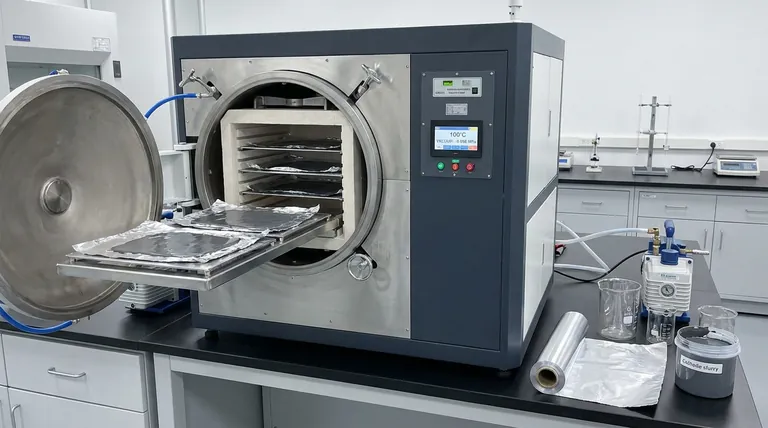
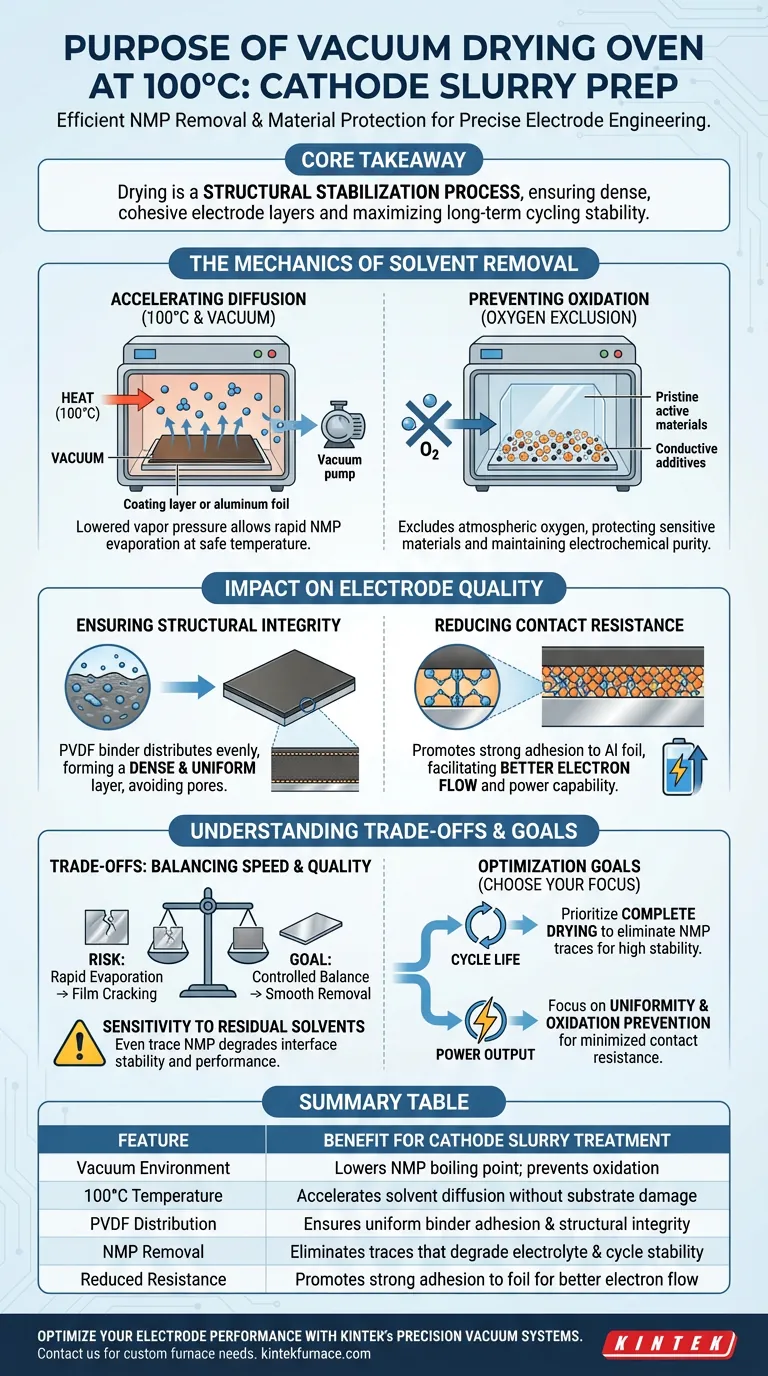
The specific application of a vacuum drying oven at 100°C plays a critical role in the precise engineering of cathode electrodes. Its primary function is to effectively remove N-Methyl-2-pyrrolidone (NMP) solvents from the slurry mixture coated on the aluminum foil. By combining heat with a vacuum environment, this process accelerates solvent diffusion while strictly preventing the oxidation of sensitive active materials.
Core Takeaway Drying at this specific temperature and pressure is not merely about evaporation; it is a structural stabilization process. It ensures the formation of a dense, cohesive electrode layer that minimizes contact resistance and maximizes the long-term cycling stability of the battery.
The Mechanics of Solvent Removal
Accelerating Diffusion at Controlled Temperatures
The NMP solvent used in cathode slurries has a relatively high boiling point. Attempting to remove it at atmospheric pressure often requires excessive heat, which can damage battery components.
By utilizing a vacuum environment, the vapor pressure is lowered. This allows the NMP solvent molecules to diffuse and evaporate rapidly at 100°C, a temperature that is effective for drying but safe for the aluminum substrate and active materials.
Preventing Oxidation
Standard drying methods expose materials to atmospheric oxygen, which acts as a contaminant in battery chemistry.
The vacuum oven excludes oxygen during the heating process. This is vital for protecting the active materials and conductive additives (such as acetylene black) from oxidation, preserving their electrochemical purity before the battery is even assembled.
Impact on Electrode Quality
Ensuring Structural Integrity
The drying phase is where the slurry transforms into a solid electrode. The vacuum process ensures that the PVDF binder distributes evenly as the solvent leaves.
This results in a dense and uniform electrode layer. Without this controlled removal, the coating could suffer from uneven density or microscopic pores that hinder performance.
Reducing Contact Resistance
A battery's efficiency depends heavily on how well the coating sticks to the current collector (the aluminum foil).
The 100°C vacuum treatment promotes strong adhesion between the active material, the binder, and the foil. This strong bond directly reduces contact resistance, facilitating better electron flow and enhancing the overall power capability of the cell.
Understanding the Trade-offs
The Risk of Rapid Evaporation
While the vacuum accelerates drying, aggressive pressure changes can be a double-edged sword.
If the solvent evaporates too violently, it can cause film cracking or structural defects in the coating. The process relies on a balance between the 100°C heat and the vacuum level to ensure smooth, rather than disruptive, solvent removal.
Sensitivity to Residual Solvents
This process leaves no margin for error regarding moisture or solvent retention.
Even trace amounts of NMP left behind due to insufficient time or vacuum depth can react with the electrolyte later. This reaction degrades the interface stability, neutralizing the benefits of the vacuum drying step.
Making the Right Choice for Your Goal
To maximize the performance of your cathode preparation, consider your specific optimization targets:
- If your primary focus is Cycle Life: Prioritize the completeness of the drying phase to eliminate all NMP traces, ensuring high cycling stability and preventing electrolyte degradation.
- If your primary focus is Power Output: Focus on the prevention of oxidation and the uniformity of the binder distribution to minimize contact resistance for efficient energy transfer.
The vacuum drying oven is not just a dehydrator; it is the tool that locks in the chemical potential of your electrode materials.
Summary Table:
| Feature | Benefit for Cathode Slurry Treatment |
|---|---|
| Vacuum Environment | Lowers NMP boiling point; prevents oxidation of active materials |
| 100°C Temperature | Accelerates solvent diffusion without damaging the aluminum substrate |
| PVDF Distribution | Ensures uniform binder adhesion and structural integrity |
| NMP Removal | Eliminates traces that degrade electrolyte and cycle stability |
| Reduced Resistance | Promotes strong adhesion to foil for better electron flow |
Optimize Your Electrode Performance with KINTEK
Precision in solvent removal is the difference between a high-performance cell and a failing one. Backed by expert R&D and manufacturing, KINTEK offers specialized Vacuum, Muffle, and CVD systems, along with other lab high-temp furnaces, all customizable for your unique battery research needs. Whether you are scaling up cathode production or refining lab-scale coatings, our technology ensures the thermal and atmospheric control required for superior electrode quality.
Ready to enhance your lab's efficiency and battery cycling stability? Contact us today to discuss your custom furnace needs!
Visual Guide
References
- Kexin Zheng, Lu Ju. Effects of Ti4+ Doping on the Structural Stability and Electrochemical Performance of Layered P2-Na0.7MnO2.05 Cathodes for Sodium-Ion Batteries. DOI: 10.3390/nano14241989
This article is also based on technical information from Kintek Furnace Knowledge Base .
Related Products
- Vacuum Heat Treat Sintering and Brazing Furnace
- Vacuum Heat Treat Sintering Furnace Molybdenum Wire Vacuum Sintering Furnace
- Dental Porcelain Zirconia Sintering Ceramic Vacuum Press Furnace
- Vacuum Hot Press Furnace Machine for Lamination and Heating
- Vacuum Hot Press Furnace Machine Heated Vacuum Press
People Also Ask
- What is one of the most important uses of vacuum heat treating furnaces in aerospace? Achieve Superior Strength in Aircraft Alloys
- What are the benefits of using vacuum heat treating furnaces for metal alloys? Achieve Superior Metal Properties and Performance
- How does vacuum heat treating affect the grain structure of metal alloys? Achieve Precise Microstructure Control
- What is the temperature of a vacuum furnace brazing? Optimize Your Joint Strength and Cleanliness
- What are the steps involved in a typical vacuum brazing treatment? Master the Process for Strong, Clean Joints







