
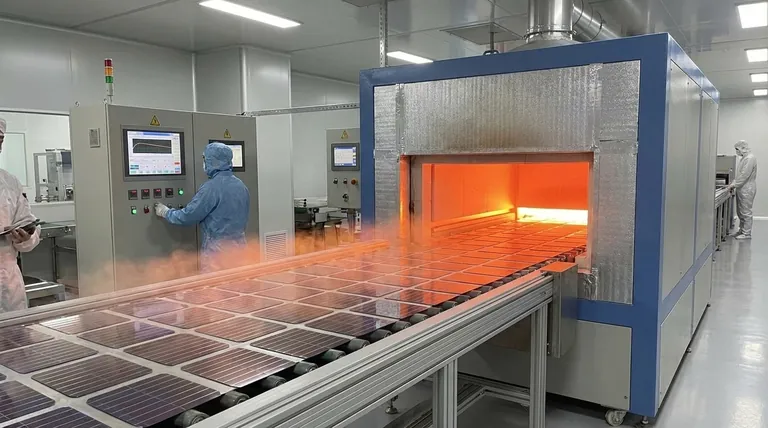
The industrial fast firing furnace serves as the critical final step in the metallization of PERT solar cells, transforming screen-printed pastes into functional electrical contacts. By subjecting the wafers to a precisely controlled, high-speed thermal cycle, this equipment enables the metal to breach insulating layers and bond directly with the silicon substrate.
The fast firing furnace bridges the gap between physical printing and electrical functionality. Its primary function is to drive metal paste through the passivation layer to form low-resistance ohmic contacts without damaging the cell's delicate semiconductor junction.
The Mechanics of Contact Formation
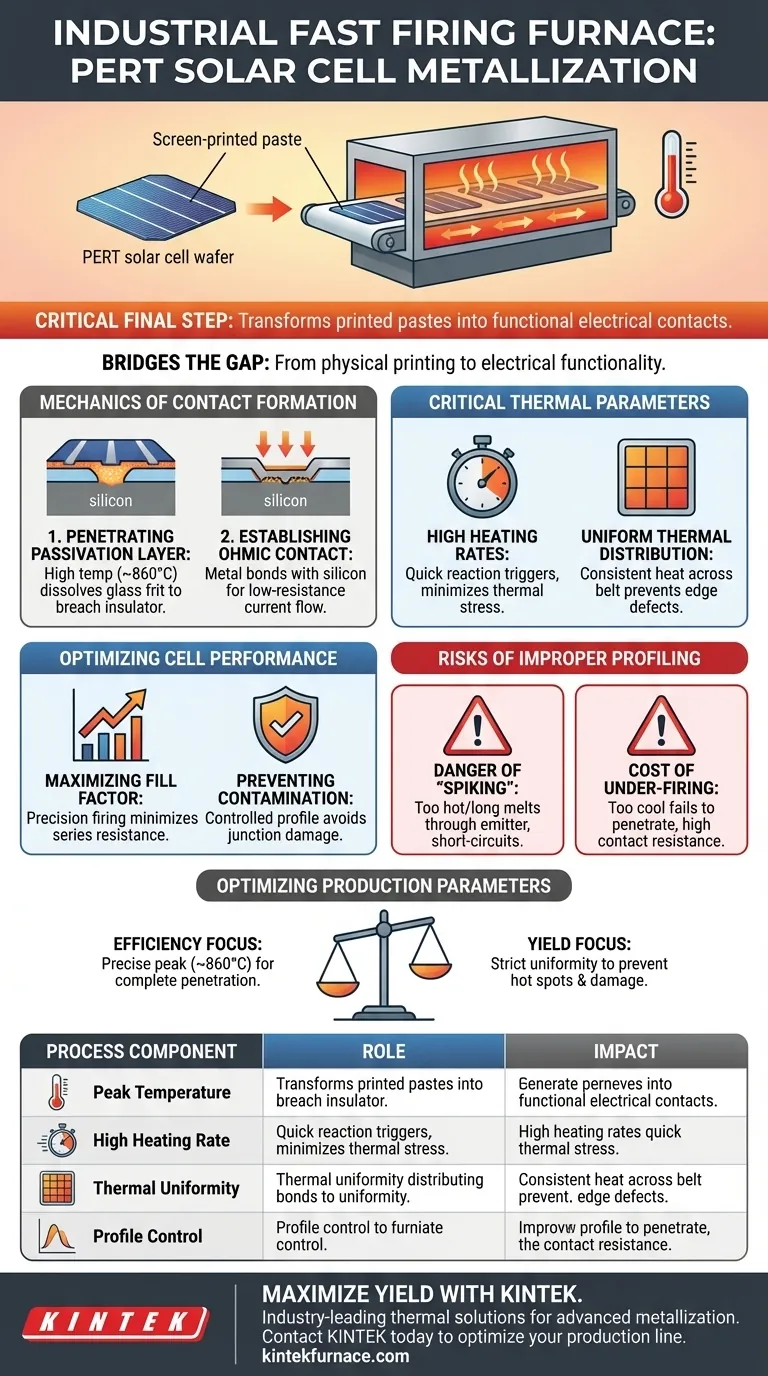
Penetrating the Passivation Layer
PERT solar cells are coated with a dielectric passivation layer that insulates the surface. To collect current, the metal contacts must break through this barrier.
The fast firing furnace achieves this by ramping the cell to a specific peak temperature, typically around 860 °C. At this intensity, the glass frit in the metal paste dissolves the passivation layer, allowing the metal to reach the silicon beneath.
Establishing Ohmic Contact
Once the barrier is breached, the metal interacts with the silicon substrate. This interaction creates a reliable ohmic contact.
A high-quality ohmic contact is essential for allowing charge carriers to flow freely out of the cell. Without this connection, the energy generated by the solar cell remains trapped, rendering the device useless.
Critical Thermal Parameters
High Heating Rates
The "fast" in fast firing is not just for throughput; it is a chemical necessity. A rapid increase in temperature is required to trigger the necessary reactions quickly.
This speed ensures that the contact forms immediately, limiting the time the wafer spends under high thermal stress.
Uniform Thermal Distribution
The furnace must maintain a strictly uniform thermal field across the entire width of the transport belt.
If the heat distribution is uneven, the center of the wafer might fire perfectly while the edges remain under-processed. Uniformity ensures consistent electrical performance across the entire surface area of every cell.
Optimizing Cell Performance
Maximizing Fill Factor
The precision of the firing process is directly linked to the solar cell's fill factor.
The fill factor is a measure of the "squareness" of the IV curve and represents the efficiency of current collection. By optimizing the firing profile, manufacturers minimize series resistance and maximize this critical performance metric.
Preventing Deep-Level Contamination
While heat is necessary to form contacts, it is also a liability. Excessive thermal exposure can cause metal atoms to diffuse too deeply into the silicon.
The fast firing furnace is designed to prevent this deep-level contamination. By controlling the profile, it ensures metal touches the emitter but does not penetrate the junction area, which would cause electrical shunts.
Risks of Improper Thermal Profiling
The Danger of "Spiking"
If the peak temperature is too high or held for too long, the metal paste can melt through the emitter region.
This phenomenon, known as spiking, effectively short-circuits the local area of the cell. This damage is irreversible and significantly degrades the cell's open-circuit voltage.
The Cost of Under-firing
Conversely, if the furnace fails to reach the required peak temperature, the paste will not fully etch through the passivation layer.
This results in "under-firing," where the metal sits on top of the insulator rather than contacting the silicon. The result is extremely high contact resistance and a non-functional solar cell.
Optimizing Your Production Parameters
Achieving high-efficiency PERT cells requires a delicate balance between aggressive heating for contact formation and restraint for junction protection.
- If your primary focus is maximizing electrical efficiency: Prioritize a precise peak temperature near 860 °C to ensure complete passivation penetration and minimal contact resistance.
- If your primary focus is minimizing yield loss: Strictly maintain thermal field uniformity to prevent hot spots that lead to deep-level metal contamination and junction damage.
Precision in the firing furnace is the final gatekeeper that determines whether a processed wafer becomes a high-performance energy generator or scrap.
Summary Table:
| Process Component | Role in PERT Metallization | Impact on Performance |
|---|---|---|
| Peak Temperature (~860°C) | Dissolves glass frit to penetrate passivation layers | Ensures metal-to-silicon contact |
| High Heating Rate | Rapidly triggers chemical reactions in metal paste | Minimizes thermal stress on wafers |
| Thermal Uniformity | Ensures consistent processing across the entire belt | Prevents edge defects and yield loss |
| Profile Control | Limits metal diffusion depth | Prevents electrical shunts and spiking |
Maximize Your PERT Solar Cell Yield with KINTEK
Precision is the difference between a high-performance energy generator and scrap. KINTEK provides industry-leading thermal solutions backed by expert R&D and manufacturing. Our customizable Muffle, Tube, and Vacuum systems are engineered to deliver the strict thermal field uniformity and rapid ramp rates required for advanced solar cell metallization.
Whether you need to optimize your peak temperature profiles or scale up production with reliable high-temp furnaces, our team is ready to support your unique manufacturing needs.
Contact KINTEK today to optimize your production line
Visual Guide
References
- Thais Crestani, João Victor Zanatta Britto. Optimization of the Boron Back Surface Field Produced with Reduced Thermal Steps in Bifacial PERT Solar Cell. DOI: 10.3390/en18092347
This article is also based on technical information from Kintek Furnace Knowledge Base .
Related Products
- Spark Plasma Sintering SPS Furnace
- Laboratory Quartz Tube Furnace RTP Heating Tubular Furnace
- Custom Made Versatile CVD Tube Furnace Chemical Vapor Deposition CVD Equipment Machine
- Small Vacuum Heat Treat and Tungsten Wire Sintering Furnace
- Multi Heating Zones CVD Tube Furnace Machine for Chemical Vapor Deposition Equipment
People Also Ask
- Why is it necessary to maintain a high vacuum environment during the SPS of SiC? Key to High-Density Ceramics
- How does the heating mechanism of Spark Plasma Sintering (SPS) function? Enhance TiC/SiC Composite Fabrication
- What are the technical advantages of using an SPS sintering furnace? Elevate Al2O3-TiC Material Performance
- What are the steps in the discharge plasma sintering process? Master Fast, High-Density Material Consolidation
- What are the advantages of spark plasma sintering (SPS) over traditional forging? Precision Microstructural Control



















