
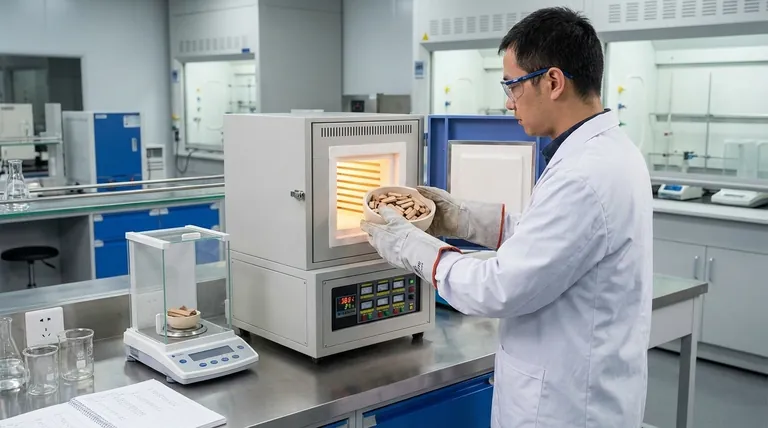
The primary purpose of operating a laboratory oven at 383 K for 24 hours is deep drying. This specific thermal treatment is designed to completely eliminate surface moisture from the raw waste wood, ensuring the material reaches a constant weight before any chemical processing begins.
Core Takeaway Moisture is a variable that distorts experimental precision. By stabilizing the sample weight at 383 K, you establish an exact dry mass, which is the only reliable baseline for calculating chemical impregnation ratios and ensuring consistent activation efficiency.
The Critical Role of Deep Drying
Eliminating Surface Moisture
Operating at 383 K (approximately 110 °C) places the environment just above the boiling point of water.
This temperature is sufficient to drive off moisture trapped within the biomass structure without initiating significant thermal decomposition or combustion of the wood itself.
The 24-hour duration is described as "prolonged exposure," which ensures that even moisture deep within the wood pores has time to migrate to the surface and evaporate.
Establishing Constant Weight
In scientific preparation, "weight" fluctuates with humidity.
The goal of this step is to reach a state where the sample's mass stops changing.
Once constant weight is achieved, you can confirm that the mass measured is purely the raw material, eliminating water weight as a variable.
Why Moisture Removal Determines Process Success
Securing the Mass Balance
The preparation of activated carbon relies heavily on the sample-to-activator mass ratio.
If the wood contains residual moisture, you are weighing water rather than carbon precursor.
This leads to an incorrect calculation of chemical reagents, potentially diluting the activator and altering the intended chemical environment.
Protecting Thermochemical Reactions
Water is not an inert bystander in high-temperature reactions; it consumes energy and can alter reaction pathways.
By removing moisture beforehand, you prevent it from interfering with the thermodynamics of the subsequent carbonization or activation stages.
This ensures that the energy input is directed entirely toward the conversion of the biomass, rather than the evaporation of excess water.
Distinguishing Drying from Thermal Stabilization
Understanding the Temperature Limit
It is vital to distinguish this drying step from thermal stabilization or pre-oxidation.
While drying occurs at 383 K (110 °C), structural changes like partial graphitization or cross-linking generally require higher temperatures (around 220 °C) and specific controls, such as slow heating rates.
The Trade-off of Temperature Selection
Attempting to accelerate drying by increasing the temperature beyond 383 K risks premature decomposition.
If the temperature rises significantly higher (e.g., toward the 220 °C range used for stabilization), the cellulose skeleton may begin to degrade or chemically alter before the moisture is fully removed.
Strict adherence to 383 K maintains the integrity of the raw material while isolating the variable of moisture.
Making the Right Choice for Your Goal
To optimize your activated carbon preparation, align your oven settings with your immediate processing needs:
- If your primary focus is Mass Precision: strictly maintain 383 K until weight fluctuation ceases to ensure your chemical ratios are calculated against the dry biomass only.
- If your primary focus is Dimensional Stability: recognize that 383 K is only for drying; you must proceed to a secondary phase (e.g., 220 °C) to reduce shrinkage or lock in shape fidelity.
The precision of your final carbon product is mathematically impossible without the dry mass baseline established at 383 K.
Summary Table:
| Parameter | Specification | Purpose |
|---|---|---|
| Temperature | 383 K (110 °C) | Drives off moisture without biomass decomposition |
| Duration | 24 Hours | Ensures complete evaporation from deep wood pores |
| Primary Goal | Constant Weight | Establishes a dry mass baseline for precise chemistry |
| Key Outcome | Accurate Mass Balance | Ensures correct sample-to-activator ratios |
Elevate Your Material Research with KINTEK
Precision in activated carbon preparation begins with consistent thermal processing. Backed by expert R&D and manufacturing, KINTEK offers a wide range of laboratory solutions—including Muffle, Tube, Rotary, Vacuum, and CVD systems—all customizable to meet your unique high-temperature needs.
Whether you require exact moisture removal or complex thermal stabilization, our lab furnaces deliver the reliability your research demands. Contact us today to optimize your lab's efficiency and find the perfect heating solution for your workflow.
Visual Guide

References
- W. F. Spencer, Aleksandar N. Nikoloski. Sustainable Production of Activated Carbon from Waste Wood Using Goethite Iron Ore. DOI: 10.3390/su17020681
This article is also based on technical information from Kintek Furnace Knowledge Base .
Related Products
- Laboratory Muffle Oven Furnace with Bottom Lifting
- 1200℃ Muffle Oven Furnace for Laboratory
- 1400℃ Muffle Oven Furnace for Laboratory
- 1800℃ High Temperature Muffle Oven Furnace for Laboratory
- 1700℃ High Temperature Muffle Oven Furnace for Laboratory
People Also Ask
- What is the importance of the calcination process? Master High-Purity Calcium Phosphate Nanopowder Production
- Why is a high-temperature laboratory muffle furnace essential for the alkali fusion process in zeolite synthesis?
- Why is a high-temperature muffle furnace required for FeOx-MOx/TiO2? Engineering High-Performance Nanocomposites
- What function does a muffle furnace perform in Ba0.75Ca0.25TiO3 calcination? Ensure Phase Purity & Synthesis
- What are the primary functions of a high-temperature laboratory muffle furnace in the preparation of biosorbent materials?

















