
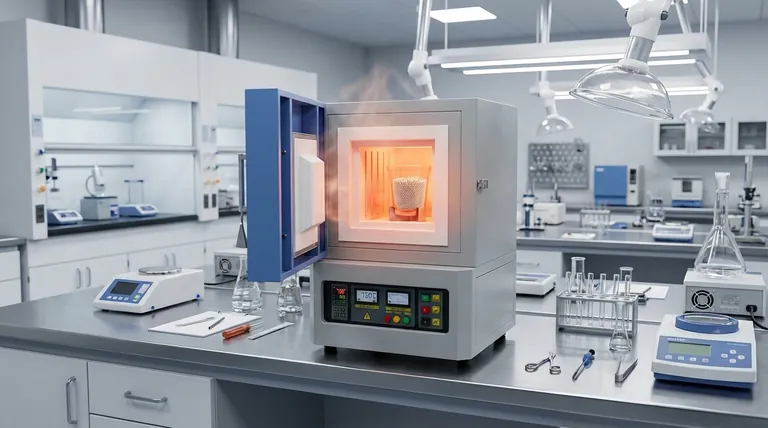
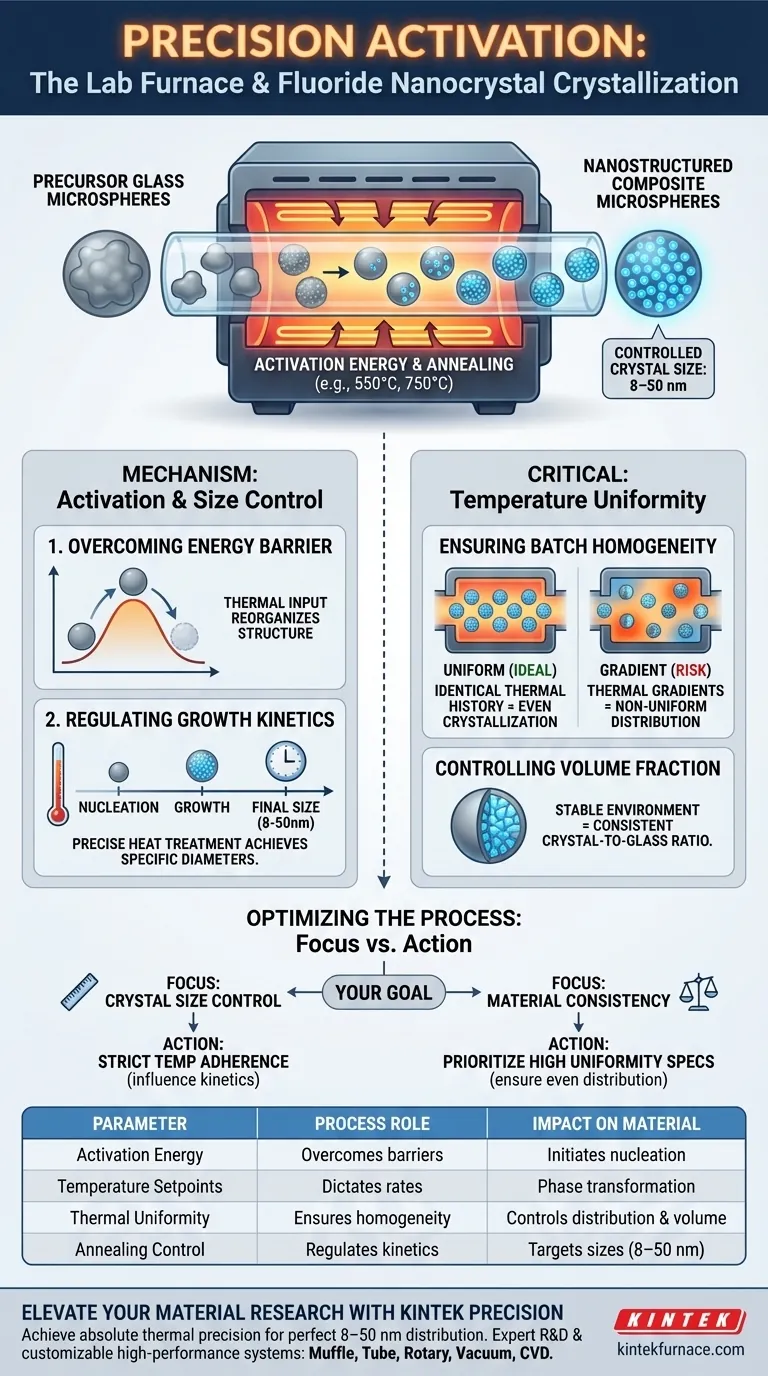
A laboratory heat treatment furnace serves as the precise activation chamber for transforming precursor glass microspheres into nanostructured materials. By maintaining exact constant-temperature environments—typically at set points such as 550°C or 750°C—the furnace supplies the necessary activation energy to trigger in-situ crystallization. This process converts the amorphous glass matrix into a composite structure embedded with fluoride nanocrystals.
The furnace is not merely a heater but a precision instrument that dictates material microstructure. Its ability to maintain strict thermal uniformity determines the volume, size, and distribution of nanocrystals, directly impacting the final optical and physical properties of the microspheres.
The Mechanism of In-Situ Crystallization
To understand the furnace's utility, one must look at how thermal energy drives the structural evolution of the glass.
Providing Activation Energy
The primary function of the furnace is to perform precise annealing.
By heating the precursor glass to specific temperatures, the furnace overcomes the thermodynamic energy barrier required for phase transformation.
This thermal input allows the glass structure to reorganize, initiating the nucleation process.
Regulating Crystal Size
The controlled environment is essential for managing the growth kinetics of the crystals.
Through regulated heat treatment, the process achieves specific nanocrystal diameters, typically ranging from 8 to 50 nm.
This size range is critical for maintaining the specific optical characteristics of the glass microspheres.
The Critical Role of Temperature Uniformity
While achieving the target temperature is necessary, how that temperature is distributed within the chamber is equally vital.
Ensuring Homogeneity
The temperature uniformity of the furnace chamber is the most significant variable in the process.
It ensures that every microsphere in the batch experiences the exact same thermal history.
Without this uniformity, crystallization would occur unevenly across the sample batch.
Controlling Volume Fraction
Precise heat distribution dictates the volume fraction of the crystals within the glass matrix.
A stable thermal environment ensures that the ratio of crystalline material to the remaining glass phase is consistent.
This consistency is required to produce microspheres with predictable performance characteristics.
Understanding the Trade-offs
Precise crystallization is a delicate balance, and equipment limitations can introduce significant errors.
The Risk of Thermal Gradients
If a furnace lacks high-grade temperature uniformity, it creates thermal gradients within the chamber.
This leads to a non-uniform distribution of nanocrystals, where some microspheres may be over-crystallized while others remain under-processed.
Such disparities result in a batch of microspheres with varying physical properties, rendering them unsuitable for high-precision applications.
Optimizing the Crystallization Process
To achieve the best results in your laboratory setting, consider how your specific goals align with furnace capabilities.
- If your primary focus is crystal size control: Strictly adhere to specific annealing temperatures (e.g., 550°C or 750°C) to influence growth kinetics and target the 8-50 nm range.
- If your primary focus is material consistency: Prioritize furnace specifications that guarantee high temperature uniformity to ensure an even distribution and volume fraction of nanocrystals.
Ultimately, the precision of your thermal equipment defines the structural integrity and uniformity of your final glass microspheres.
Summary Table:
| Parameter | Process Role | Impact on Material |
|---|---|---|
| Activation Energy | Overcomes thermodynamic barriers | Initiates nucleation in amorphous matrix |
| Temperature Setpoints | Typically 550°C to 750°C | Dictates phase transformation rates |
| Thermal Uniformity | Ensures batch homogeneity | Controls crystal distribution and volume fraction |
| Annealing Control | Regulates growth kinetics | Targets specific nanocrystal sizes (8–50 nm) |
Elevate Your Material Research with KINTEK Precision
Achieving the perfect 8–50 nm nanocrystal distribution requires more than just heat—it demands absolute thermal precision. Backed by expert R&D and manufacturing, KINTEK offers high-performance Muffle, Tube, Rotary, Vacuum, and CVD systems, all customizable for your unique lab requirements.
Whether you are refining fluoride nanocrystals or developing advanced nanostructured materials, our high-temperature furnaces provide the uniformity and control essential for predictable results. Contact us today to discuss your specific heat treatment needs and let our experts help you design the ideal furnace solution.
Visual Guide
References
- Zhigang Gao, Guoping Dong. Robust low threshold full-color upconversion lasing in rare-earth activated nanocrystal-in-glass microcavity. DOI: 10.1038/s41377-024-01671-3
This article is also based on technical information from Kintek Furnace Knowledge Base .
Related Products
- Small Vacuum Heat Treat and Tungsten Wire Sintering Furnace
- Laboratory Quartz Tube Furnace RTP Heating Tubular Furnace
- Vacuum Heat Treat Furnace with Ceramic Fiber Liner
- 2200 ℃ Graphite Vacuum Heat Treat Furnace
- Laboratory Muffle Oven Furnace with Bottom Lifting
People Also Ask
- How does vacuum sintering improve dimensional tolerances? Achieve Uniform Shrinkage and Precision
- What are the key components of a vacuum sintering furnace? Essential Parts for Precision Material Processing
- What is the purpose of setting a mid-temperature dwell stage? Eliminate Defects in Vacuum Sintering
- What are the main structural components of a vacuum sintering furnace? Unlock Precision in High-Temperature Processing
- What are the main types of sintering furnaces? Find the Perfect Match for Your Materials



















