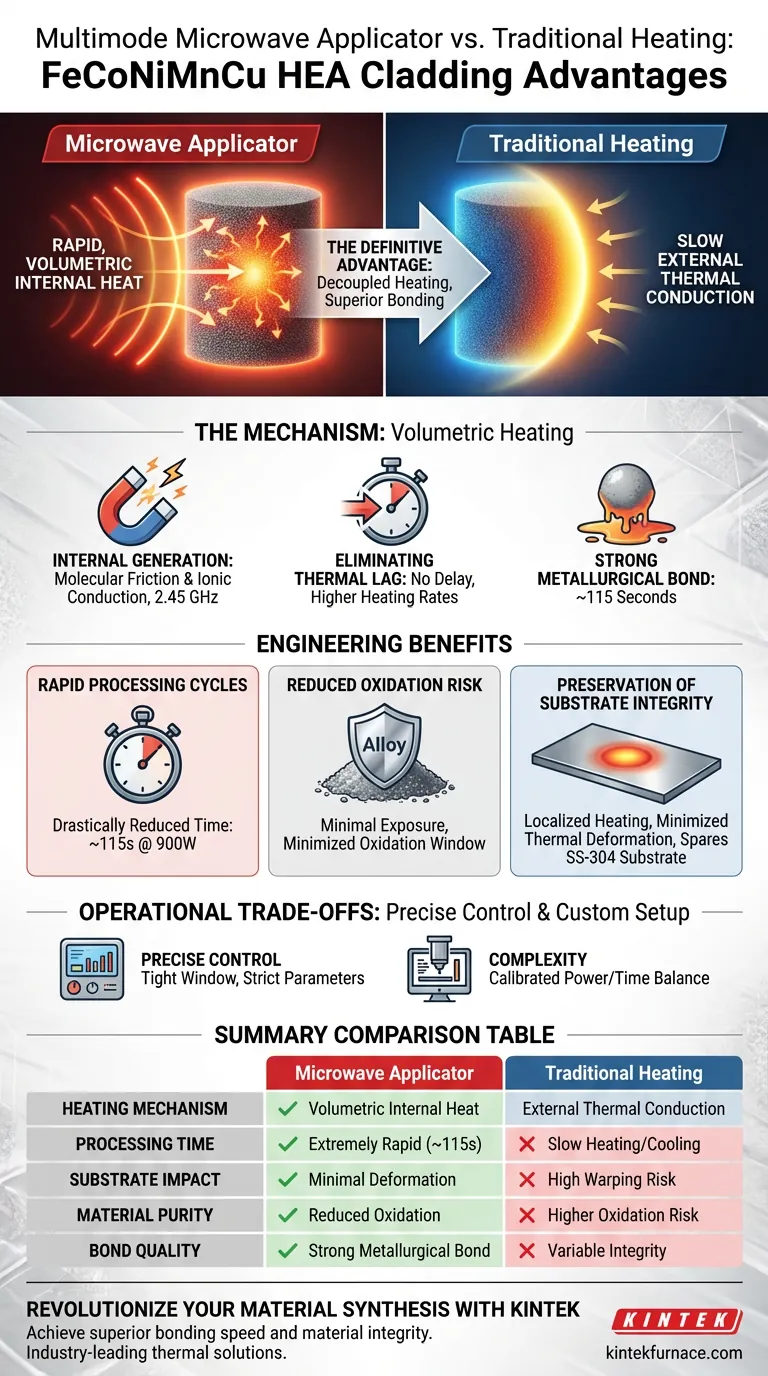
The definitive advantage of using a multimode microwave applicator is the generation of rapid, volumetric internal heat within the alloy material. Unlike traditional methods that rely on slow external thermal conduction, this technique utilizes electromagnetic waves to induce localized melting in the FeCoNiMnCu powder. This achieves a strong metallurgical bond in approximately 115 seconds while protecting the underlying substrate from excessive thermal deformation.
By shifting from external heat transfer to internal heat generation, microwave processing decouples the melting of the cladding from the heating of the substrate. This results in superior bonding speed and material integrity that traditional furnaces cannot match.
The Mechanism of Volumetric Heating
Internal Heat Generation
Traditional heating heats the outside of a material and waits for thermal energy to conduct inward. A multimode microwave applicator, operating at 2.45 GHz, reverses this process.
Molecular Friction and Ionic Conduction
The microwave energy acts directly on the High-Entropy Alloy (HEA) particles. Heat is generated internally through molecular friction and ionic conduction.
Eliminating Thermal Lag
Because the heat is generated within the material itself, there is no delay caused by thermal conductivity. This allows for significantly higher heating rates compared to conventional external heating sources.
Engineering Benefits for HEA Cladding
Rapid Processing Cycles
The efficiency of volumetric heating drastically reduces processing time. In this specific application, the cladding process requires only a short exposure duration of 115 seconds at 900W.
Reduced Oxidation Risk
Extended exposure to high temperatures in traditional furnaces often leads to material oxidation. The extreme speed of microwave heating significantly shortens the experimental cycle, thereby minimizing the window of opportunity for oxidation to occur.
Preservation of Substrate Integrity
A critical challenge in cladding is bonding the alloy without warping the base material. Microwave heating offers high selectivity, focusing energy on the powder.
Minimized Thermal Deformation
This localized heating ensures the FeCoNiMnCu powder melts to form a bond, but the SS-304 substrate is spared from prolonged thermal stress. This results in minimal overall deformation of the substrate.
Understanding the Operational Trade-offs
The Necessity of Precise Control
The speed of microwave heating is its greatest asset, but it also reduces the margin for error. With a processing window as tight as 115 seconds, parameters must be strictly controlled.
Complexity of Equipment
Unlike a standard furnace, these results rely on a "customized" applicator setup. Achieving the specific localized melting without overheating requires a calibrated balance of power (900W) and exposure time.
Making the Right Choice for Your Goal
While traditional heating is simple, microwave applicators offer precision and speed for advanced alloy synthesis.
- If your primary focus is Process Efficiency: Utilize microwave heating to reduce total processing times by potentially more than 90% compared to conventional thermal cycles.
- If your primary focus is Part Integrity: Choose this method to achieve a strong metallurgical bond while maintaining the dimensional accuracy of the substrate.
- If your primary focus is Material Purity: Leverage the rapid heating rates to reduce the risk of oxidation and avoid the need for expensive vacuum systems.
Microwave applicators transform cladding from a slow, thermal-stress-intensive process into a rapid, precise engineering solution.
Summary Table:
| Feature | Microwave Applicator (Multimode) | Traditional Heating Methods |
|---|---|---|
| Heating Mechanism | Volumetric internal heat (Molecular friction) | External thermal conduction |
| Processing Time | Extremely rapid (~115 seconds) | Slow heating/cooling cycles |
| Substrate Impact | Minimal thermal deformation; localized heating | High risk of warping/thermal stress |
| Material Purity | Reduced oxidation risk due to speed | Higher oxidation risk from long exposure |
| Bond Quality | Strong metallurgical bond | Variable bond integrity |
Revolutionize Your Material Synthesis with KINTEK
Are you looking to achieve superior bonding speed and material integrity for high-entropy alloys? KINTEK provides industry-leading thermal solutions backed by expert R&D and precision manufacturing.
Whether you need Muffle, Tube, Rotary, Vacuum, or CVD systems, our high-temperature lab furnaces are fully customizable to meet your unique research and production needs. Enhance your laboratory's efficiency and preserve substrate integrity with our advanced heating technologies.
Contact KINTEK today to discuss your custom furnace requirements!
Visual Guide
References
- Shubham Sharma, Emad A. A. Ismail. Investigation of surface hardness, thermostability, tribo-corrosion, and microstructural morphological properties of microwave-synthesized high entropy alloy FeCoNiMnCu coating claddings on steel. DOI: 10.1038/s41598-024-55331-y
This article is also based on technical information from Kintek Furnace Knowledge Base .
Related Products
- 915MHz MPCVD Diamond Machine Microwave Plasma Chemical Vapor Deposition System Reactor
- MPCVD Machine System Reactor Bell-jar Resonator for Lab and Diamond Growth
People Also Ask
- What is the MPCVD method and why is it considered effective for diamond deposition? Superior Purity & High Growth Rates
- What factors influence the quality of diamond deposition in the MPCVD method? Master the Critical Parameters for High-Quality Diamond Growth
- What are some key features and benefits of the microwave plasma chemical vapor deposition system? Achieve Unmatched Material Synthesis
- What is the purpose of a microwave plasma chemical vapor deposition system? Grow High-Purity Diamonds and Advanced Materials
- What is the basic principle of operation for the microwave plasma chemical vapor deposition system? Unlock High-Purity Material Growth