
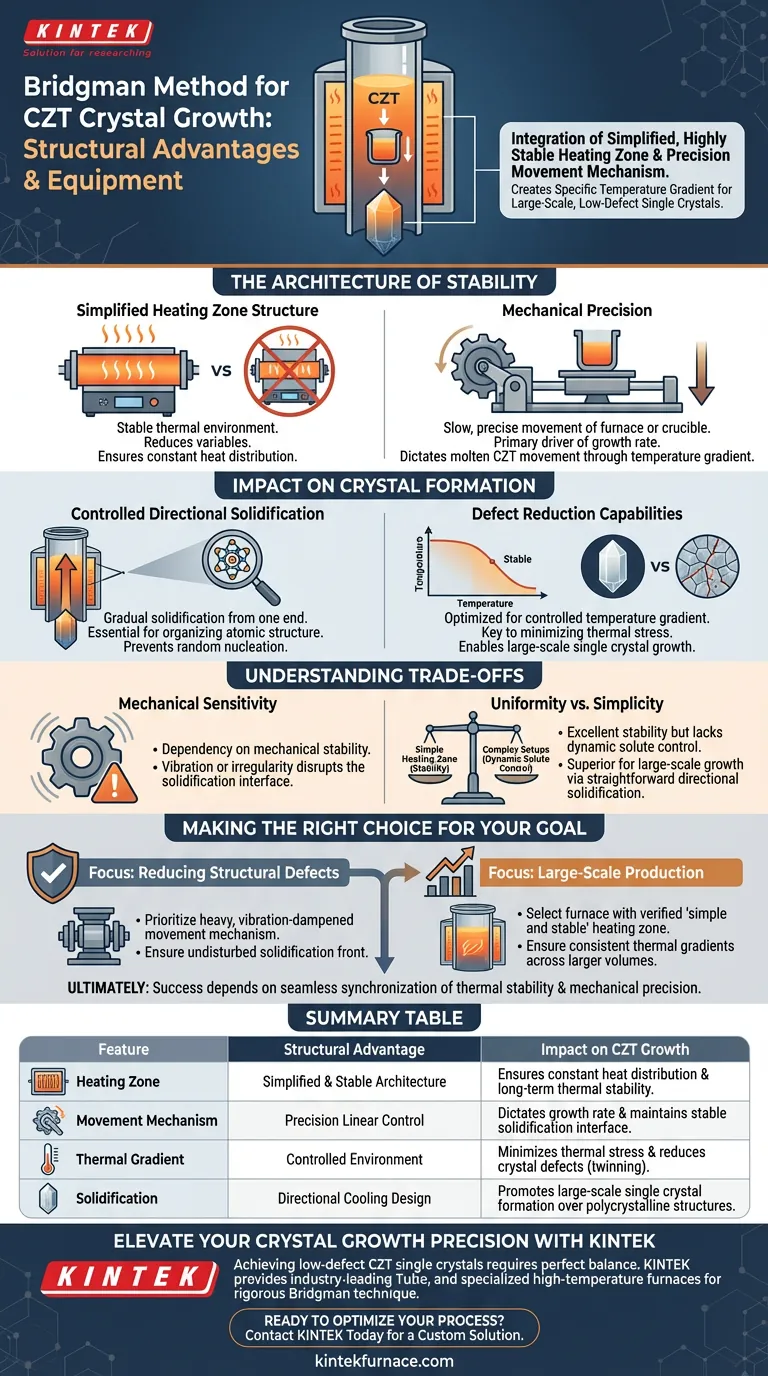
The primary structural advantage of specialized crystal growth furnaces used for the Bridgman Method lies in the integration of a simplified, highly stable heating zone with a precision movement mechanism. These furnaces rely on a fundamental design architecture that prioritizes thermal stability and mechanical control to manage the solidification interface.
By maintaining a stable heating zone and precisely controlling the relative motion of the furnace or crucible, this equipment creates the specific temperature gradient required to transform polycrystalline raw materials into large-scale, low-defect single crystals.
The Architecture of Stability
Simplified Heating Zone Structure
Unlike more complex growth methods that require intricate multi-zone modulation, Bridgman furnaces utilize a simple and stable heating zone. This structural simplicity reduces the number of variables affecting the thermal environment. It ensures that the heat distribution remains constant throughout the long duration of the growth cycle.
Mechanical Precision
The structural design incorporates a mechanism for the slow, precise movement of either the furnace body or the crucible itself. This mechanical feature is not merely for transport; it is the primary driver of the growth rate. It dictates exactly how fast the molten Cadmium Zinc Telluride (CZT) moves through the temperature gradient.
Impact on Crystal Formation
Controlled Directional Solidification
The interaction between the stable heating structure and the moving component forces the raw material to solidify gradually from one end. This directional cooling is essential for organizing the atomic structure of the crystal. It prevents the random nucleation that characterizes polycrystalline materials.
Defect Reduction Capabilities
The equipment is structurally optimized to maintain a controlled temperature gradient environment. This specific physical condition is the key factor in minimizing thermal stress during solidification. By stabilizing this gradient, the furnace structure directly contributes to reducing crystal defects and enabling the growth of large-scale single crystals.
Understanding the Trade-offs
Mechanical Sensitivity
While the heating structure is simple, the reliance on physical movement introduces a dependency on mechanical stability. Any vibration or irregularity in the movement mechanism (of the crucible or furnace body) can disrupt the solidification interface.
Uniformity vs. Simplicity
The Bridgman furnace's simple heating zone is excellent for stability, but it may lack the dynamic solute control found in more complex setups like the Traveling Heater Method (THM). While Bridgman is superior for creating large-scale crystals via straightforward directional solidification, it relies heavily on the initial quality of the polycrystalline raw material.
Making the Right Choice for Your Goal
To maximize the effectiveness of the Bridgman Method for CZT growth, align your equipment choice with your specific quality targets.
- If your primary focus is reducing structural defects: Prioritize a furnace design with a heavy, vibration-dampened movement mechanism to ensure the solidification front remains undisturbed.
- If your primary focus is large-scale production: Select a furnace with a verified "simple and stable" heating zone architecture to ensure consistent thermal gradients across larger volumes.
Ultimately, the success of the Bridgman Method depends not on thermal complexity, but on the seamless synchronization of thermal stability and mechanical precision.
Summary Table:
| Feature | Structural Advantage | Impact on CZT Growth |
|---|---|---|
| Heating Zone | Simplified & Stable Architecture | Ensures constant heat distribution and long-term thermal stability. |
| Movement Mechanism | Precision Linear Control | Dictates growth rate and maintains a stable solidification interface. |
| Thermal Gradient | Controlled Environment | Minimizes thermal stress and reduces crystal defects like twinning. |
| Solidification | Directional Cooling Design | Promotes large-scale single crystal formation over polycrystalline structures. |
Elevate Your Crystal Growth Precision with KINTEK
Achieving low-defect CZT single crystals requires a perfect balance of thermal stability and mechanical control. KINTEK provides industry-leading Tube and specialized high-temperature furnaces designed specifically for rigorous growth methods like the Bridgman technique.
Backed by expert R&D and precision manufacturing, our systems offer the vibration-dampened movement and stable thermal gradients necessary to maximize your yield. Whether you need standard or fully customizable vacuum and CVD systems, KINTEK empowers your lab with the tools for excellence.
Ready to optimize your directional solidification process? Contact KINTEK today for a custom solution.
Visual Guide
References
- Z. J. Li, Zeqian Wu. Research on the Technological Progress of CZT Array Detectors. DOI: 10.3390/s24030725
This article is also based on technical information from Kintek Furnace Knowledge Base .
Related Products
- Laboratory Quartz Tube Furnace RTP Heating Tubular Furnace
- Chairside Dental Porcelain Zirconia Sintering Furnace with Transformer for Ceramic Restorations
- Multi Zone Laboratory Quartz Tube Furnace Tubular Furnace
- Vertical Laboratory Quartz Tube Furnace Tubular Furnace
- Dental Porcelain Zirconia Sintering Ceramic Vacuum Press Furnace
People Also Ask
- What physical conditions does a laboratory Tube Furnace provide for SOEC? Precision Heat for Solid Oxide Characterization
- What are the main features and functions of a laboratory tube furnace? Unlock Precise High-Temp Control for Your Lab
- What conditions do tube furnaces provide for Au-Seeded TiO2 nanowires? Master Precision Thermal Synthesis
- What parameters must be controlled when calcining freeze-dried oxide precursors in a laboratory tube furnace? A Guide
- What role does a laboratory tube furnace play in geological and mineralogical research? Unlock Earth's Secrets with Precision








