
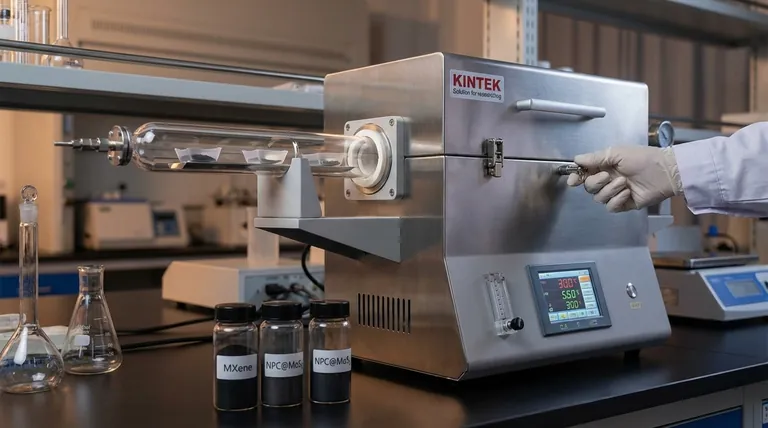
A vacuum drying oven is indispensable for processing MXene solutions and NPC@MoS2 nanostructures because it creates a controlled, low-pressure environment that fundamentally alters how solvents evaporate. This process allows water or ethanol to be removed rapidly at significantly reduced temperatures, preventing thermal damage while simultaneously eliminating oxygen to shield these sensitive materials from chemical degradation.
Core Takeaway Processing oxygen-sensitive nanomaterials requires a drying method that balances speed with chemical protection. Vacuum drying lowers the boiling point of solvents, enabling efficient evaporation without the high heat or oxygen exposure that destroys the electrochemical activity and surface structure of MXene and NPC@MoS2.
The Mechanism: Pressure and Temperature
The primary function of a vacuum oven is to manipulate the physical properties of the solvents used in your solution.
Lowering Solvent Boiling Points
By reducing the environmental pressure within the chamber, the vacuum oven significantly lowers the boiling point of solvents like water, ethanol, or methanol.
Enabling Low-Temperature Evaporation
This pressure reduction allows solvents to evaporate quickly at temperatures far below their standard boiling points. You can achieve thorough drying at safe temperatures (e.g., 60°C to 100°C) without subjecting the material to the thermal stress required for atmospheric drying.
Protecting Chemical Integrity
For materials like MXene and NPC@MoS2, the chemical composition of the surface is directly tied to performance.
Preventing Oxidation
MXene nanosheets and NPC@MoS2 are highly oxygen-sensitive. In a standard oven, high temperatures combined with atmospheric oxygen would lead to rapid oxidative degradation. The vacuum environment effectively removes oxygen from the chamber, neutralizing this threat.
Preserving Electrochemical Activity
Oxidation destroys the conductive network and surface functional groups that give these materials their utility. By maintaining an oxygen-free environment during drying, you preserve the material's electrochemical activity and ensure the stability of its functional groups.
Preserving Nanostructure and Morphology
Beyond chemical protection, vacuum drying is critical for maintaining the physical architecture of nanostructures.
preventing Pore Collapse
Nanostructures often rely on complex pore networks for ion transport. High-temperature atmospheric drying can cause these structures to collapse or pores to become blocked. Vacuum drying removes solvent molecules from deep within the pores gently, preventing structural collapse and maintaining a high specific surface area.
Enhancing Adhesion and Uniformity
The vacuum process facilitates the uniform removal of solvents. This allows MXene layers to adhere firmly and evenly to substrates (such as carbon fibers), ensuring a robust conductive network rather than a patchy, agglomerated coating.
Understanding the Trade-offs
While vacuum drying is superior for these materials, it requires precise process control to avoid distinct pitfalls.
Risk of Agglomeration via Capillary Forces
While vacuum drying generally prevents collapse, extremely rapid evaporation can sometimes generate strong capillary forces. If the pressure drops too suddenly, it may force nanomaterials to aggregate or agglomerate, potentially reducing the active surface area.
Equipment Contamination
The vacuum environment is a closed system. If the vacuum pump allows oil backstreaming, or if the oven is not perfectly clean, contaminants can be drawn into the porous nanostructures, permanently altering their chemical properties.
Making the Right Choice for Your Goal
To maximize the benefits of vacuum drying for your specific application, consider these focused recommendations:
- If your primary focus is Electrochemical Performance: Prioritize deep vacuum levels to ensure total oxygen removal, preserving the conductive network of MXene layers.
- If your primary focus is Structural Morphology: Use a moderate temperature setting (e.g., 60°C) combined with vacuum to prevent the collapse of hollow or porous nanostructures like NPC@MoS2.
The vacuum drying oven is not just a drying tool; it is a preservation chamber that locks in the chemical and structural properties essential for advanced nanomaterial performance.
Summary Table:
| Feature | Impact on MXene & NPC@MoS2 Processing |
|---|---|
| Reduced Pressure | Lowers solvent boiling points, enabling low-temperature evaporation. |
| Oxygen-Free Environment | Prevents oxidative degradation of sensitive nanomaterial surfaces. |
| Gentle Solvent Removal | Protects pore networks from collapse and maintains high surface area. |
| Controlled Environment | Ensures uniform adhesion and preserves electrochemical activity. |
| Thermal Protection | Eliminates high-heat stress that can damage sensitive functional groups. |
Elevate Your Nanomaterial Research with KINTEK
Precision is non-negotiable when processing sensitive materials like MXene and NPC@MoS2. Backed by expert R&D and manufacturing, KINTEK offers high-performance vacuum drying ovens and specialized lab high-temp furnaces—including Muffle, Tube, Rotary, and CVD systems—all customizable for your unique research needs.
Don't compromise your chemical integrity. Contact us today to discover how our advanced heating solutions can optimize your lab's workflow and preserve your material performance!
References
- Hanqing Pan, Lei Zhang. Hollow Carbon and MXene Dual‐Reinforced MoS<sub>2</sub> with Enlarged Interlayers for High‐Rate and High‐Capacity Sodium Storage Systems. DOI: 10.1002/advs.202400364
This article is also based on technical information from Kintek Furnace Knowledge Base .
Related Products
- Vacuum Heat Treat Sintering and Brazing Furnace
- Vacuum Heat Treat Sintering Furnace Molybdenum Wire Vacuum Sintering Furnace
- Dental Porcelain Zirconia Sintering Ceramic Vacuum Press Furnace
- Molybdenum Vacuum Heat Treat Furnace
- Vacuum Hot Press Furnace Machine Heated Vacuum Press
People Also Ask
- What are the benefits of using vacuum heat treating furnaces for metal alloys? Achieve Superior Metal Properties and Performance
- How does vacuum heat treating affect the grain structure of metal alloys? Achieve Precise Microstructure Control
- What is one of the most important uses of vacuum heat treating furnaces in aerospace? Achieve Superior Strength in Aircraft Alloys
- What is the temperature of a vacuum furnace brazing? Optimize Your Joint Strength and Cleanliness
- What are the steps involved in a typical vacuum brazing treatment? Master the Process for Strong, Clean Joints












