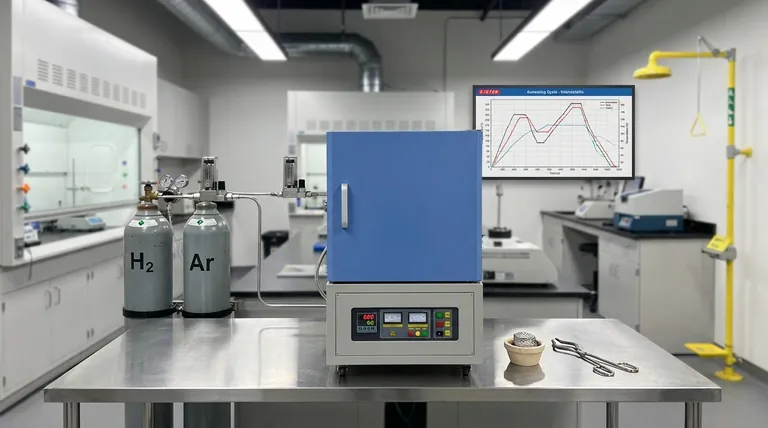
Precision is the catalyst for structural order. A high-precision programmed heating furnace is non-negotiable for annealing intermetallic compounds because it executes the complex temperature curves required to transition metals from a random alloy state to an ordered intermetallic structure. This specific control balances the kinetic energy needed for atomic rearrangement against the risk of destroying the material's active surface area through overheating.
The transformation requires a delicate thermal balance: enough energy to reorganize atoms, but not enough to fuse particles together. High-precision furnaces provide the exact programmable environments necessary to maintain this equilibrium, ensuring the final material retains the high specific surface area required for effective catalysis.
The Mechanics of Structural Transformation
From Random to Ordered
The creation of intermetallic compounds is not a simple heating process; it is a structural reorganization. Raw alloys often exist in a random state, where atoms are disordered. Programmed heating allows you to configure complex temperature curves and constant-temperature durations to guide these atoms into a specific, ordered intermetallic structure.
Managing Kinetic Energy
To achieve this order, atoms require mobility. Precise temperature control provides the necessary kinetic energy for atoms to migrate and find their correct lattice positions. Without this specific energy input, the transition to the desired ordered phase will remain incomplete.
Preserving Material Integrity
Preventing Sintering and Agglomeration
There is a fine line between mobilizing atoms and melting them together. Excessive heat causes metal particles to sinter or agglomerate, drastically reducing the material's surface area. High-precision furnaces prevent these temperature overshoots, ensuring the particles remain distinct.
Protecting Active Sites
For catalytic applications, surface area is performance. By avoiding agglomeration, the furnace ensures the material maintains a high specific surface area. This preservation of structure guarantees that the active sites—where chemical reactions actually occur—remain clearly defined and accessible.
Advanced Control Features
Multi-Zone Thermal Stability
In advanced setups like tube furnaces, stability is achieved through multi-zone independent control. This creates a stable thermal field, ensuring uniform heating across the entire sample rather than localized hot spots. Consistency here prevents uneven phase transitions across the substrate.
Integrated Atmosphere Control
The reduction process often requires specific chemical environments, such as hydrogen gas. When integrated with flow control systems, these furnaces allow for the precise regulation of carrier gases. This enables accurate phase regulation of the intermetallic compounds alongside the thermal treatment.
Understanding the Trade-offs
Process Time vs. Throughput
High-precision programmed heating is inherently time-consuming. The requirement for complex ramp rates and soak times means the annealing cycle is significantly longer than simple bulk heating methods. You trade manufacturing speed for material quality and structural definition.
Calibration Sensitivity
The "high precision" aspect introduces strict maintenance requirements. To maintain the exact temperature curves required to prevent sintering, the equipment requires frequent calibration. Drift in thermal couples or flow controllers can lead to failed batches where the random-to-ordered transition is missed or the surface area is destroyed.
Optimizing Your Annealing Strategy
To achieve the best results with intermetallic compounds, align your furnace settings with your specific material goals:
- If your primary focus is Catalytic Activity: Prioritize strict upper-limit temperature control to prevent agglomeration and maximize specific surface area.
- If your primary focus is Phase Purity: Utilize extended soak times at transition temperatures to ensure complete atomic rearrangement into the ordered structure.
Precision in your thermal profile is the defining factor between a functional catalyst and a sintered block of metal.
Summary Table:
| Feature | Impact on Intermetallic Compounds | Key Benefit |
|---|---|---|
| Programmed Heating | Guides atoms from random to ordered states | Precise phase transition and structural purity |
| Temperature Stability | Balances kinetic energy without overheating | Prevents particle sintering and agglomeration |
| Atmosphere Control | Regulates carrier gas flow (e.g., Hydrogen) | Facilitates effective reduction and phase regulation |
| Multi-Zone Control | Eliminates localized hot spots | Ensures uniform heating across the entire sample |
| Thermal Precision | Preserves high specific surface area | Maximizes active sites for catalytic performance |
Elevate Your Material Research with KINTEK Precision
Precision is the defining factor between a functional catalyst and a sintered block of metal. At KINTEK, we understand the delicate thermal balance required for intermetallic structural transformation. Backed by expert R&D and world-class manufacturing, we provide high-performance Muffle, Tube, Rotary, Vacuum, and CVD systems—all fully customizable to meet your specific annealing and reduction requirements.
Don't compromise on your material integrity. Contact KINTEK today to discover how our advanced heating solutions can optimize your lab's efficiency and ensure perfect phase purity for your target customers.
References
- Zhiquan Hou, Hongxing Dai. Exploring Intermetallic Compounds: Properties and Applications in Catalysis. DOI: 10.3390/catal14080538
This article is also based on technical information from Kintek Furnace Knowledge Base .
Related Products
- Multi Heating Zones CVD Tube Furnace Machine for Chemical Vapor Deposition Equipment
- Laboratory Quartz Tube Furnace RTP Heating Tubular Furnace
- Split Multi Heating Zone Rotary Tube Furnace Rotating Tube Furnace
- Vacuum Heat Treat Furnace with Ceramic Fiber Liner
- 2200 ℃ Graphite Vacuum Heat Treat Furnace
People Also Ask
- What is the function of a multi-zone tube furnace in CVD synthesis? Master 2D In2Se3 Nanosheet Precision
- What role do multi zone tube furnaces play in new energy research? Unlock Precise Thermal Control for Innovation
- What temperature-related capabilities make multi zone tube furnaces valuable for research? Unlock Precision Thermal Control
- What environmental protection applications utilize multi zone tube furnaces? Unlock Precision in Waste Treatment and Green Tech
- Why are multi zone tube furnaces particularly useful for nanomaterial research? Unlock Precise Thermal Control for Advanced Synthesis