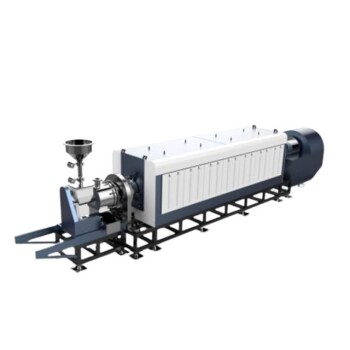
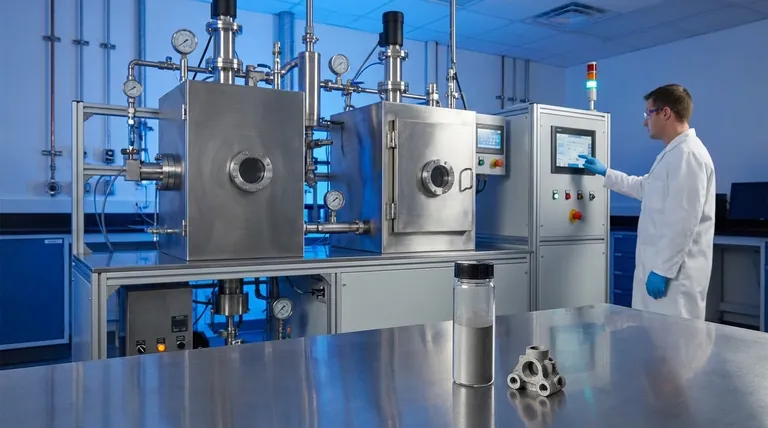
Ultrasonic spray pyrolysis is a precision manufacturing technique designed to overcome the limitations of traditional mechanical atomization. By utilizing ultrasonic waves to atomize precursor solutions into extremely fine droplets before reducing them in a furnace, this equipment provides a superior method for creating high-quality metal powders.
The core value of ultrasonic spray pyrolysis lies in its precision control. It transforms liquid solutions into ultra-fine, highly spherical, and pure metal powders with a uniformity that is essential for modern, high-performance material applications.
The Mechanics of Quality
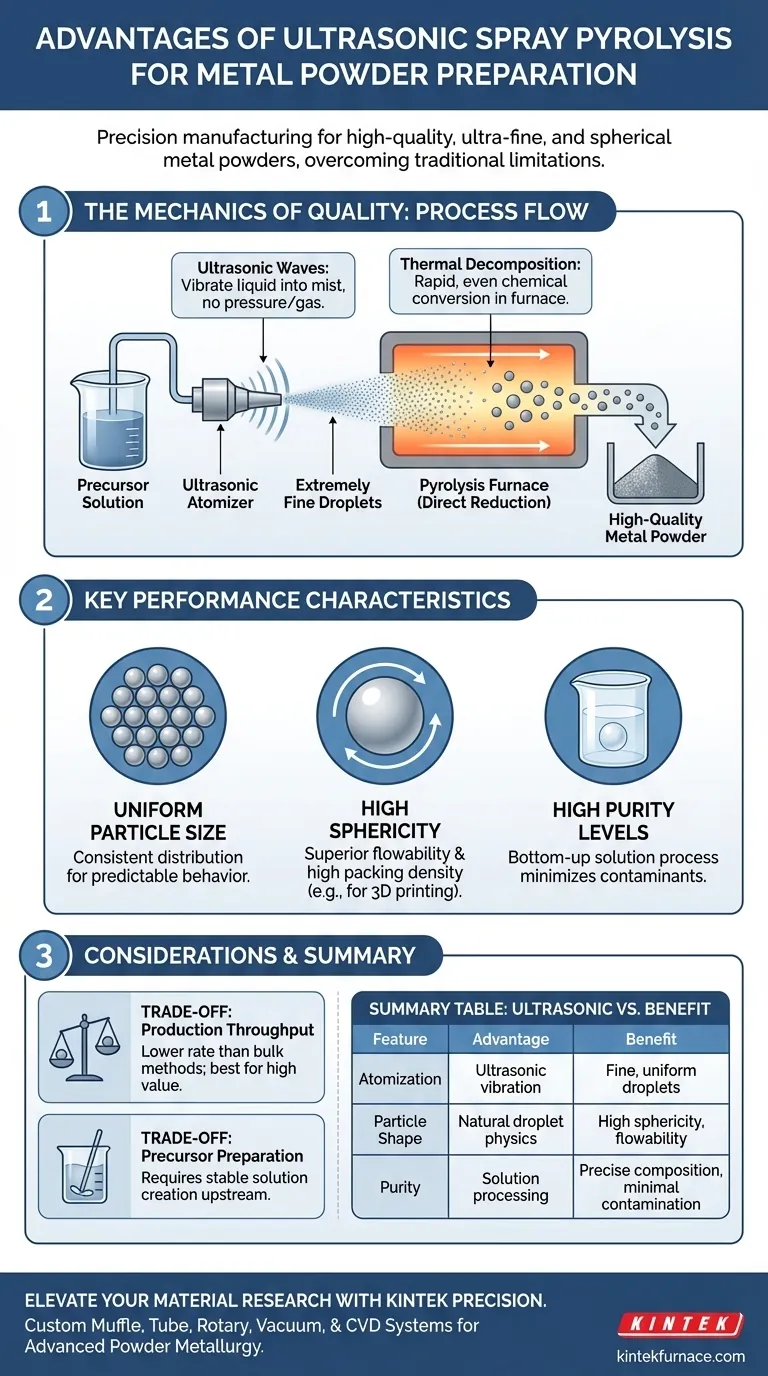
The Role of Ultrasonic Atomization
The fundamental advantage of this equipment is the use of ultrasonic waves rather than pressure or gas to break down fluids.
This mechanism vibrates the liquid precursor solution at specific frequencies.
The result is the generation of a mist composed of extremely fine droplets, which serves as the foundation for the final powder's quality.
Direct Reduction
Once atomized, these droplets are introduced directly into a pyrolysis furnace.
Here, the droplets undergo thermal decomposition and reduction.
Because the starting material is a fine mist, the chemical conversion happens rapidly and evenly throughout the droplet volume.
Key Performance Characteristics
Uniform Particle Size Distribution
One of the most critical challenges in powder metallurgy is achieving consistency.
Ultrasonic equipment produces droplets of a nearly identical size.
Consequently, the resulting metal or alloy powders exhibit a uniform particle size distribution, ensuring predictable behavior in final applications.
High Sphericity
The physics of droplet formation naturally favors a spherical shape.
This geometry is retained as the droplet dries and reacts in the furnace.
High sphericity improves the flowability of the powder and allows for higher packing density, which is vital for processes like 3D printing and sintering.
High Purity Levels
The process begins with a solution rather than a bulk solid, allowing for high control over chemical composition.
This "bottom-up" approach minimizes the introduction of foreign contaminants.
The result is high purity ultra-fine powder, meeting the strict standards required for advanced alloy development.
Understanding the Trade-offs
Production Throughput
While this method excels in quality, it is generally a solution-based process.
This often means the production rate (volume per hour) may be lower compared to coarse, bulk industrial atomization methods.
It is best reserved for high-value applications where quality trumps raw tonnage.
Precursor Preparation
The process relies on the ability to create a stable precursor solution.
Users must ensure their target metal or alloy can be dissolved effectively.
This adds a chemical preparation step upstream that is not present in melt-based atomization.
Aligning Technology with Production Goals
To determine if ultrasonic spray pyrolysis is the right solution for your facility, consider your specific material requirements.
- If your primary focus is High-Performance Materials: This equipment is ideal, as it delivers the purity and uniformity required for critical applications like aerospace or medical devices.
- If your primary focus is Powder Flowability: The high sphericity offered by this process provides excellent flow characteristics for additive manufacturing.
- If your primary focus is Alloy Complexity: The solution-based approach allows for precise mixing of elements at the molecular level before powder formation.
By prioritizing particle control over bulk volume, ultrasonic spray pyrolysis enables the creation of next-generation materials that standard methods simply cannot match.
Summary Table:
| Feature | Advantage of Ultrasonic Spray Pyrolysis | Benefit to Metal Powder |
|---|---|---|
| Atomization Method | Ultrasonic wave vibration (no pressure/gas) | Extremely fine, uniform droplet formation |
| Particle Shape | Natural droplet physics | High sphericity for superior flowability |
| Purity Level | Bottom-up solution processing | Minimal contamination and precise composition |
| Size Distribution | Consistent droplet frequency | Uniform particles for predictable sintering |
| Alloy Control | Molecular-level solution mixing | High precision for complex material development |
Elevate Your Material Research with KINTEK Precision
Unlock the full potential of advanced powder metallurgy with KINTEK’s high-performance laboratory solutions. Backed by expert R&D and world-class manufacturing, we offer specialized Muffle, Tube, Rotary, Vacuum, and CVD systems—all fully customizable to meet your unique ultrasonic spray pyrolysis and thermal processing needs.
Whether you are developing next-generation alloys for aerospace or optimizing powders for 3D printing, our team provides the technical expertise and equipment precision you require. Contact KINTEK today to discuss your custom furnace solution and see how we can bring unparalleled uniformity and purity to your production process.
Visual Guide
References
- Srečko Stopić. Feature Papers in Extractive Metallurgy. DOI: 10.3390/met15070751
This article is also based on technical information from Kintek Furnace Knowledge Base .
Related Products
- Electric Rotary Kiln Pyrolysis Furnace Plant Machine Small Rotary Kiln Calciner
- Electric Rotary Kiln Continuous Working Small Rotary Furnace Kiln for Pyrolysis Plant Heating
- Electric Rotary Kiln Small Rotary Furnace Biomass Pyrolysis Plant Rotating Furnace
- Custom Made Versatile CVD Tube Furnace Chemical Vapor Deposition CVD Equipment Machine
- Multi Heating Zones CVD Tube Furnace Machine for Chemical Vapor Deposition Equipment
People Also Ask
- What are the advantages of electric rotary kilns compared to fuel-fired ones? Boost Precision and Efficiency in Your Process
- What advantages do electric rotary kilns offer over fuel-based kilns? Boost Efficiency and Purity in Your Process
- What materials can be processed in an electric rotary kiln? Versatile Solutions for Advanced Materials
- What are the main applications of a rotary kiln electric furnace? Achieve Uniform Heat Treatment for Powders
- What are the key components of a rotary kiln electric furnace? Unlock Efficient Thermal Processing