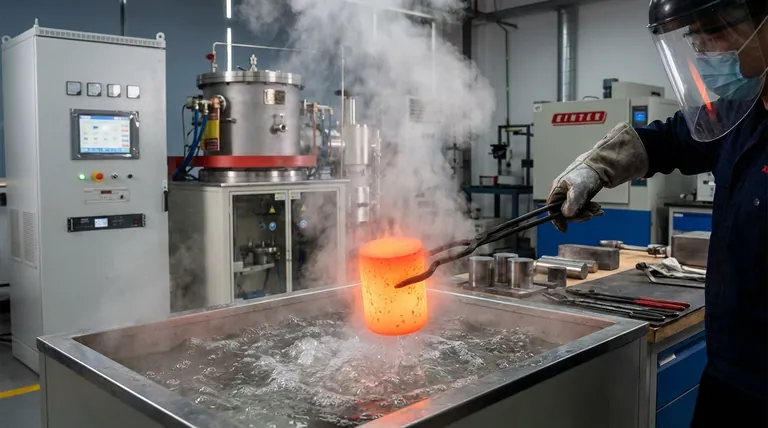
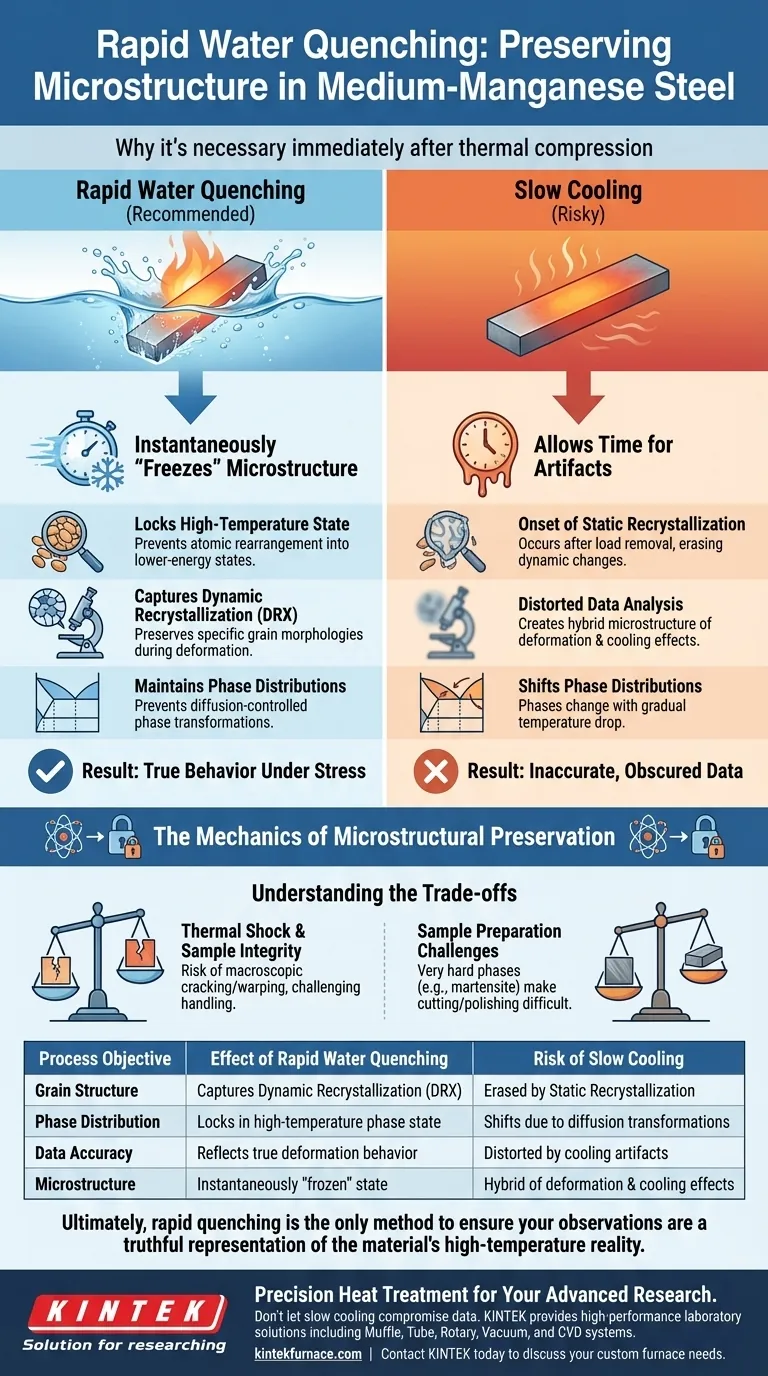
Rapid water quenching is strictly necessary to instantaneously "freeze" the microstructure of medium-manganese steel the moment thermal compression ends. By utilizing extremely high cooling rates, this process prevents the material from undergoing further changes that naturally occur during slower cooling, effectively capturing a snapshot of the high-temperature state.
Thermal compression induces transient changes in steel that are unstable once the physical load is removed. Rapid water quenching preserves the dynamic recrystallization grains and phase distributions as they existed during deformation, ensuring that subsequent analysis reflects the material's true behavior under stress rather than artifacts of the cooling process.
The Mechanics of Microstructural Preservation
Locking in the High-Temperature State
At the precise moment thermal compression concludes, the internal structure of medium-manganese steel is in a highly specific, transient state.
Rapid water quenching acts as a temporal lock. It drops the temperature so quickly that the atoms do not have the thermal energy required to rearrange themselves into a lower-energy, equilibrium state.
Capturing Dynamic Recrystallization
During hot deformation, the steel undergoes a process known as dynamic recrystallization (DRX). This results in specific grain morphologies that tell the story of how the material handled the stress.
If the material is allowed to cool slowly, these grains will change. Quenching ensures the grains observed under a microscope at room temperature look exactly as they did while the material was being compressed at high temperatures.
Maintaining Phase Distributions
Medium-manganese steel relies on complex phase distributions for its properties. These phases are temperature-dependent and will shift if the temperature drops gradually.
Quenching prevents these additional phase transformations. It ensures that the phase distribution you analyze is the one resulting from the compression process, not the cooling process.
The Risks of Slow Cooling
The Onset of Static Recrystallization
If the cooling rate is insufficient, the material immediately begins a process called static recrystallization. This occurs after the deformation load is removed but while the material is still hot.
This "static" change erases the evidence of the "dynamic" changes that occurred during compression. It obscures the data, making it impossible to isolate the effects of the thermal compression itself.
Distorted Data Analysis
The goal of thermal compression testing is often to understand the material's morphology during processing.
Slow cooling introduces a time-lag error. The microstructure observed at room temperature would be a hybrid of deformation effects and cooling effects, rendering the data inaccurate for determining high-temperature behavior.
Understanding the Trade-offs
Thermal Shock and Sample Integrity
While quenching is necessary for microstructural accuracy, the violence of the temperature drop induces significant thermal stress.
This thermal shock can occasionally lead to macroscopic cracking or warping of the sample. While this preserves the microstructure, it can make the physical handling and sectioning of the specimen more difficult.
Sample Preparation Challenges
Rapidly quenched medium-manganese steel often transforms into very hard phases, such as martensite, at room temperature.
This hardness makes the material difficult to cut, grind, and polish for microscopy. You gain data accuracy, but you trade away ease of sample preparation.
Ensuring Data Integrity in Your Experiments
To ensure your observations are valid, align your cooling strategy with your analytical goals:
- If your primary focus is dynamic behavior: You must quench immediately to capture dynamic recrystallization grains without the interference of static restoration.
- If your primary focus is phase mapping: Use rapid cooling to lock in the phase distributions present at the deformation temperature, preventing diffusion-controlled transformations.
Ultimately, rapid quenching is the only method to ensure that your room-temperature observations are a truthful representation of the material's high-temperature reality.
Summary Table:
| Process Objective | Effect of Rapid Water Quenching | Risk of Slow Cooling |
|---|---|---|
| Grain Structure | Captures Dynamic Recrystallization (DRX) | Erased by Static Recrystallization |
| Phase Distribution | Locks in high-temperature phase state | Shifts due to diffusion transformations |
| Data Accuracy | Reflects true deformation behavior | Distorted by cooling artifacts |
| Microstructure | Instantaneously "frozen" state | Hybrid of deformation and cooling effects |
Precision Heat Treatment for Your Advanced Research
Don't let slow cooling rates compromise your experimental data. KINTEK provides high-performance laboratory solutions—including Muffle, Tube, Rotary, Vacuum, and CVD systems—specifically designed to meet the rigorous demands of thermal processing and material characterization.
Backed by expert R&D and manufacturing, our systems are fully customizable to handle the unique thermal profiles required for medium-manganese steel and other advanced alloys. Ensure microstructural integrity with equipment built for accuracy.
Contact KINTEK today to discuss your custom furnace needs
Visual Guide
References
- Guangshun Guo, Fucheng Zhang. Effects of C and Al Alloying on Constitutive Model Parameters and Hot Deformation Behavior of Medium-Mn Steels. DOI: 10.3390/ma17030732
This article is also based on technical information from Kintek Furnace Knowledge Base .
Related Products
- HFCVD Machine System Equipment for Drawing Die Nano Diamond Coating
- High Performance Vacuum Bellows for Efficient Connection and Stable Vacuum in Systems
- Custom Made Versatile CVD Tube Furnace Chemical Vapor Deposition CVD Equipment Machine
People Also Ask
- What is Hot-filament Chemical Vapor Deposition (HFCVD)? Achieve High-Quality Thin Films with Precision Control
- What are the equipment for chemical vapor deposition? A Guide to the 5 Essential Components
- What is the significance of the vacuum pressure control system in the CVD coating process for powders?
- What is the function of high-purity Argon (Ar) gas during CVD? Optimize Your Thin Film Uniformity and Purity
- What are the advantages of using Chemical Vapor Deposition (CVD) for coating turbine blades? Enhance Life & Performance