
Rapid quenching serves as a microstructural lock. By plunging the AlSi10Mg alloy into a cold medium (typically ice water) immediately after high-temperature heat treatment, the process utilizes a massive temperature differential to instantaneously freeze the state of the aluminum matrix.
The primary function of quenching AlSi10Mg is to inhibit the natural tendency of silicon particles to grow. It prevents the excessive coarsening of eutectic silicon that inevitably occurs during slow cooling, ensuring the material retains a specific, fine-grained distribution of the silicon phase.
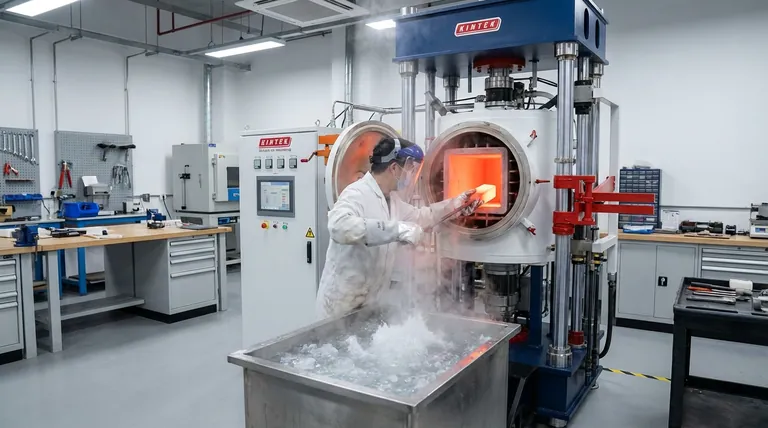
The Mechanism of Microstructural Freezing
Utilizing Temperature Differentials
The process relies on a drastic difference in temperature between the heat-treated alloy (often at 300°C or 400°C) and the quenching medium.
This massive differential forces the material to cool at a rate significantly faster than natural convection would allow.
Instantaneous State Preservation
The objective is to "freeze" the microstructure in its high-temperature state.
By dropping the temperature almost instantly, the atomic diffusion required for microstructural changes is halted before those changes can progress.
Controlling the Silicon Phase
Inhibiting Particle Aggregation
In AlSi10Mg alloys, silicon particles naturally tend to aggregate and clump together when heat is applied over time.
Rapid quenching interrupts this physical process, stopping large-scale aggregation before it can compromise the material's structure.
Preventing Eutectic Coarsening
Without quenching, the eutectic silicon within the alloy would undergo "coarsening," where small particles dissolve and redeposit onto larger ones.
Quenching prevents this growth, maintaining a finer, more uniform silicon structure.
Maintaining Distribution
The ultimate goal of this thermal shock is to preserve the dispersion of the silicon phase.
A well-dispersed silicon phase is critical for maintaining the specific mechanical properties intended by the heat treatment.
Common Pitfalls: The Cost of Slow Cooling
The Consequence of Inadequate Cooling Rates
The primary trade-off in this process involves the cooling speed; if the cooling rate is not sufficiently rapid, the "freezing" effect fails.
Slow cooling allows time for diffusion, leading to the very issue quenching aims to solve: excessive coarsening of the microstructure.
Loss of Microstructural Control
If the temperature drop is gradual, the silicon particles will disperse and aggregate in an uncontrolled manner.
This results in a microstructural state that deviates from the desired distribution, potentially altering the alloy's final performance characteristics.
Making the Right Choice for Your Goal
To optimize the processing of AlSi10Mg, you must align your cooling strategy with your microstructural targets.
- If your primary focus is preventing silicon growth: You must utilize rapid quenching to instantly halt the diffusion processes that lead to particle coarsening.
- If your primary focus is maintaining specific phase distribution: You should avoid slow cooling methods, as they permit the large-scale aggregation of silicon particles.
Control the cooling rate, and you effectively control the final architecture of the alloy.
Summary Table:
| Process Aspect | Mechanism / Function | Impact on Microstructure |
|---|---|---|
| Temperature Drop | Massive differential (ice water) | Instantaneous state preservation |
| Silicon Control | Inhibits particle aggregation | Prevents eutectic coarsening |
| Diffusion | Halts atomic movement | Stops growth of large particles |
| Cooling Rate | High-velocity thermal shock | Maintains fine-grained distribution |
Optimize Your AlSi10Mg Heat Treatment with KINTEK
Precise microstructural control demands high-performance equipment. Backed by expert R&D and manufacturing, KINTEK offers a wide range of lab high-temp furnaces—including Muffle, Tube, Rotary, Vacuum, and CVD systems—all fully customizable to meet your unique metallurgical needs.
Whether you are refining silicon distribution or seeking the perfect quenching cycle, our technical experts are here to help you achieve consistent, high-quality results. Contact us today to find your custom furnace solution!
References
- Busisiwe J. Mfusi, Ntombi Mathe. Optimisation of the Heat Treatment Profile for Powder-Bed Fusion Built AlSi10Mg by Age Hardening and Ice-Water Quenching. DOI: 10.3390/met14030292
This article is also based on technical information from Kintek Furnace Knowledge Base .
Related Products
- Laboratory Quartz Tube Furnace RTP Heating Tubular Furnace
- Spark Plasma Sintering SPS Furnace
- Vacuum Heat Treat Sintering and Brazing Furnace
- Vacuum Heat Treat Sintering Furnace with Pressure for Vacuum Sintering
- 9MPa Air Pressure Vacuum Heat Treat and Sintering Furnace
People Also Ask
- What physical conditions does a laboratory Tube Furnace provide for SOEC? Precision Heat for Solid Oxide Characterization
- What are the main features and functions of a laboratory tube furnace? Unlock Precise High-Temp Control for Your Lab
- What conditions does a tube furnace provide for post-ion-implantation? Achieve Precise Microstructural Repair
- Why is control of heating rate and gas flow in a lab tube furnace critical for EM wave absorption materials?
- What parameters must be controlled when calcining freeze-dried oxide precursors in a laboratory tube furnace? A Guide



















