
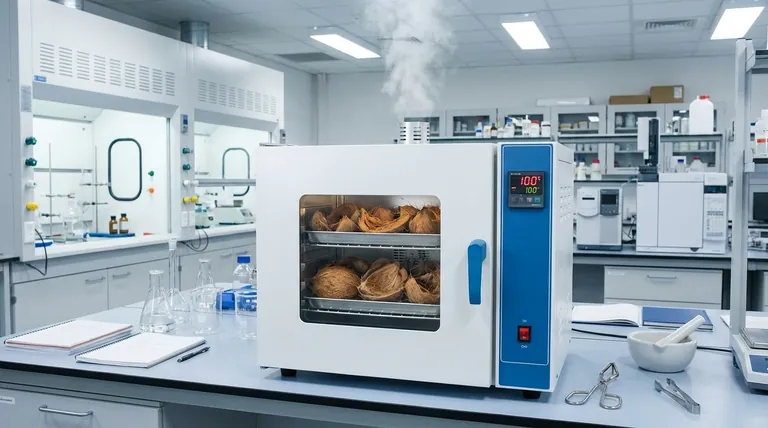
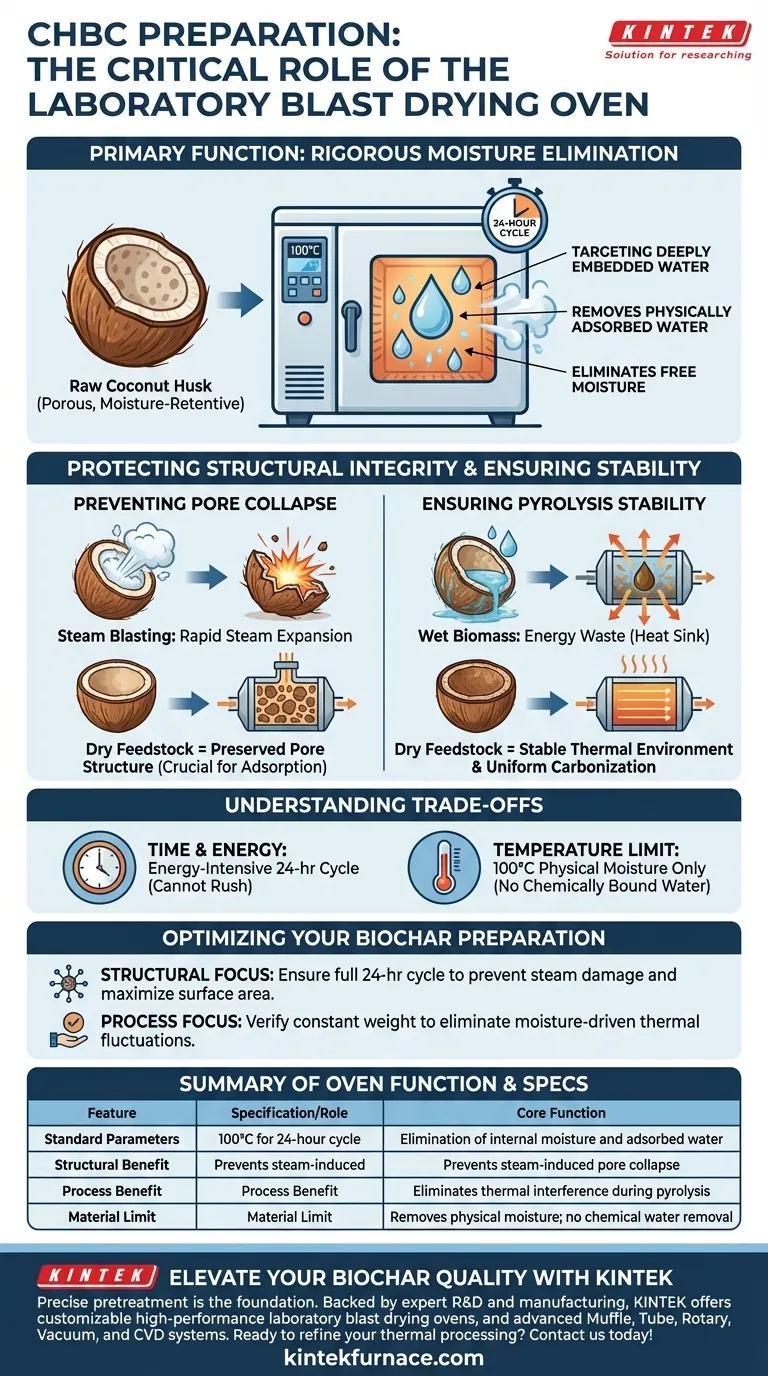
The primary function of a laboratory blast drying oven in this context is the rigorous elimination of internal moisture. specifically for Coconut Husk Biochar (CHBC), the oven is set to 100°C for a continuous 24-hour cycle to remove physically adsorbed water and free moisture. This step is a prerequisite for stabilizing the material before it undergoes high-temperature pyrolysis.
By removing moisture prior to carbonization, the blast drying oven prevents the rapid expansion of steam that causes irregular pore collapse. This ensures the physical structure of the biochar remains intact and the subsequent pyrolysis process proceeds without thermal interference.
The Critical Role of Moisture Removal
Targeting Deeply Embedded Water
Coconut husks are porous and retain significant amounts of water. The blast drying oven does not just dry the surface; it removes physically adsorbed water and free moisture trapped within the internal structure.
Specific Parameters for CHBC
For coconut husk biochar specifically, the protocol requires a precise temperature of 100°C maintained for 24 hours. This specific duration and heat level ensure complete drying without initiating premature thermal degradation of the biomass.
Protecting Structural Integrity
Preventing Pore Collapse
The most significant risk during pyrolysis is the rapid phase change of water into steam. If moisture remains in the husk, high temperatures cause this water to expand explosively within the material.
Avoiding "Steam Blasting"
This rapid release of steam can rupture the biochar's internal walls. By drying the material first, you prevent this irregular collapse, preserving the biochar pore structure required for high-quality adsorption applications.
Ensuring Pyrolysis Stability
Eliminating Thermal Interference
Moisture acts as a heat sink. If wet biomass enters the pyrolysis reactor, energy is wasted evaporating water rather than carbonizing the material.
Stabilizing the Reaction
Removing moisture eliminates its influence on the high-temperature pyrolysis process. This allows for a stable thermal environment and ensures the chemical changes occur uniformly throughout the batch.
Understanding the Trade-offs
Time and Energy Consumption
The 24-hour continuous drying cycle is energy-intensive and creates a bottleneck in production speed. You cannot rush this process; shortening the time poses a risk of incomplete drying.
Temperature Precision Limits
While effective for moisture, a standard blast drying oven operating at 100°C cannot remove chemically bound water (crystalline water). It is strictly limited to physical moisture removal; higher temperatures required for chemical dehydration would risk altering the feedstock's properties before pyrolysis begins.
Optimizing Your Biochar Preparation
To ensure consistent results, align your drying protocol with your specific research or production goals.
- If your primary focus is Structural Integrity: Ensure the full 24-hour cycle is completed to prevent steam-induced pore collapse and maximize surface area.
- If your primary focus is Process Stability: Verify the sample reaches constant weight to eliminate moisture-driven temperature fluctuations during pyrolysis.
This pretreatment step is the foundation of quality control, converting variable raw biomass into a consistent feedstock ready for carbonization.
Summary Table:
| Feature | Specification/Role in CHBC Preparation |
|---|---|
| Core Function | Elimination of internal moisture and physically adsorbed water |
| Standard Parameters | 100°C for a continuous 24-hour cycle |
| Structural Benefit | Prevents steam-induced pore collapse (maintains surface area) |
| Process Benefit | Eliminates thermal interference and energy waste during pyrolysis |
| Material Limit | Removes physical moisture; does not remove chemically bound water |
Elevate Your Biochar Quality with KINTEK
Precise pretreatment is the foundation of high-performance biochar. Backed by expert R&D and manufacturing, KINTEK offers high-performance laboratory blast drying ovens, and advanced Muffle, Tube, Rotary, Vacuum, and CVD systems—all customizable to your unique research needs. Whether you are optimizing pore structure or scaling up carbonization, our equipment ensures the thermal stability and precision your lab demands.
Ready to refine your thermal processing? Contact us today to find the perfect solution!
Visual Guide
References
- Adil Ahmed, Perumal Asaithambi. Valorization of coconut husk into biochar for lead (Pb <sup>2+</sup> ) adsorption. DOI: 10.1515/gps-2024-0230
This article is also based on technical information from Kintek Furnace Knowledge Base .
Related Products
- Laboratory Muffle Oven Furnace with Bottom Lifting
- 1800℃ High Temperature Muffle Oven Furnace for Laboratory
- 1200℃ Muffle Oven Furnace for Laboratory
- High Temperature Muffle Oven Furnace for Laboratory Debinding and Pre Sintering
- 1700℃ High Temperature Muffle Oven Furnace for Laboratory
People Also Ask
- Why is a high-temperature muffle furnace required for FeOx-MOx/TiO2? Engineering High-Performance Nanocomposites
- What function does a muffle furnace perform in Ba0.75Ca0.25TiO3 calcination? Ensure Phase Purity & Synthesis
- Why is a high-temperature laboratory muffle furnace essential for the alkali fusion process in zeolite synthesis?
- What is the importance of the calcination process? Master High-Purity Calcium Phosphate Nanopowder Production
- What are the primary functions of a high-temperature laboratory muffle furnace in the preparation of biosorbent materials?






