Precise temperature control is not optional in Thermoluminescence (TL) kinetic analysis; it is foundational. A heating system with a closed-loop feedback mechanism is essential because it ensures the temperature history of the sample is strictly regulated. Without the active correction provided by a closed-loop system, you cannot achieve the thermal stability required to accurately measure the release of charge carriers.
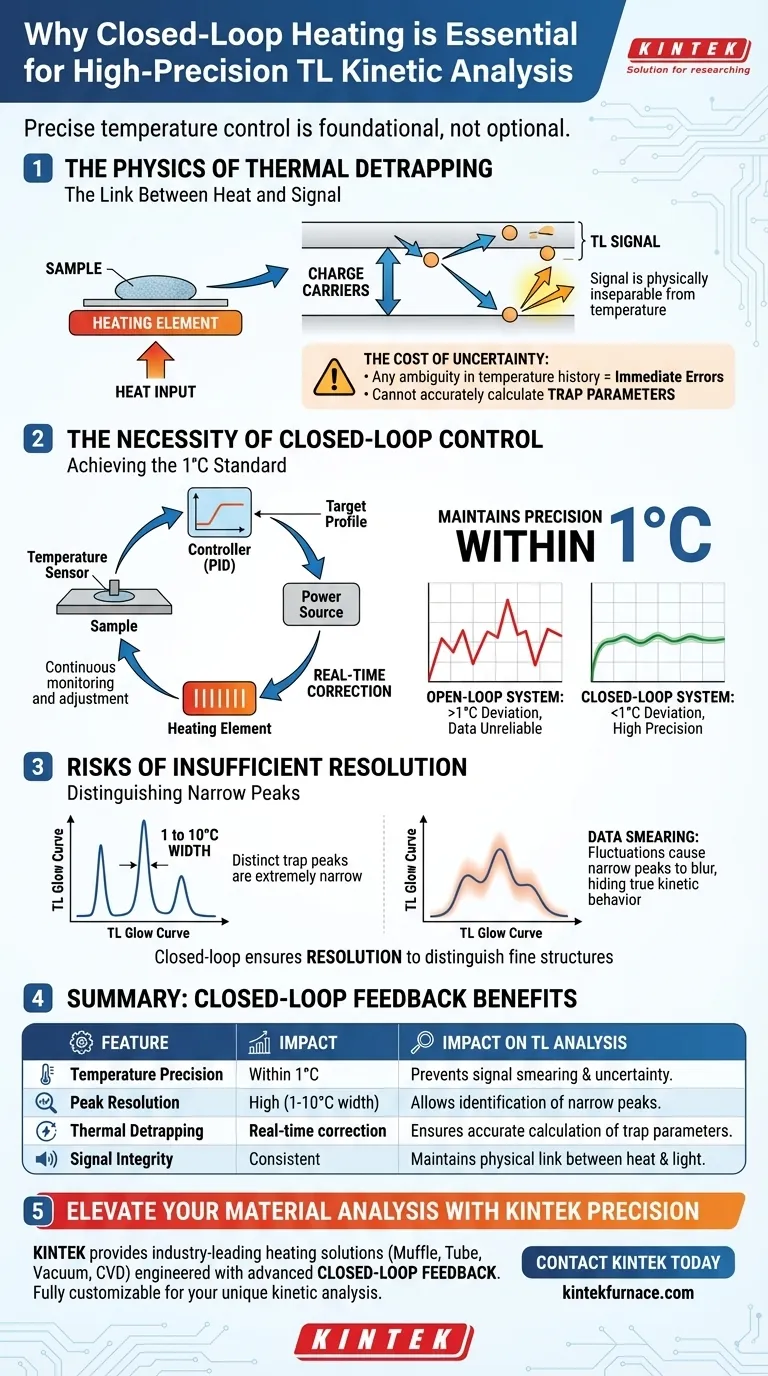
The validity of TL kinetic parameters depends entirely on accurate thermal detrapping. A closed-loop system maintains temperature precision within 1°C, which is strictly necessary to resolve narrow signal peaks and prevent experimental uncertainty from corrupting the analysis.
The Physics of Thermal Detrapping
The Link Between Heat and Signal
In TL analysis, the light signal you measure is generated by the thermal detrapping of charge carriers.
This means the release of energy is directly triggered by heat. Consequently, the signal is physically inseparable from the temperature applied to the sample at that specific moment.
The Cost of Uncertainty
Because the signal is thermally driven, any ambiguity in the sample's temperature history creates immediate errors.
If you do not know the exact temperature, you cannot accurately calculate the trap parameters (the specific energy characteristics of the material).
The Necessity of Closed-Loop Control
Achieving the 1°C Standard
A closed-loop feedback mechanism continuously monitors the actual temperature and adjusts the heating power in real-time to match the target profile.
This mechanism is vital because it maintains temperature control precision within 1°C.
Why High Precision Matters
Open-loop systems, or systems with poor feedback, allow temperature accumulation or lag that exceeds this 1°C threshold.
For high-precision analysis, a deviation greater than 1°C renders the data mathematically unreliable.
Risks of Insufficient Resolution
Distinguishing Narrow Peaks
The most critical reason for this precision lies in the nature of the TL glow curve.
Distinct trap peaks in the data can be extremely narrow, often spanning a width of only 1 to 10°C.
Preventing Data Smearing
If your heating system fluctuates or drifts, these narrow peaks will blur or merge.
A closed-loop system ensures you have the resolution to distinguish these fine structures, rather than recording a "smeared" signal that hides the true kinetic behavior of the material.
Making the Right Choice for Your Goal
How to Apply This to Your Project
When selecting or configuring equipment for TL analysis, the heating stage is often the limiting factor for data quality. Review your experimental requirements against the hardware specifications.
- If your primary focus is distinct peak resolution: Ensure your controller guarantees stability within 1°C to identify peaks as narrow as 10°C or less.
- If your primary focus is calculating trap parameters: You must use closed-loop feedback to eliminate temperature history uncertainty, or your kinetic calculations will be flawed.
Ultimately, high-precision TL analysis requires that the thermal input is as strictly controlled as the optical output is measured.
Summary Table:
| Feature | Closed-Loop Feedback | Impact on TL Analysis |
|---|---|---|
| Temperature Precision | Within 1°C | Prevents signal smearing and experimental uncertainty. |
| Peak Resolution | High (1-10°C width) | Allows identification of distinct, narrow trap peaks. |
| Thermal Detrapping | Real-time correction | Ensures accurate calculation of trap energy parameters. |
| Signal Integrity | Consistent | Maintains physical link between heat input and light output. |
Elevate Your Material Analysis with KINTEK Precision
High-precision Thermoluminescence analysis demands the strictest thermal control. KINTEK provides industry-leading heating solutions—including Muffle, Tube, Vacuum, and CVD systems—engineered with advanced closed-loop feedback for laboratory excellence.
Backed by expert R&D and manufacturing, our systems are fully customizable to meet your unique kinetic analysis requirements. Don't let temperature drift compromise your data.
Contact KINTEK today to discuss your custom furnace needs
Visual Guide
References
- Hayder Khudhair Obayes. Review: Theory of Thermoluminescence & Related by Reuven Chen (Author), Stephen W S Mckeever. DOI: 10.55640/eijmrms-05-07-02
This article is also based on technical information from Kintek Furnace Knowledge Base .
Related Products
- Laboratory Quartz Tube Furnace RTP Heating Tubular Furnace
- 2200 ℃ Tungsten Vacuum Heat Treat and Sintering Furnace
- Multi Heating Zones CVD Tube Furnace Machine for Chemical Vapor Deposition Equipment
- Split Multi Heating Zone Rotary Tube Furnace Rotating Tube Furnace
- Vacuum Heat Treat Furnace with Ceramic Fiber Liner
People Also Ask
- What physical conditions does a laboratory Tube Furnace provide for SOEC? Precision Heat for Solid Oxide Characterization
- What are the main features and functions of a laboratory tube furnace? Unlock Precise High-Temp Control for Your Lab
- What parameters must be controlled when calcining freeze-dried oxide precursors in a laboratory tube furnace? A Guide
- What role does a laboratory tube furnace play in geological and mineralogical research? Unlock Earth's Secrets with Precision
- Why is a laboratory tube furnace necessary for BiVO4/RGO synthesis? Achieve Precise Nano-Structure Control