Knowledge Why is a forced-air drying oven necessary for impregnated kaolin catalysts? Achieve Uniform Component Immobilization
Author avatar

Tech Team · Kintek Furnace

Updated 23 hours ago

Why is a forced-air drying oven necessary for impregnated kaolin catalysts? Achieve Uniform Component Immobilization


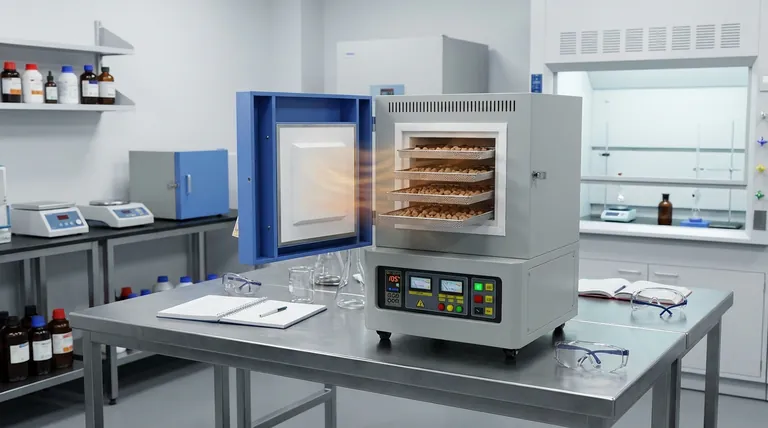
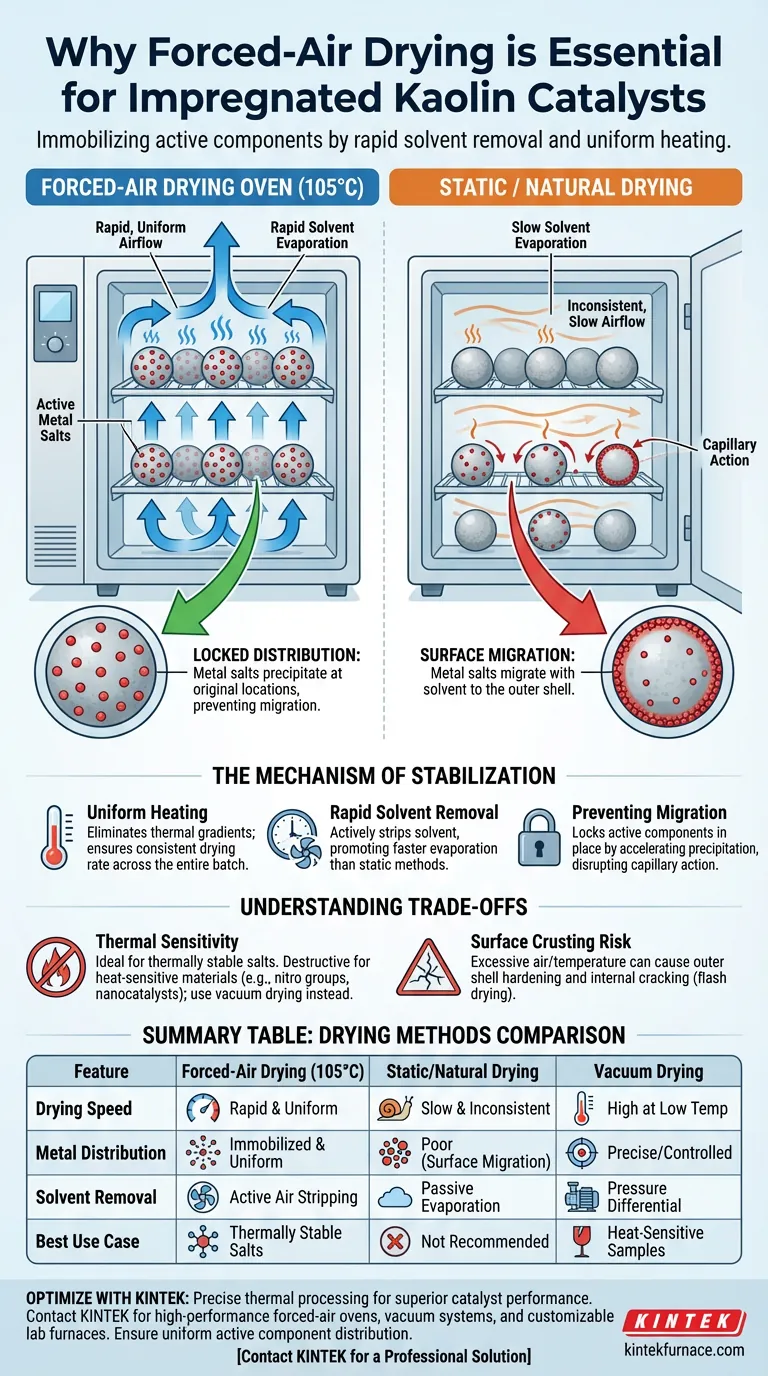
The primary necessity of a forced-air drying oven is to immobilize active components. By utilizing forced hot air circulation at approximately 105°C, the oven ensures rapid solvent removal and uniform heating across the impregnated kaolin. This mechanical action is strictly required to prevent the dissolved metal salts from migrating or redistributing, which inevitably occurs during slower, natural drying methods.

Core Takeaway The success of an impregnated catalyst relies on where the active metals sit on the support. Forced-air drying is a method of "locking" these components in their initial state, preventing capillary forces from moving them around before they solidify.
Why is a forced-air drying oven necessary for impregnated kaolin catalysts? Achieve Uniform Component Immobilization

The Mechanism of Stabilization

Uniform Heating Through Circulation

In static drying environments, heat distribution can be inconsistent, leading to "hot spots" and "cold spots."

Forced-air circulation eliminates these thermal gradients. It ensures that every particle of the kaolin carrier experiences the same temperature simultaneously, resulting in a consistent drying rate across the entire batch.

Rapid Solvent Removal

Speed is a functional requirement, not just a time-saver.

The forced airflow actively strips evaporated solvent away from the catalyst surface. This promotes a faster rate of evaporation than static ovens, which is essential for the immediate precipitation of the active ingredients.

Preventing Component Migration

The Risk of Capillary Action

When a catalyst dries slowly, the solvent moves from the interior of the pore to the outer surface via capillary action.

If the drying is too slow (as in natural drying), the solvent drags the dissolved metal salts along with it. This causes the active components to accumulate on the outer shell of the catalyst rather than remaining evenly distributed throughout the pores.

Locking in Distribution

The forced-air method removes the solvent fast enough to disrupt this migration process.

By accelerating evaporation, the metal salts reach supersaturation and precipitate quickly at their original locations. This preserves the initial distribution state on the carrier surface, ensuring the final catalyst performs predictably.

Understanding the Trade-offs

Thermal Sensitivity Constraints

While forced-air drying at 105°C is ideal for thermally stable metal salts, it is destructive for heat-sensitive materials.

If your catalyst contains organic functional groups (such as nitro groups) or high-activity nanocatalysts prone to oxidation, forced-air drying may cause premature decomposition. In those specific cases, vacuum drying at lower temperatures is the required alternative.

The Risk of Surface Crusting

There is a balance between "rapid drying" and "flash drying."

If the air velocity or temperature is excessively high, the outer surface of the catalyst may dry and harden before the interior. This can trap moisture inside or lead to physical cracking, potentially damaging the pore structure of the kaolin support.

Making the Right Choice for Your Goal

  • If your primary focus is uniform metal distribution: Use a forced-air oven to prevent the migration and agglomeration of salts during solvent evaporation.
  • If your primary focus is preserving heat-sensitive structures: Avoid forced air; opt for vacuum drying to remove solvents at lower temperatures without oxidation.
  • If your primary focus is mechanical integrity: Ensure the drying rate is controlled enough to prevent rapid vaporization from cracking the catalyst tablets.

The forced-air oven is not merely a tool for moisture removal; it is a control device used to freeze the active geometry of the catalyst in place.

Summary Table:

Feature Forced-Air Drying (105°C) Static/Natural Drying Vacuum Drying
Drying Speed Rapid & Uniform Slow & Inconsistent High at Low Temp
Metal Distribution Immobilized & Uniform Poor (Surface Migration) Precise/Controlled
Solvent Removal Active Air Stripping Passive Evaporation Pressure Differential
Best Use Case Thermally Stable Salts Not Recommended Heat-Sensitive Samples

Optimize Your Catalyst Production with KINTEK

Precise thermal processing is the key to locking in catalyst performance. Backed by expert R&D and manufacturing, KINTEK offers high-performance forced-air ovens, vacuum systems, and customizable lab furnaces—including Muffle, Tube, and Rotary systems—tailored to your unique research needs. Ensure uniform active component distribution and superior mechanical integrity for your kaolin supports today.

Contact KINTEK for a Professional Solution

Visual Guide
Why is a forced-air drying oven necessary for impregnated kaolin catalysts? Achieve Uniform Component Immobilization Visual Guide

References

  1. Luqman Buchori, Ndaru Okvitarini. Preparation of KI/KIO3/Methoxide Kaolin Catalyst and Performance Test of Catalysis in Biodiesel Production. DOI: 10.26554/sti.2024.9.2.359-370

This article is also based on technical information from Kintek Furnace Knowledge Base .

Related Products

People Also Ask

Related Products

1200℃ Muffle Oven Furnace for Laboratory

1200℃ Muffle Oven Furnace for Laboratory

KINTEK KT-12M Muffle Furnace: Precision 1200°C heating with PID control. Ideal for labs needing rapid, uniform heat. Explore models & customization options.

1400℃ High Temperature Laboratory Tube Furnace with Quartz and Alumina Tube

1400℃ High Temperature Laboratory Tube Furnace with Quartz and Alumina Tube

KINTEK's Tube Furnace with Alumina Tube: Precision high-temperature processing up to 2000°C for labs. Ideal for material synthesis, CVD, and sintering. Customizable options available.

1700℃ High Temperature Laboratory Tube Furnace with Quartz or Alumina Tube

1700℃ High Temperature Laboratory Tube Furnace with Quartz or Alumina Tube

KINTEK's Tube Furnace with Alumina Tube: Precision heating up to 1700°C for material synthesis, CVD, and sintering. Compact, customizable, and vacuum-ready. Explore now!

Small Vacuum Heat Treat and Tungsten Wire Sintering Furnace

Small Vacuum Heat Treat and Tungsten Wire Sintering Furnace

Compact vacuum tungsten wire sintering furnace for labs. Precise, mobile design with superior vacuum integrity. Ideal for advanced material research. Contact us!

Vacuum Dental Porcelain Sintering Furnace for Dental Laboratories

Vacuum Dental Porcelain Sintering Furnace for Dental Laboratories

KinTek Vacuum Porcelain Furnace: Precision dental lab equipment for high-quality ceramic restorations. Advanced firing control & user-friendly operation.

Vacuum Hot Press Furnace Machine Heated Vacuum Press Tube Furnace

Vacuum Hot Press Furnace Machine Heated Vacuum Press Tube Furnace

Discover KINTEK's advanced Vacuum Tube Hot Press Furnace for precise high-temperature sintering, hot pressing, and material bonding. Customizable solutions for labs.

Vacuum Heat Treat Furnace with Ceramic Fiber Liner

Vacuum Heat Treat Furnace with Ceramic Fiber Liner

KINTEK's Vacuum Furnace with Ceramic Fiber Lining offers precise high-temperature processing up to 1700°C, ensuring uniform heat distribution and energy efficiency. Ideal for labs and production.

High Pressure Laboratory Vacuum Tube Furnace Quartz Tubular Furnace

High Pressure Laboratory Vacuum Tube Furnace Quartz Tubular Furnace

KINTEK High Pressure Tube Furnace: Precision heating up to 1100°C with 15Mpa pressure control. Ideal for sintering, crystal growth, and lab research. Customizable solutions available.

Vertical Laboratory Quartz Tube Furnace Tubular Furnace

Vertical Laboratory Quartz Tube Furnace Tubular Furnace

Precision KINTEK Vertical Tube Furnace: 1800℃ heating, PID control, customizable for labs. Ideal for CVD, crystal growth & materials testing.

Vacuum Heat Treat Sintering Furnace with Pressure for Vacuum Sintering

Vacuum Heat Treat Sintering Furnace with Pressure for Vacuum Sintering

KINTEK's Vacuum Pressure Sintering Furnace offers 2100℃ precision for ceramics, metals, and composites. Customizable, high-performance, and contamination-free. Get a quote now!

Vacuum Hot Press Furnace Machine for Lamination and Heating

Vacuum Hot Press Furnace Machine for Lamination and Heating

KINTEK Vacuum Lamination Press: Precision bonding for wafer, thin-film & LCP applications. 500°C max temp, 20-ton pressure, CE certified. Custom solutions available.

Vacuum Induction Melting Furnace and Arc Melting Furnace

Vacuum Induction Melting Furnace and Arc Melting Furnace

Explore KINTEK's Vacuum Induction Melting Furnace for high-purity metal processing up to 2000℃. Customizable solutions for aerospace, alloys, and more. Contact us today!

Laboratory Vacuum Tilt Rotary Tube Furnace Rotating Tube Furnace

Laboratory Vacuum Tilt Rotary Tube Furnace Rotating Tube Furnace

KINTEK Laboratory Rotary Furnace: Precision heating for calcination, drying, sintering. Customizable solutions with vacuum & controlled atmosphere. Enhance research now!

Electric Rotary Kiln Continuous Working Small Rotary Furnace Kiln for Pyrolysis Plant Heating

Electric Rotary Kiln Continuous Working Small Rotary Furnace Kiln for Pyrolysis Plant Heating

KINTEK's electric rotary furnaces offer precision heating up to 1100°C for calcination, drying, and pyrolysis. Durable, efficient, and customizable for labs and production. Explore models now!

1200℃ Split Tube Furnace Laboratory Quartz Tube Furnace with Quartz Tube

1200℃ Split Tube Furnace Laboratory Quartz Tube Furnace with Quartz Tube

Discover KINTEK's 1200℃ Split Tube Furnace with quartz tube for precise high-temperature lab applications. Customizable, durable, and efficient. Get yours now!

Electric Rotary Kiln Pyrolysis Furnace Plant Machine Small Rotary Kiln Calciner

Electric Rotary Kiln Pyrolysis Furnace Plant Machine Small Rotary Kiln Calciner

KINTEK Electric Rotary Kiln: Precise 1100℃ calcination, pyrolysis & drying. Eco-friendly, multi-zone heating, customizable for lab & industrial needs.

Spark Plasma Sintering SPS Furnace

Spark Plasma Sintering SPS Furnace

Discover KINTEK's advanced Spark Plasma Sintering (SPS) Furnace for rapid, precise material processing. Customizable solutions for research and production.

Ultra High Vacuum Stainless Steel KF ISO CF Flange Pipe Straight Pipe Tee Cross Fitting

Ultra High Vacuum Stainless Steel KF ISO CF Flange Pipe Straight Pipe Tee Cross Fitting

KF/ISO/CF ultra-high vacuum stainless steel flange pipe systems for precision applications. Customizable, durable, and leak-tight. Get expert solutions now!

CF KF Flange Vacuum Electrode Feedthrough Lead Sealing Assembly for Vacuum Systems

CF KF Flange Vacuum Electrode Feedthrough Lead Sealing Assembly for Vacuum Systems

Reliable CF/KF flange vacuum electrode feedthrough for high-performance vacuum systems. Ensures superior sealing, conductivity & durability. Customizable options available.

Chairside Dental Porcelain Zirconia Sintering Furnace with Transformer for Ceramic Restorations

Chairside Dental Porcelain Zirconia Sintering Furnace with Transformer for Ceramic Restorations

Dental Porcelain Speedy Sintering Furnace: Fast 9-minute zirconia sintering, 1530°C precision, SiC heaters for dental labs. Boost productivity today!


Leave Your Message





