
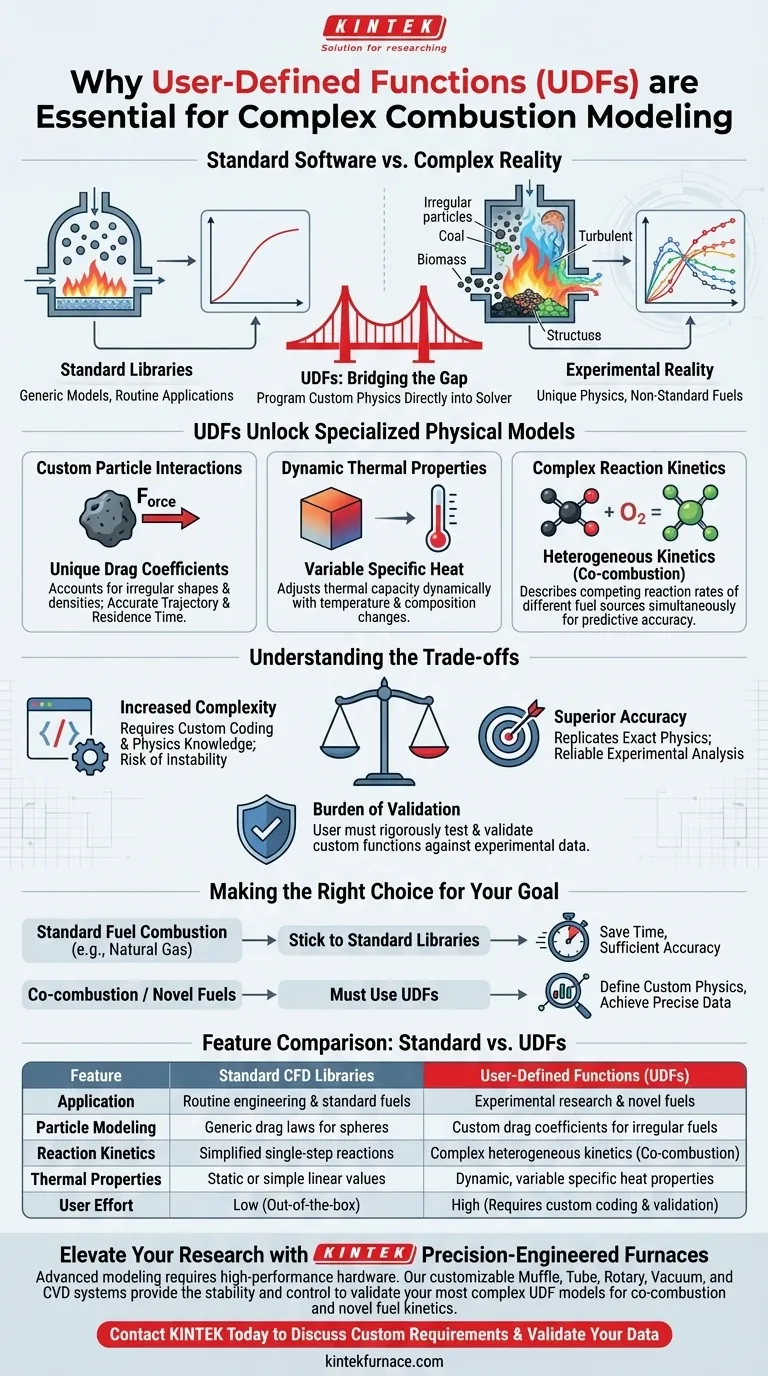
User-Defined Functions (UDFs) are essential in experimental furnace modeling because standard simulation software libraries typically lack the specialized physical models required for non-standard combustion processes. By utilizing UDFs, researchers can program custom physics—such as unique particle drag coefficients or complex reaction kinetics—directly into the solver, ensuring the simulation accurately mirrors the unique behaviors found in complex scenarios like coal and biomass co-combustion.
Standard software libraries are designed for general applications, but experimental research often operates outside these boundaries. UDFs provide the necessary customization to model specific physical phenomena, bridging the gap between generic algorithms and the granular reality of experimental data.
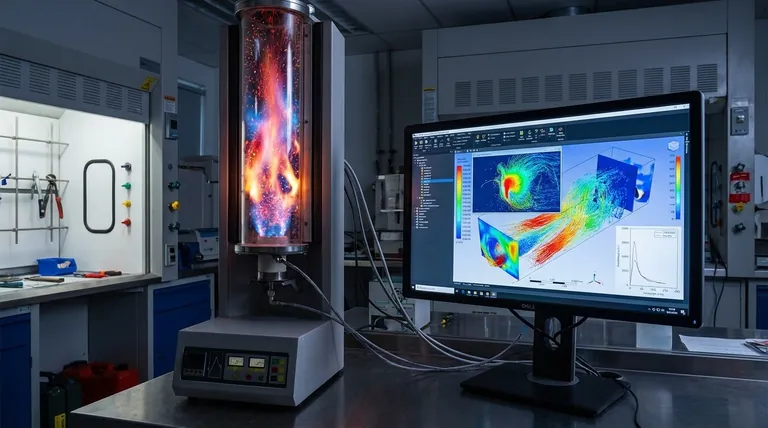
Overcoming the Limitations of Standard Libraries
The Gap in Off-the-Shelf Software
Most computational fluid dynamics (CFD) software comes equipped with a library of standard physical models. While effective for routine engineering, these generic models often fail to capture the nuances of experimental setups.
When your furnace parameters deviate from the norm, standard libraries become insufficient. Relying on them can lead to significant discrepancies between your simulation results and your experimental measurements.
Customizing Particle Interactions
In complex combustion, especially involving solid fuels, particle behavior is critical. Standard drag laws may not account for the irregular shapes or densities of experimental fuels.
UDFs allow you to define unique particle drag coefficients. This ensures that the trajectory and residence time of fuel particles within the furnace are calculated based on their actual physical properties, rather than an approximation.
Handling Dynamic Thermal Properties
Thermal properties in a furnace are rarely static. As temperature and composition change, so do the properties of the materials involved.
Standard solvers often simplify these values. UDFs enable the implementation of variable specific heat properties, allowing the model to adjust thermal capacity dynamically as the combustion process evolves.
Modeling Complex Reaction Kinetics
The Challenge of Heterogeneous Reactions
Combustion is rarely a simple, single-step process. This is particularly true in co-combustion scenarios, such as burning coal and biomass together.
These processes involve complex heterogeneous reaction kinetics—reactions occurring between different phases (solid fuel and gaseous oxidizers). Standard kinetic models often cannot describe the competing reaction rates of two different fuel sources simultaneously.
Achieving Predictive Accuracy
By using UDFs, you can define specific reaction rates and mechanisms that match your specific fuel blend.
This level of detail captures unique reaction artifacts that standard models miss. The result is a significant improvement in the predictive accuracy of the simulation, making it a reliable tool for experimental analysis.
Understanding the Trade-offs
Increased Complexity vs. Accuracy
While UDFs offer superior accuracy, they introduce complexity. You are moving from selecting options in a menu to writing and compiling code.
This requires a deeper understanding of the underlying physics and the solver's architecture. A logic error in a UDF can lead to solution instability or divergence.
The Burden of Validation
When you use a standard library, you rely on models validated by the software vendor. When you write a UDF, validation becomes your responsibility.
You must rigorously test your custom functions against experimental data to ensure that the "improved" physics are actually correct and not introducing new errors.
Making the Right Choice for Your Goal
If you are deciding whether to implement UDFs in your project, consider your specific simulation needs:
- If your primary focus is standard fuel combustion: Stick to standard libraries to save time, as generic models are likely sufficient for well-documented fuels like natural gas.
- If your primary focus is co-combustion or novel fuels: You must use UDFs to define custom drag coefficients and kinetics, as standard models will likely yield inaccurate data for mixed fuel sources.
UDFs transform a generic simulation tool into a specialized instrument capable of replicating the exact physics of your experimental furnace.
Summary Table:
| Feature | Standard CFD Libraries | User-Defined Functions (UDFs) |
|---|---|---|
| Application | Routine engineering & standard fuels | Experimental research & novel fuels |
| Particle Modeling | Generic drag laws for spheres | Custom drag coefficients for irregular fuels |
| Reaction Kinetics | Simplified single-step reactions | Complex heterogeneous kinetics (e.g., Co-combustion) |
| Thermal Properties | Static or simple linear values | Dynamic, variable specific heat properties |
| User Effort | Low (Out-of-the-box) | High (Requires custom coding & validation) |
Elevate Your Research with Precision-Engineered Furnaces
At KINTEK, we understand that advanced modeling requires high-performance hardware that matches your simulations. Backed by expert R&D and manufacturing, we provide a comprehensive range of Muffle, Tube, Rotary, Vacuum, and CVD systems—all of which are fully customizable to meet the unique needs of your experimental combustion projects.
Whether you are analyzing coal-biomass co-combustion or novel fuel kinetics, our high-temperature lab furnaces provide the stability and control necessary to validate your most complex UDF models. Contact KINTEK today to discuss your custom furnace requirements and bring your experimental data to life.
Visual Guide
References
- Garikai T. Marangwanda, Daniel M. Madyira. Evaluating Combustion Ignition, Burnout, Stability, and Intensity of Coal–Biomass Blends Within a Drop Tube Furnace Through Modelling. DOI: 10.3390/en18061322
This article is also based on technical information from Kintek Furnace Knowledge Base .
Related Products
- Laboratory Muffle Oven Furnace with Bottom Lifting
- Laboratory Quartz Tube Furnace RTP Heating Tubular Furnace
- 1700℃ High Temperature Laboratory Tube Furnace with Alumina Tube
- 1400℃ High Temperature Laboratory Tube Furnace with Alumina Tube
- 1200℃ Split Tube Furnace Laboratory Quartz Tube Furnace with Quartz Tube
People Also Ask
- What is the importance of the calcination process? Master High-Purity Calcium Phosphate Nanopowder Production
- Why is a high-temperature muffle furnace required for FeOx-MOx/TiO2? Engineering High-Performance Nanocomposites
- What function does a muffle furnace perform in Ba0.75Ca0.25TiO3 calcination? Ensure Phase Purity & Synthesis
- Why is a high-temperature laboratory muffle furnace essential for the alkali fusion process in zeolite synthesis?
- What are the primary functions of a high-temperature laboratory muffle furnace in the preparation of biosorbent materials?



















