Knowledge How does the SCRS model simplify furnace combustion simulation? Efficiency Meets Accuracy in Thermal Modeling
Author avatar

Tech Team · Kintek Furnace

Updated 1 day ago

How does the SCRS model simplify furnace combustion simulation? Efficiency Meets Accuracy in Thermal Modeling


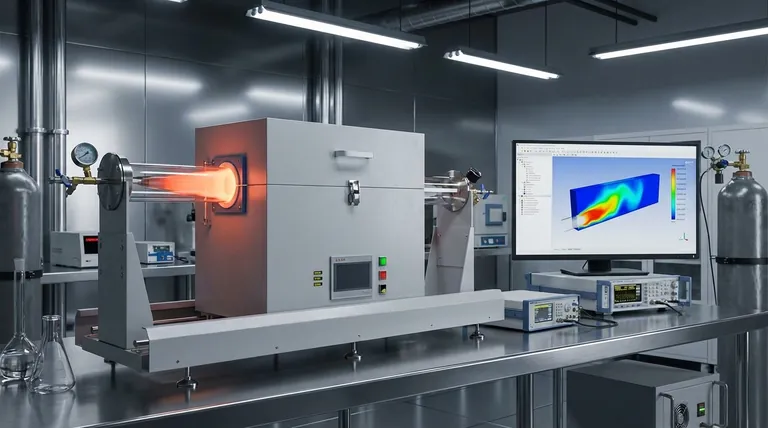
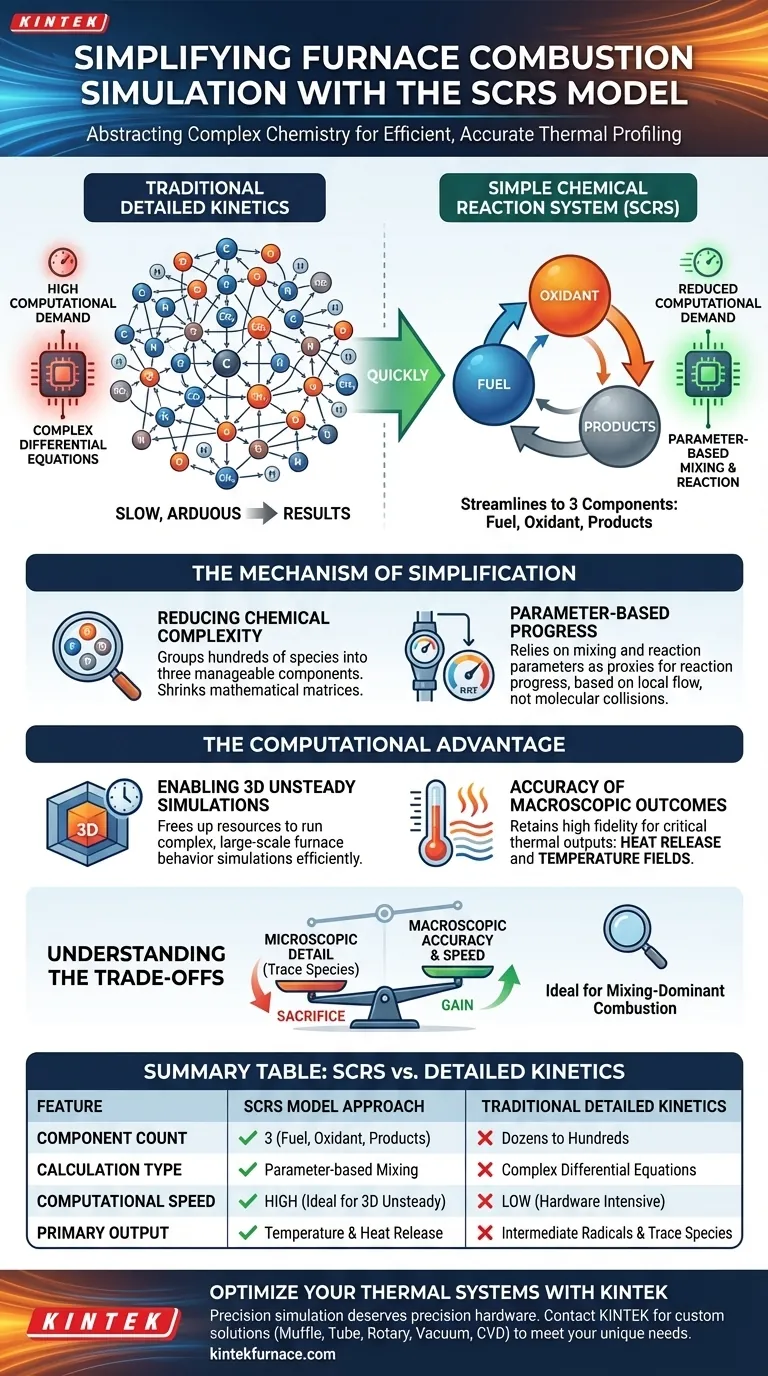
The Simple Chemical Reaction System (SCRS) model streamlines numerical simulations by abstracting complex combustion chemistry into a fundamental interaction between just three components: fuel, oxidant, and products. Instead of calculating the intricate behaviors of numerous intermediate chemical species, SCRS utilizes mixing and reaction parameters to describe the process, significantly reducing computational demand while maintaining accuracy in temperature and heat release predictions.

The SCRS model solves the computational bottleneck of combustion simulation by prioritizing macroscopic mixing over microscopic chemical details. It allows for efficient 3D unsteady simulations without sacrificing the accuracy of the resulting thermal fields.
How does the SCRS model simplify furnace combustion simulation? Efficiency Meets Accuracy in Thermal Modeling

The Mechanism of Simplification

Reducing Chemical Complexity

In detailed combustion simulations, a solver must typically track dozens or even hundreds of intermediate chemical species and their reactions.

The SCRS model bypasses this by grouping the entire system into three manageable components: fuel, oxidant, and products. This reduction drastically shrinks the size of the mathematical matrices the solver must process at every time step.

Parameter-Based Progress

Rather than solving differential equations for every chemical kinetic step, SCRS relies on mixing and chemical reaction parameters.

These parameters act as proxies for the reaction progress. They allow the simulation to determine how much fuel has been consumed and how much heat has been released based on local flow and mixing conditions, rather than molecular-level collision rates.

The Computational Advantage

Enabling 3D Unsteady Simulations

Simulating a furnace in three dimensions over time (unsteady simulation) is computationally expensive.

By removing the "stiff" equations associated with detailed chemical kinetics, SCRS frees up computational resources. This makes it feasible to run complex, large-scale simulations of furnace behavior that would otherwise be too slow or hardware-intensive to solve.

Accuracy of Macroscopic Outcomes

Despite the simplification, the model retains high fidelity where it counts for furnace engineering: heat release and temperature fields.

The primary reference indicates that for predicting the thermal environment—which is the primary function of a furnace—the interaction between the three core components provides sufficient data to generate accurate results.

Understanding the Trade-offs

The Sacrifice of Microscopic Detail

The efficiency of the SCRS model comes from ignoring detailed chemical kinetics.

While excellent for thermal profiling, this approach does not explicitly model the formation of intermediate radicals or complex trace species. You are trading chemical granularity for computational speed.

Scope of Applicability

This model is ideal for scenarios where the physical mixing of fuel and air is the dominant factor in combustion.

However, if your simulation requires precise tracking of slow-forming pollutants or ignition delays dependent on specific chemical chains, the simplified three-component approach may require careful validation.

Making the Right Choice for Your Simulation

To determine if the Simple Chemical Reaction System is the right tool for your furnace simulation, consider your specific engineering goals.

  • If your primary focus is Thermal Profiling: The SCRS model is highly recommended as it accurately predicts temperature fields and heat release with minimal computational overhead.
  • If your primary focus is Time-Dependent Flow: The reduction in calculation load makes SCRS the superior choice for handling the heavy demands of 3D unsteady simulations.

The SCRS model proves that in large-scale engineering simulations, intelligent simplification often yields the most practical and efficient path to accurate results.

Summary Table:

Feature SCRS Model Approach Traditional Detailed Kinetics
Component Count 3 (Fuel, Oxidant, Products) Dozens to Hundreds of Species
Calculation Type Parameter-based Mixing Complex Differential Equations
Computational Speed High (Ideal for 3D Unsteady) Low (Hardware Intensive)
Primary Output Temperature & Heat Release Intermediate Radicals & Trace Species
Best For Large-scale Thermal Profiling Detailed Chemical Pollutant Tracking

Optimize Your Thermal Systems with KINTEK

Precision in simulation deserves precision in hardware. KINTEK provides industry-leading thermal solutions, including Muffle, Tube, Rotary, Vacuum, and CVD systems, all designed to meet the rigorous demands of modern lab and industrial research. Backed by expert R&D and manufacturing, our furnaces are fully customizable to your unique simulation and production needs.

Ready to elevate your lab’s high-temperature capabilities? Contact KINTEK today to discuss how our customizable systems can bring your numerical simulations to life.

Visual Guide
How does the SCRS model simplify furnace combustion simulation? Efficiency Meets Accuracy in Thermal Modeling Visual Guide

References

  1. O. I. Varfolomeeva, D. A. Khvorenkov. Development of a universal model for numerical analysis of firebox processes in heat-generating plants. DOI: 10.30724/1998-9903-2025-27-6-171-186

This article is also based on technical information from Kintek Furnace Knowledge Base .

Related Products

People Also Ask

Related Products

Laboratory Quartz Tube Furnace RTP Heating Tubular Furnace

Laboratory Quartz Tube Furnace RTP Heating Tubular Furnace

KINTEK's RTP Rapid Heating Tube Furnace delivers precise temperature control, rapid heating up to 100°C/sec, and versatile atmosphere options for advanced lab applications.

Laboratory Muffle Oven Furnace with Bottom Lifting

Laboratory Muffle Oven Furnace with Bottom Lifting

Boost lab efficiency with KT-BL Bottom Lifting Furnace: precise 1600℃ control, superior uniformity, and enhanced productivity for material science and R&D.

1400℃ Muffle Oven Furnace for Laboratory

1400℃ Muffle Oven Furnace for Laboratory

KT-14M Muffle Furnace: Precision 1400°C heating with SiC elements, PID control, and energy-efficient design. Ideal for labs.

Vertical Laboratory Quartz Tube Furnace Tubular Furnace

Vertical Laboratory Quartz Tube Furnace Tubular Furnace

Precision KINTEK Vertical Tube Furnace: 1800℃ heating, PID control, customizable for labs. Ideal for CVD, crystal growth & materials testing.

High Temperature Muffle Oven Furnace for Laboratory Debinding and Pre Sintering

High Temperature Muffle Oven Furnace for Laboratory Debinding and Pre Sintering

KT-MD Debinding & Pre-Sintering Furnace for ceramics - precise temperature control, energy-efficient design, customizable sizes. Boost your lab efficiency today!

1800℃ High Temperature Muffle Oven Furnace for Laboratory

1800℃ High Temperature Muffle Oven Furnace for Laboratory

KINTEK Muffle Furnaces: Precision 1800°C heating for labs. Energy-efficient, customizable, with PID control. Ideal for sintering, annealing, and research.

1400℃ High Temperature Laboratory Tube Furnace with Quartz and Alumina Tube

1400℃ High Temperature Laboratory Tube Furnace with Quartz and Alumina Tube

KINTEK's Tube Furnace with Alumina Tube: Precision high-temperature processing up to 2000°C for labs. Ideal for material synthesis, CVD, and sintering. Customizable options available.

1700℃ High Temperature Laboratory Tube Furnace with Quartz or Alumina Tube

1700℃ High Temperature Laboratory Tube Furnace with Quartz or Alumina Tube

KINTEK's Tube Furnace with Alumina Tube: Precision heating up to 1700°C for material synthesis, CVD, and sintering. Compact, customizable, and vacuum-ready. Explore now!

1700℃ High Temperature Muffle Oven Furnace for Laboratory

1700℃ High Temperature Muffle Oven Furnace for Laboratory

KT-17M Muffle Furnace: High-precision 1700°C lab furnace with PID control, energy efficiency, and customizable sizes for industrial & research applications.

High Pressure Laboratory Vacuum Tube Furnace Quartz Tubular Furnace

High Pressure Laboratory Vacuum Tube Furnace Quartz Tubular Furnace

KINTEK High Pressure Tube Furnace: Precision heating up to 1100°C with 15Mpa pressure control. Ideal for sintering, crystal growth, and lab research. Customizable solutions available.

Mesh Belt Controlled Atmosphere Furnace Inert Nitrogen Atmosphere Furnace

Mesh Belt Controlled Atmosphere Furnace Inert Nitrogen Atmosphere Furnace

KINTEK Mesh Belt Furnace: High-performance controlled atmosphere furnace for sintering, hardening & heat treatment. Customizable, energy-efficient, precise temperature control. Get a quote now!

1700℃ Controlled Inert Nitrogen Atmosphere Furnace

1700℃ Controlled Inert Nitrogen Atmosphere Furnace

KT-17A Controlled Atmosphere Furnace: Precise 1700°C heating with vacuum & gas control. Ideal for sintering, research & material processing. Explore now!

Small Vacuum Heat Treat and Tungsten Wire Sintering Furnace

Small Vacuum Heat Treat and Tungsten Wire Sintering Furnace

Compact vacuum tungsten wire sintering furnace for labs. Precise, mobile design with superior vacuum integrity. Ideal for advanced material research. Contact us!

2200 ℃ Tungsten Vacuum Heat Treat and Sintering Furnace

2200 ℃ Tungsten Vacuum Heat Treat and Sintering Furnace

2200°C Tungsten Vacuum Furnace for high-temperature materials processing. Precise control, superior vacuum, customizable solutions. Ideal for research & industrial applications.

Controlled Inert Nitrogen Hydrogen Atmosphere Furnace

Controlled Inert Nitrogen Hydrogen Atmosphere Furnace

Discover KINTEK's Hydrogen Atmosphere Furnace for precise sintering & annealing in controlled environments. Up to 1600°C, safety features, customizable.

Multi Zone Laboratory Quartz Tube Furnace Tubular Furnace

Multi Zone Laboratory Quartz Tube Furnace Tubular Furnace

KINTEK Multi-Zone Tube Furnace: Precise 1700℃ heating with 1-10 zones for advanced material research. Customizable, vacuum-ready, and safety-certified.

Laboratory Vacuum Tilt Rotary Tube Furnace Rotating Tube Furnace

Laboratory Vacuum Tilt Rotary Tube Furnace Rotating Tube Furnace

KINTEK Laboratory Rotary Furnace: Precision heating for calcination, drying, sintering. Customizable solutions with vacuum & controlled atmosphere. Enhance research now!

Vacuum Heat Treat Sintering and Brazing Furnace

Vacuum Heat Treat Sintering and Brazing Furnace

KINTEK Vacuum Brazing Furnaces deliver precision, clean joints with superior temperature control. Customizable for diverse metals, ideal for aerospace, medical, and thermal applications. Get a quote!

Vacuum Heat Treat Sintering Furnace with Pressure for Vacuum Sintering

Vacuum Heat Treat Sintering Furnace with Pressure for Vacuum Sintering

KINTEK's Vacuum Pressure Sintering Furnace offers 2100℃ precision for ceramics, metals, and composites. Customizable, high-performance, and contamination-free. Get a quote now!

1400℃ Controlled Inert Nitrogen Atmosphere Furnace

1400℃ Controlled Inert Nitrogen Atmosphere Furnace

KT-14A Controlled Atmosphere Furnace for labs & industry. 1400°C max temp, vacuum sealing, inert gas control. Customizable solutions available.


Leave Your Message