Vacuum sealing is the fundamental prerequisite for synthesizing TaAs2 single crystals because it isolates the reaction from atmospheric interference. This process specifically prevents the high-temperature oxidation of Tantalum and Arsenic powders while establishing the closed thermodynamic system necessary for the Iodine transport agent to function.
The vacuum environment serves a dual purpose: it acts as a chemical shield against oxidation and a physical regulator for vapor pressure. Without this sealed, evacuated state, the transport agent cannot effectively drive the directional migration of gas-phase components, rendering the growth of high-purity single crystals impossible.
The Role of Environmental Isolation
Preventing Material Degradation
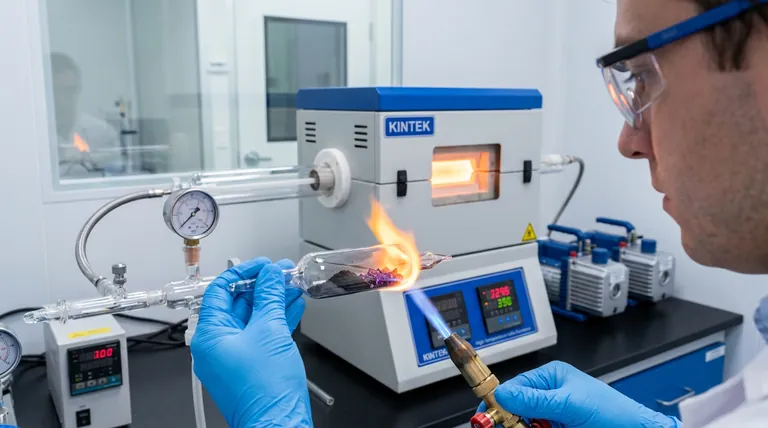
The primary function of the vacuum seal is to create a contaminant-free environment. Tantalum (Ta) and Arsenic (As) are highly reactive, particularly when subjected to the high temperatures required for Chemical Vapor Transport (CVT).
If oxygen or moisture is present in the quartz capillary, the raw materials will oxidize rather than react with each other. This oxidation effectively destroys the precursors before the crystal growth phase can even begin.
Ensuring Stoichiometric Precision
By evacuating the tube to a high vacuum state, you remove air interference that could alter the chemical balance.
This exclusion of foreign gases ensures that the reaction proceeds with precise stoichiometric ratios. It minimizes the risk of undesirable side reactions, leading to the formation of TaAs2 rather than unwanted oxides or impurities.
Enabling the Transport Mechanism
Facilitating Gas-Phase Migration
The vacuum seal is not just about protection; it is about propulsion. The CVT method relies on an Iodine transport agent to move materials from a source zone to a growth zone.
For this to happen, the system must be closed to allow the Iodine to facilitate the directional migration of gas-phase components. The vacuum ensures there is no back-pressure from atmospheric gases, allowing the transport agent to cycle efficiently.
Maintaining Specific Pressure Gradients
Crystal growth in CVT is driven by a pressure gradient resulting from a temperature difference.
The sealed quartz tube maintains the specific vapor pressure required for this thermodynamic process. If the seal is compromised or the vacuum is insufficient, the internal pressure will deviate from the required parameters, stalling the migration of components and halting crystal growth.
Common Pitfalls to Avoid
Inadequate Vacuum Levels
A "rough" vacuum is often insufficient for high-purity semiconductor synthesis. As noted in similar CVT processes, achieving a high vacuum (often in the range of 10^-3 to 10^-5 mbar) is critical to fully eliminate moisture.
Failing to reach this threshold often results in crystals with high defect densities or surface oxidation, even if the tube appears sealed.
Quartz Tube Integrity
While the quartz tube is essential for withstanding high temperatures (often exceeding 800°C), it is physically fragile.
The trade-off of a high-vacuum sealed system is that the pressure differential stresses the quartz. Micro-cracks or weak seals can lead to catastrophic failure or slow leaks during the heating ramp, introducing contamination mid-process.
Ensuring Success in Your Synthesis
To maximize the quality of your TaAs2 crystals, consider your primary objective when establishing your vacuum protocol:
- If your primary focus is Phase Purity: Prioritize achieving the highest possible vacuum (lowest base pressure) before sealing to completely eliminate oxygen and moisture side-reactions.
- If your primary focus is Crystal Size: Ensure the quartz tube dimensions and seal integrity are robust enough to maintain stable internal pressure gradients over long growth durations.
The vacuum seal is not merely a container; it is the thermodynamic control variable that dictates the purity and structure of your final material.
Summary Table:
| Factor | Role in TaAs2 Synthesis | Impact of Failure |
|---|---|---|
| Atmospheric Isolation | Prevents oxidation of Ta and As powders | Precursor degradation and impurity formation |
| Thermodynamic Control | Establishes a closed system for Iodine transport | Stalled gas-phase migration and no growth |
| Vapor Pressure | Maintains pressure gradients via vacuum seal | Inconsistent migration and crystal defects |
| Stoichiometry | Ensures precise 1:2 ratio of Ta to As | Formation of unwanted phases or oxides |
Elevate Your Material Synthesis with KINTEK
Precise control over vacuum and temperature is the cornerstone of successful Chemical Vapor Transport (CVT). At KINTEK, we understand that synthesizing high-purity TaAs2 single crystals requires more than just standard equipment—it requires reliability and precision.
Backed by expert R&D and manufacturing, KINTEK offers a comprehensive range of Muffle, Tube, Rotary, Vacuum, and CVD systems. Our lab high-temp furnaces are fully customizable to meet the unique pressure and temperature gradients your research demands.
Ready to optimize your crystal growth? Contact our technical experts today to find the perfect customized furnace solution for your laboratory needs.
References
- Haiyao Hu, Claudia Felser. Multipocket synergy towards high thermoelectric performance in topological semimetal TaAs2. DOI: 10.1038/s41467-024-55490-6
This article is also based on technical information from Kintek Furnace Knowledge Base .
Related Products
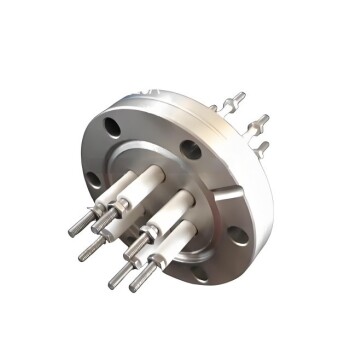
- CF KF Flange Vacuum Electrode Feedthrough Lead Sealing Assembly for Vacuum Systems
- Vacuum Sealed Continuous Working Rotary Tube Furnace Rotating Tube Furnace
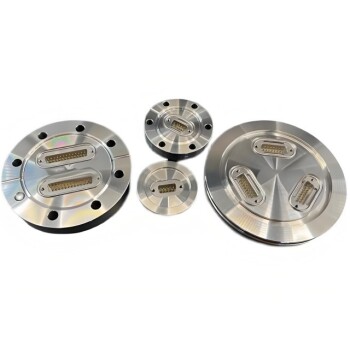
- Ultra Vacuum Electrode Feedthrough Connector Flange Power Lead for High Precision Applications
- Ultra-High Vacuum Flange Aviation Plug Glass Sintered Airtight Circular Connector for KF ISO CF
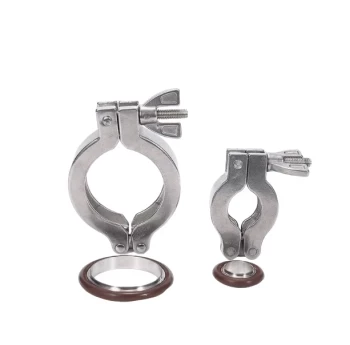
- Stainless Steel Quick Release Vacuum Chain Three Section Clamp
People Also Ask
- Why is a PTFE-lined stainless steel autoclave used for Ni12P5 synthesis? Key Benefits for Nanomaterial Production
- What is the function of PTFE sealing rings in plastic pyrolysis? Ensure Safe, Anaerobic Material Decomposition
- What is the function of a Teflon-lined stainless steel autoclave in the hydrothermal synthesis of Bi2O3 precursors?
- Why is a stainless steel autoclave with a Teflon liner necessary for BiVO4? Ensure Purity & High Performance
- What role does a Teflon-lined stainless steel autoclave play in the hydrothermal synthesis of PtLaOx@S-1 catalysts?