
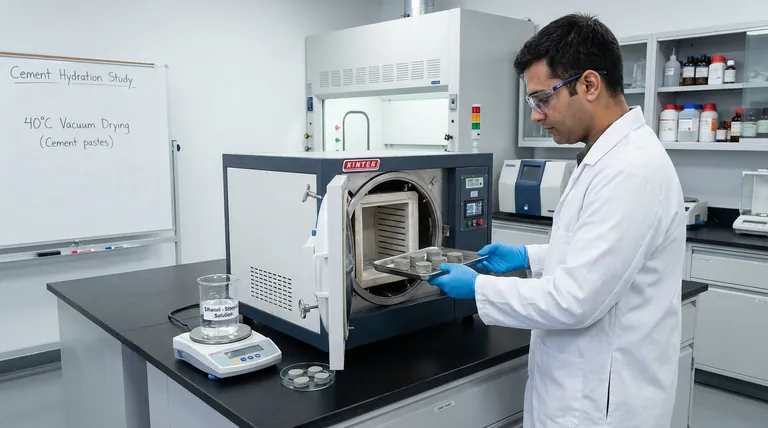
A vacuum drying oven acts as a critical sample preparation tool in cement hydration studies by gently removing residual solvents, such as ethanol, that are used to arrest the hydration process. It accomplishes this at low temperatures (typically 40 °C) under reduced pressure, ensuring the chemical integrity of the paste is preserved for accurate analysis.
The reliability of cement analysis hinges on stopping the reaction without destroying the evidence. A vacuum drying oven solves this by removing stopping agents in an isolated, low-heat environment, effectively preventing both carbonation and the thermal decomposition of delicate hydration phases.
Preserving Chemical Integrity
To study cement hydration, researchers must "freeze" the reaction at specific times. This is often done by exchanging pore water with a solvent like ethanol. The vacuum oven is the definitive tool for the next step: removing that solvent without damaging the sample.
Low-Temperature Solvent Removal
Standard drying methods often require high heat to evaporate liquids. However, high temperatures can alter cement chemistry.
A vacuum oven operates under reduced pressure, which lowers the boiling point of solvents. This allows for the effective removal of ethanol at gentle temperatures, such as 40 °C, preventing heat-induced damage.
Protecting Sensitive Phases
Certain hydration products, particularly ettringite, are thermally unstable.
Subjecting a sample to high temperatures in a standard oven would cause these phases to decompose. By maintaining a low temperature, the vacuum oven ensures that the ettringite remains intact for subsequent analysis.
Preventing Carbonation
Cement paste is highly reactive with the atmosphere. Specifically, it reacts with carbon dioxide (CO2) to form calcium carbonate, a process known as carbonation.
Because the vacuum oven isolates the sample from the air during the drying process, it effectively blocks carbonation reactions. This ensures the sample reflects the true state of hydration rather than atmospheric weathering.
Ensuring Analytical Accuracy
The ultimate goal of using a vacuum drying oven is to prepare samples that yield valid data in downstream testing.
Accuracy in X-ray Diffraction (XRD)
XRD analysis relies on the presence of specific crystal structures to identify phases.
If the drying process destroys crystals (like ettringite) or creates new compounds (through carbonation), the XRD pattern will be incorrect. Vacuum drying ensures the phase composition recorded is accurate to the specific hydration age.
Reliability in Thermogravimetric Analysis (TG)
TG analysis measures mass loss upon heating to determine composition.
Residual solvents or atmospheric contamination would introduce "false" mass loss events. By thoroughly removing ethanol and preventing carbonation, vacuum drying ensures that TG data accurately reflects the decomposition of genuine hydration products.
Understanding the Trade-offs
While vacuum drying is superior for preservation, it requires careful management of variables to avoid compromising data.
The Temperature Limit
Even under vacuum, temperature control is paramount. Exceeding moderate temperatures (like 40 °C) defeats the purpose of the equipment, as it may still lead to the dehydration or decomposition of the very phases you are trying to protect.
Duration vs. Dryness
Vacuum drying at low temperatures is a gentler process, but it can be slower than high-heat methods.
Removing the sample before the solvent is completely evacuated will result in contamination during TG analysis. Patience is required to ensure the solvent is fully removed without raising the temperature.
Making the Right Choice for Your Goal
The specific contribution of the vacuum oven depends on the analytical technique you plan to use next.
- If your primary focus is Phase Identification (XRD): The vacuum oven is essential to prevent the thermal decomposition of heat-sensitive crystals like ettringite.
- If your primary focus is Chemical Quantification (TG): The vacuum oven is critical for preventing carbonation, ensuring that measured mass losses are attributed solely to hydration products.
By isolating the sample from heat and air, the vacuum drying oven provides the baseline stability required for high-precision cement science.
Summary Table:
| Feature | Advantage in Cement Hydration Study | Benefit for Analysis |
|---|---|---|
| Low-Temperature Drying | Prevents decomposition of unstable phases (e.g., ettringite) | Ensures accurate XRD crystal identification |
| Reduced Pressure | Lowers solvent boiling points for gentle removal | Maintains sample chemical integrity without high heat |
| Vacuum Isolation | Blocks atmospheric CO2 exposure | Prevents carbonation and data interference in TG analysis |
| Controlled Environment | Removes residual solvents like ethanol thoroughly | Eliminates 'false' mass loss events in quantification |
Precision is paramount in cement science. Backed by expert R&D and manufacturing, KINTEK offers high-performance vacuum drying systems, Muffle, Tube, Rotary, and CVD furnaces—all customizable for your unique lab needs. Ensure the integrity of your research with our advanced thermal solutions. Contact KINTEK today to enhance your lab's analytical accuracy!
References
- Wenguang Zhang, Sun Jin-Feng. Influence of Curing Temperature on the Performance of Calcined Coal Gangue–Limestone Blended Cements. DOI: 10.3390/ma17081721
This article is also based on technical information from Kintek Furnace Knowledge Base .
Related Products
- Vacuum Heat Treat Sintering and Brazing Furnace
- Vacuum Heat Treat Sintering Furnace Molybdenum Wire Vacuum Sintering Furnace
- Dental Porcelain Zirconia Sintering Ceramic Vacuum Press Furnace
- Molybdenum Vacuum Heat Treat Furnace
- Vacuum Hot Press Furnace Machine Heated Vacuum Press
People Also Ask
- What is one of the most important uses of vacuum heat treating furnaces in aerospace? Achieve Superior Strength in Aircraft Alloys
- What are the benefits of using vacuum heat treating furnaces for metal alloys? Achieve Superior Metal Properties and Performance
- How does vacuum heat treating affect the grain structure of metal alloys? Achieve Precise Microstructure Control
- What is the temperature of a vacuum furnace brazing? Optimize Your Joint Strength and Cleanliness
- What are the steps involved in a typical vacuum brazing treatment? Master the Process for Strong, Clean Joints












