
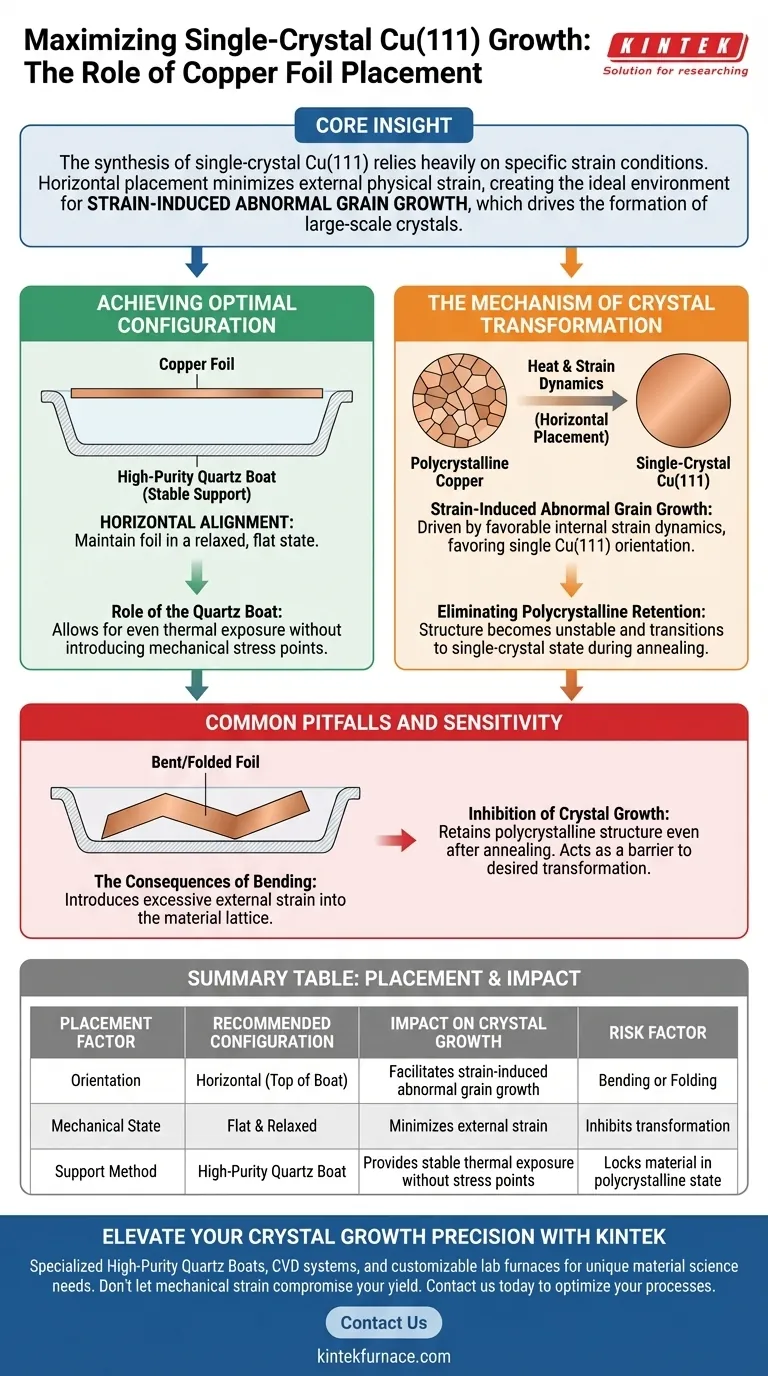
The physical orientation of copper foil is the determining factor in successfully synthesizing single-crystal Cu(111). To ensure the transformation from a polycrystalline structure to a single crystal, you must place the copper foil horizontally across the top of the high-purity quartz boat.
Core Insight: The synthesis of single-crystal Cu(111) relies heavily on specific strain conditions. Horizontal placement minimizes external physical strain, creating the ideal environment for strain-induced abnormal grain growth, which drives the formation of large-scale crystals.

Achieving Optimal Configuration
Horizontal Alignment
The copper foil must be positioned horizontally on the top of the quartz boat.
This specific placement is not arbitrary; it is designed to maintain the foil in a relaxed, flat state during the heating process.
The Role of the Quartz Boat
The high-purity quartz boat acts as a stable support structure.
By resting the foil on top, the boat allows for even thermal exposure without introducing mechanical stress points that would occur if the foil were wedged inside or draped unevenly.
The Mechanism of Crystal Transformation
Strain-Induced Abnormal Grain Growth
The process of converting polycrystalline copper into a centimeter-scale single crystal is driven by a mechanism known as strain-induced abnormal grain growth.
For this mechanism to function correctly, the material must not be subjected to excessive external deformation forces.
Horizontal placement ensures that the internal strain dynamics favor the growth of the single Cu(111) crystal orientation rather than competing grains.
Eliminating Polycrystalline Retention
When the foil is positioned correctly, the polycrystalline structure is unstable and transitions to the single-crystal state during annealing.
This transformation is the primary goal of the preparation process.
Common Pitfalls and Sensitivity
The Consequences of Bending
A common error is bending or folding the copper foil to fit it into the apparatus.
Research indicates that any significant bending introduces excessive strain into the material lattice.
Inhibition of Crystal Growth
This added strain from folding acts as a barrier to the desired transformation.
Instead of evolving into single-crystal Cu(111), a bent foil will retain its polycrystalline structure even after the annealing process is complete.
Ensuring Process Success
To maximize your yield of single-crystal copper, apply the following guidelines based on your preparation setup:
- If your goal is high-quality Single-Crystal Cu(111): Ensure the foil is perfectly flat and rests horizontally on top of the boat to facilitate strain-induced abnormal grain growth.
- If your goal is troubleshooting failed samples: Inspect the pre-annealing setup for any folds, bends, or mechanical stress that may have locked the material in a polycrystalline state.
Minimize physical deformation during loading to ensure the thermodynamic conditions necessary for single-crystal formation.
Summary Table:
| Placement Factor | Recommended Configuration | Impact on Crystal Growth |
|---|---|---|
| Orientation | Horizontal (Top of Boat) | Facilitates strain-induced abnormal grain growth |
| Mechanical State | Flat & Relaxed | Minimizes external strain to prevent polycrystalline retention |
| Support Method | High-Purity Quartz Boat | Provides stable thermal exposure without stress points |
| Risk Factor | Bending or Folding | Inhibits transformation; locks material in polycrystalline state |
Elevate Your Crystal Growth Precision with KINTEK
Precision in single-crystal synthesis begins with the right thermal environment and high-purity apparatus. Backed by expert R&D and manufacturing, KINTEK offers specialized High-Purity Quartz Boats, CVD systems, and a range of customizable lab high-temp furnaces—including Muffle, Tube, Rotary, and Vacuum systems—engineered to meet your unique material science needs.
Don't let mechanical strain or thermal instability compromise your Cu(111) yield. Contact us today to discover how our high-performance equipment can optimize your laboratory processes and ensure consistent, high-quality results.
Visual Guide
References
- Jia Tu, Mingdi Yan. Chemical Vapor Deposition of Monolayer Graphene on Centimeter-Sized Cu(111) for Nanoelectronics Applications. DOI: 10.1021/acsanm.5c00588
This article is also based on technical information from Kintek Furnace Knowledge Base .
Related Products
- High Pressure Laboratory Vacuum Tube Furnace
- Magnesium Extraction and Purification Condensing Tube Furnace
- Vertical Laboratory Quartz Tube Furnace Tubular Furnace
- Vacuum Induction Melting Furnace
- 1200℃ Split Tube Furnace Laboratory Quartz Tube Furnace with Quartz Tube
People Also Ask
- What role does a high vacuum tube furnace play in Co-Al sintering? Master High-Purity Porous Material Synthesis
- What are the different types of tube furnaces available? Find the Perfect Fit for Your Lab's Needs
- What are the main advantages of vacuum tube furnaces in the market? Achieve Purity and Precision in Material Processing
- What is the role of a vacuum tube furnace during the final thermal treatment stage of Fe3O4@CSAC catalysts?
- What role does a laboratory tube furnace play in geological and mineralogical research? Unlock Earth's Secrets with Precision




