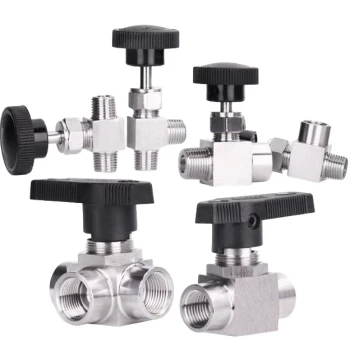
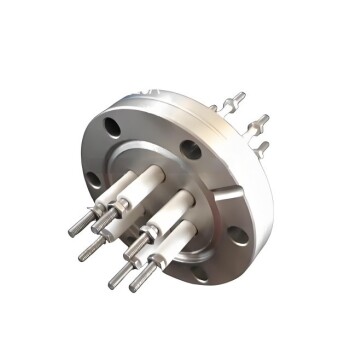
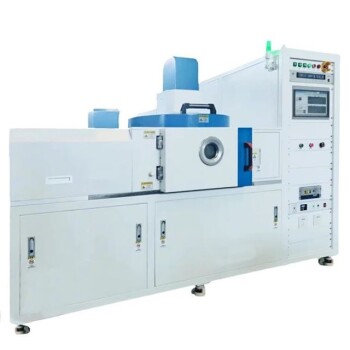
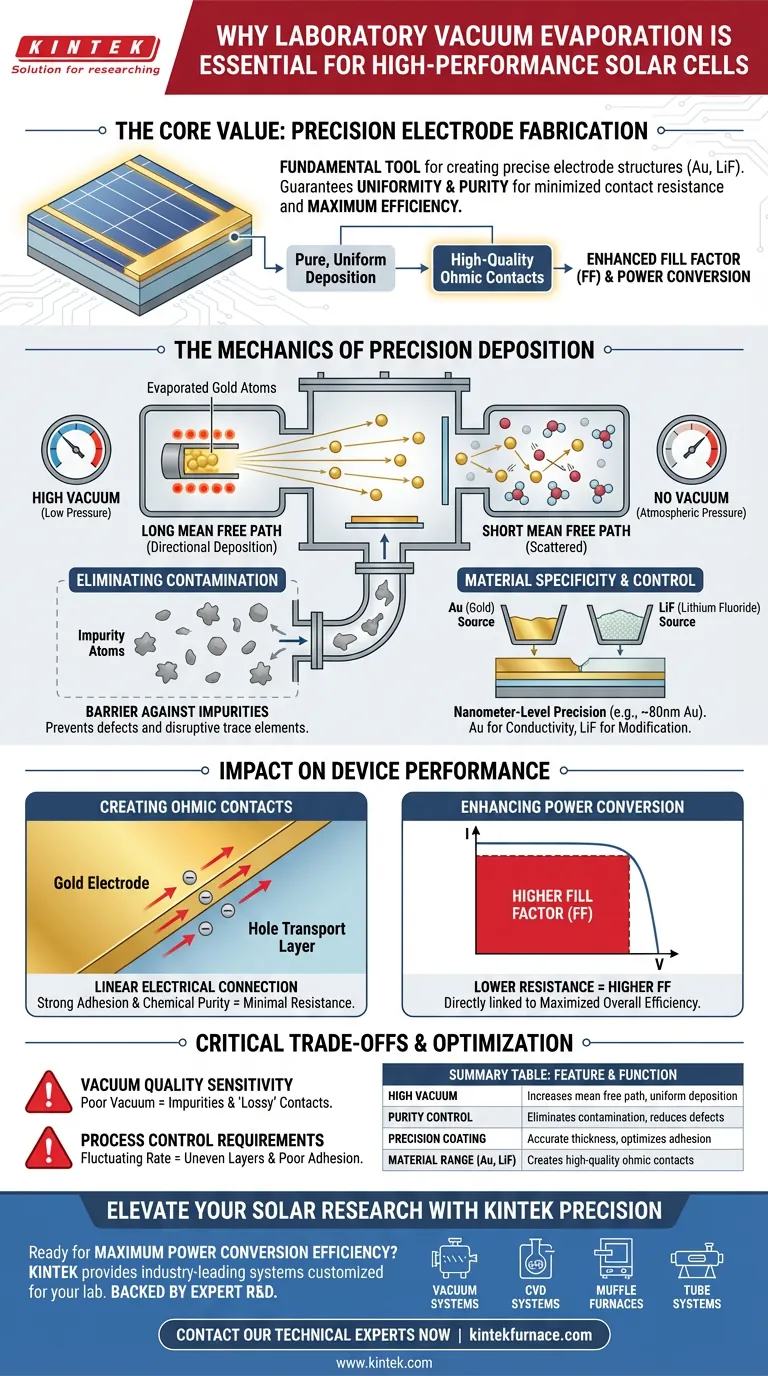
A laboratory vacuum evaporation system is the fundamental tool required to fabricate the precise electrode structures necessary for high-performance solar cells. Specifically, it allows for the thermal evaporation of gold (Au) and lithium fluoride (LiF) modification layers under high-vacuum conditions. This equipment is essential because it guarantees the uniformity and purity of the metal deposition, which is the only way to minimize contact resistance and ensure the device functions efficiently.
The core value of this system lies in its ability to create high-quality ohmic contacts through pure, uniform deposition; this directly enhances the Fill Factor (FF) and maximizes the overall power conversion efficiency of the solar cell.
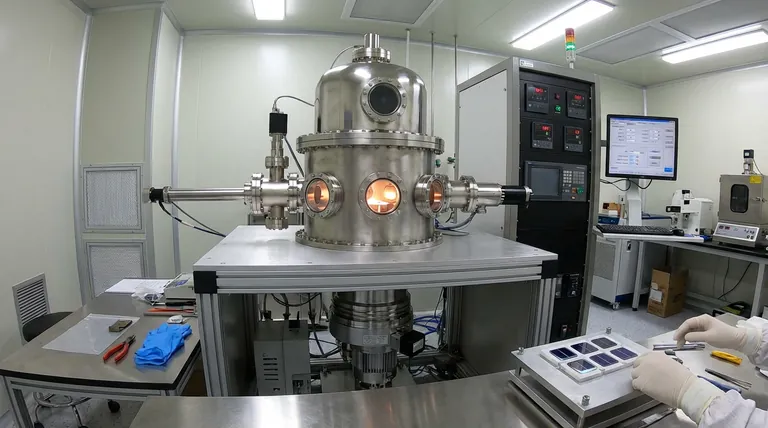
The Mechanics of Precision Deposition
To understand why this system is non-negotiable, one must look at the physical behavior of atoms during the coating process.
The Role of High Vacuum
The system operates by creating an extremely low-pressure environment. In this state, the "mean free path" of the evaporated atoms increases significantly.
This means gold atoms can travel from the source to the device surface without colliding with gas molecules. This directional path is critical for ensuring the electrode is deposited exactly where it is needed without scattering.
Eliminating Contamination
The high-vacuum state serves a dual purpose: it acts as a barrier against contamination.
By removing atmospheric gases, the system prevents impurity atoms from becoming trapped within the electrode layer. Even trace impurities can disrupt the electrical properties of the material, so this purity is essential for performance.
Material Specificity
The system is specifically optimized for depositing materials like gold (Au) and lithium fluoride (LiF).
Gold is selected for its superior electrical conductivity, while LiF acts as a crucial modification layer. The thermal evaporation process allows these distinct materials to be layered with nanometer-level precision.
Impact on Device Performance
The physical deposition process translates directly into the electrical metrics of the solar cell.
Creating Ohmic Contacts
The primary goal of the electrode is to extract current from the device. To do this efficiently, the interface between the electrode and the semiconductor must be an ohmic contact.
The vacuum system ensures that the gold electrode (often around 80 nm thick) adheres perfectly to the hole transport layer. This strong adhesion and chemical purity create a linear electrical connection with minimal resistance.
Enhancing Power Conversion
Minimizing contact resistance has a cascading effect on the solar cell's output.
Lower resistance leads to a higher Fill Factor (FF), which is a measure of the "squareness" of the current-voltage curve. A higher FF is mathematically tied to higher overall power conversion efficiency, particularly in complex architectures like triple-junction solar cells.
Understanding the Critical Trade-offs
While vacuum evaporation is essential for high performance, it introduces specific challenges that must be managed.
Sensitivity to Vacuum Quality
The quality of the electrode is entirely dependent on the quality of the vacuum.
If the pressure is not sufficiently low, the mean free path shortens, and impurities will act as defects in the electrode. This results in "lossy" contacts that dissipate power rather than extracting it.
Process Control Requirements
Achieving an optimal 80 nm thickness requires precise thermal control.
Fluctuations in evaporation rate can lead to uneven layers. An uneven layer may fail to provide adequate coverage or adhesion, compromising the mechanical stability of the contact.
Optimizing Your Fabrication Strategy
To ensure your solar cell preparation yields the best results, consider how these variables align with your specific objectives.
- If your primary focus is maximizing efficiency: Prioritize the highest possible vacuum levels to eliminate impurities and maximize the Fill Factor (FF).
- If your primary focus is mechanical stability: Focus on the thermal control of the evaporation rate to ensure strong adhesion between the gold electrode and the hole transport layer.
The vacuum evaporation system is not just a coating tool; it is the bridge between raw materials and a functioning, high-efficiency energy device.
Summary Table:
| Feature | Function in Solar Cell Fabrication | Impact on Performance |
|---|---|---|
| High Vacuum | Increases mean free path of atoms | Ensures uniform, directional deposition |
| Purity Control | Eliminates atmospheric contamination | Reduces defects and electrical losses |
| Precision Coating | Accurate thickness (e.g., 80nm Au) | Optimizes adhesion and conductivity |
| Material Range | Thermal evaporation of Au and LiF | Creates high-quality ohmic contacts |
Elevate Your Solar Research with KINTEK Precision
Ready to achieve maximum power conversion efficiency? KINTEK provides industry-leading laboratory vacuum systems tailored for high-performance electrode preparation. Backed by expert R&D and manufacturing, we offer a comprehensive range of customizable solutions—including Vacuum, CVD, Muffle, and Tube systems—designed to meet the unique needs of your lab.
Maximize your Fill Factor and ensure pure, uniform deposition today. Contact our technical experts now to find the perfect high-temperature furnace or vacuum system for your research.
Visual Guide
References
- Hang Hu, Ulrich W. Paetzold. Triple-junction perovskite–perovskite–silicon solar cells with power conversion efficiency of 24.4%. DOI: 10.1039/d3ee03687a
This article is also based on technical information from Kintek Furnace Knowledge Base .
Related Products
- 304 316 Stainless Steel High Vacuum Ball Stop Valve for Vacuum Systems
- Cylindrical Resonator MPCVD Machine System for Lab Diamond Growth
- Vacuum Induction Melting Furnace
- Custom Made Versatile CVD Tube Furnace Chemical Vapor Deposition CVD Equipment Machine
- CF KF Flange Vacuum Electrode Feedthrough Lead Sealing Assembly for Vacuum Systems
People Also Ask
- What role do vacuum-sealed high-purity silica ampoules play in phase equilibrium experiments? Enhance Sample Integrity
- What is the function of quartz vacuum encapsulation in RhSeCl CVT? Mastering Pure Crystal Growth
- What role does a closed pressure vessel play during the carbonation of gamma-C2S? Unlock Rapid Mineralization
- What type of pump is used in water circulating vacuum pumps and how is it installed? Discover Robust Fluid-Based Vacuum Solutions
- What is the specific function of the water circulation cooler in zirconium sponge processing? Key for Purity & Safety