
The vacuum drying oven is indispensable for preserving the chemical purity and structural architecture of CuCl nano-arrays. It serves a dual purpose: extracting deep-seated moisture from the complex nickel foam porosity while simultaneously maintaining an oxygen-free environment to prevent rapid surface oxidation.
By lowering the boiling point of residual liquids, vacuum drying protects the delicate CuCl crystallinity from thermal damage and prevents the chemical degradation that occurs in atmospheric conditions.
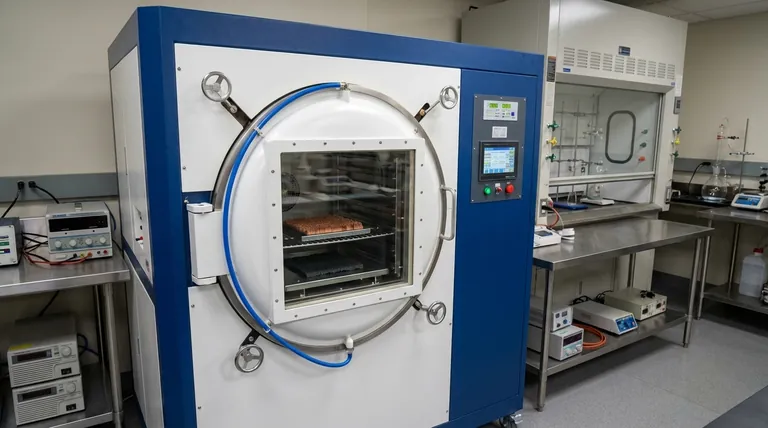
Critical Preservation of Material Integrity
The synthesis of CuCl nano-arrays is a delicate process where structure defines performance. The vacuum drying oven addresses specific vulnerabilities in the material.
Preventing Surface Oxidation
Copper (I) Chloride (CuCl) is highly susceptible to oxidation when exposed to air, especially at elevated temperatures. A standard drying oven would expose the hot arrays to atmospheric oxygen, degrading the material.
The vacuum environment eliminates oxygen during the drying process. This ensures the chemical composition remains pure CuCl rather than converting into unwanted copper oxides.
Protecting Nano-Array Morphology
The physical shape—or morphology—of the nano-arrays is fragile. High temperatures required for standard drying can cause these microscopic structures to collapse or agglomerate.
Vacuum drying allows solvents to evaporate at significantly lower temperatures. This gentle evaporation preserves the intricate geometry of the nano-arrays and maintains the precise crystallinity of the precursor.
Navigating the Multi-Porous Structure
Nickel foam is a complex, 3D scaffold with deep, multi-porous channels. Surface drying techniques often fail to remove liquid trapped deep within this matrix.
The pressure differential in a vacuum oven forces moisture and residual solvents out of these deep micropores. This ensures the material is dry throughout, not just on the exterior surface.
Optimizing Electrochemical Performance
Beyond mere preservation, the vacuum drying process actively prepares the electrode for its final application.
Reducing Interfacial Resistance
For an electrode to function efficiently, electrons must move freely between the material and the electrolyte. Residual moisture or oxidation layers create barriers that impede this flow.
By thoroughly removing contaminants and preventing oxide layers, the vacuum oven significantly reduces interfacial resistance. This leads to sharper, more accurate electrical property measurements.
Enhancing Electrolyte Infiltration
The ultimate goal is often to pair the electrode with an electrolyte, such as a PVA-KOH gel. If the micropores are blocked by residual solvents, the electrolyte cannot penetrate.
Vacuum drying leaves the pores completely open and accessible. This allows the electrolyte to effectively wet and infiltrate the electrode arrays, maximizing the active surface area available for the reaction.
Common Pitfalls to Avoid
Understanding what happens without this equipment highlights its necessity.
The Risk of Thermal Degradation
Using a conventional high-temperature blast oven is often a mistake for CuCl synthesis. The higher heat required to evaporate water at atmospheric pressure can induce structural collapse or phase changes in the crystalline lattice.
The Hidden Danger of Trapped Moisture
If you rely on air drying, moisture often remains trapped in the nickel foam's pores. This residual water can trigger side reactions or electrolyte decomposition later, compromising the long-term stability of the device.
Making the Right Choice for Your Goal
The vacuum drying step is not a formality; it is a control point for quality.
- If your primary focus is Chemical Purity: Rely on the vacuum environment to strictly prevent surface oxidation and maintain the specific CuCl stoichiometry.
- If your primary focus is Electrochemical Efficiency: Use the vacuum process to ensure deep pore clearance, which lowers resistance and maximizes electrolyte wetting.
The vacuum drying oven is the bridge between a fragile chemical precursor and a robust, high-performance electrode.
Summary Table:
| Feature | Impact on CuCl/Nickel Foam Synthesis | Benefit to Material Performance |
|---|---|---|
| Oxygen-Free Environment | Prevents CuCl from converting to copper oxides | Ensures high chemical purity and stoichiometry |
| Lower Boiling Point | Facilitates low-temperature solvent evaporation | Protects delicate nano-structures from thermal collapse |
| Pressure Differential | Extracts liquids from deep 3D nickel foam pores | Ensures thorough drying and prevents side reactions |
| Pore Clearance | Opens microscopic channels for gel electrolytes | Enhances wetting and maximizes active surface area |
| Oxide Prevention | Eliminates resistive surface layers | Significantly reduces interfacial resistance |
Elevate Your Nano-Material Synthesis with KINTEK
Precise control over your drying environment is the difference between a high-performance electrode and a failed experiment. KINTEK provides industry-leading Vacuum, Muffle, and Tube furnace systems specifically designed to meet the rigorous demands of advanced material research.
Whether you are synthesizing CuCl nano-arrays or complex 3D scaffolds, our expert-backed R&D and customizable manufacturing ensure your lab equipment is tailored to your unique specifications. Contact KINTEK today to discover how our specialized high-temp solutions can optimize your electrochemical performance and protect your material integrity.
Visual Guide

References
- Tao Chen, Qiangchun Liu. RuCu Nanorod Arrays Synergistically Promote Efficient Water-Splitting. DOI: 10.3390/catal15010098
This article is also based on technical information from Kintek Furnace Knowledge Base .
Related Products
- Vacuum Heat Treat Sintering and Brazing Furnace
- Vacuum Heat Treat Sintering Furnace Molybdenum Wire Vacuum Sintering Furnace
- Dental Porcelain Zirconia Sintering Ceramic Vacuum Press Furnace
- Molybdenum Vacuum Heat Treat Furnace
- Vacuum Hot Press Furnace Machine Heated Vacuum Press
People Also Ask
- How does vacuum heat treating affect the grain structure of metal alloys? Achieve Precise Microstructure Control
- What is one of the most important uses of vacuum heat treating furnaces in aerospace? Achieve Superior Strength in Aircraft Alloys
- What are the benefits of using vacuum heat treating furnaces for metal alloys? Achieve Superior Metal Properties and Performance
- What is the temperature of a vacuum furnace brazing? Optimize Your Joint Strength and Cleanliness
- What are the steps involved in a typical vacuum brazing treatment? Master the Process for Strong, Clean Joints












