
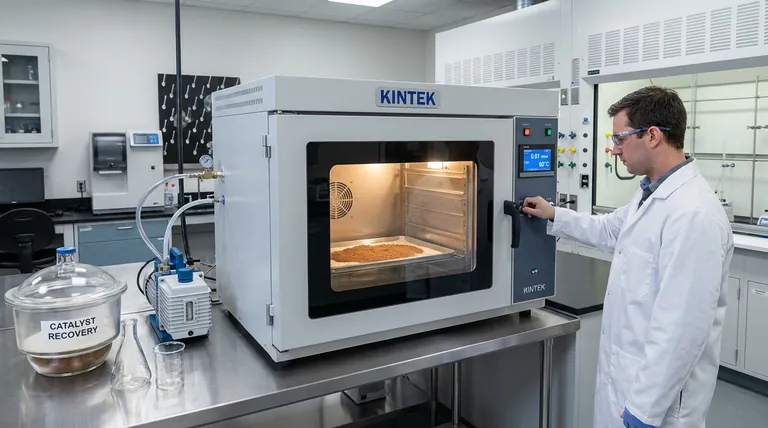
The significance of using a laboratory vacuum drying oven during the catalyst recovery phase of depolymerization lies in its ability to preserve active sites. By creating a low-pressure environment, it removes residual solvents and moisture from catalyst pores at significantly reduced temperatures. This specific process is required to prevent the premature decomposition of active nitro functional groups and avoids oxidative damage that would occur if the material were exposed to high heat and atmospheric oxygen.
Core Takeaway Vacuum drying decouples solvent removal from thermal stress. By lowering the boiling point of liquids trapped within the catalyst, you can achieve deep drying without subjecting the material to temperatures that degrade its chemical structure, ensuring that any loss of activity is due to the reaction itself, not the recovery process.
Preserving Chemical Integrity
Protecting Sensitive Functional Groups
In catalytic depolymerization, catalysts often contain specific active sites, such as nitro functional groups, which are thermally sensitive.
Standard drying methods require high temperatures to evaporate solvents, which can cause these groups to decompose before the catalyst is even reused.
Eliminating Oxidative Stress
Heating a catalyst in a standard oven exposes it to atmospheric oxygen, accelerating degradation.
A vacuum oven operates in an oxygen-depleted environment, which prevents oxidative deterioration of the catalyst surface and protects organic-inorganic hybrid structures from breaking down.
Maintaining Physical Structure
Preventing Agglomeration
When catalysts are dried at high temperatures under standard pressure, rapid evaporation can cause particles to fuse together.
This phenomenon, known as hard agglomeration or high-temperature cracking, reduces the active surface area. Vacuum drying maintains a loose, porous powder structure, which is essential for maximizing contact area in subsequent reaction cycles.
Deep Pore Cleaning
Catalysts used in depolymerization often have complex, porous structures where solvents and moisture can become trapped.
The vacuum environment lowers the boiling point of these trapped liquids, allowing them to evaporate efficiently from deep within the catalyst pores without requiring damaging heat levels.
Ensuring Reliable Data
Establishing True Reusability
The primary goal of recovering a catalyst is to test its stability over multiple cycles (reusability).
If the drying process damages the catalyst, it becomes impossible to distinguish between degradation caused by the chemical reaction and degradation caused by the drying step.
Standardization of Recovery
Using a vacuum drying oven provides a consistent, reproducible baseline for catalyst treatment.
This ensures that the catalyst is chemically clean and structurally sound before undergoing secondary calcination or regeneration, thereby improving the reliability of stability tests.
Understanding the Trade-offs
Process Speed vs. Integrity
While vacuum drying preserves quality, it can be a slower process compared to high-temperature blast drying.
You are trading rapid turnover for material preservation; rushing this stage with higher heat defeats the purpose of the vacuum environment.
Equipment Maintenance
Unlike standard ovens, vacuum ovens require the maintenance of seals and pumps to ensure a consistent pressure drop.
A leak in the system can introduce oxygen and raise the effective boiling point, inadvertently leading to the incomplete removal of solvents or oxidation of the sample.
Making the Right Choice for Your Goal
To maximize the effectiveness of your catalyst recovery phase, consider the following specific goals:
- If your primary focus is preserving active sites: Set the temperature well below the thermal decomposition threshold of your specific functional groups (e.g., nitro groups) and rely on deep vacuum for evaporation.
- If your primary focus is preventing agglomeration: Ensure the vacuum is applied gradually to prevent "bumping," allowing the powder to remain loose and avoiding surface compaction.
- If your primary focus is reusability data: Standardize the vacuum level and time exactly across all batches to eliminate drying variables from your stability analysis.
The vacuum drying oven is not merely a drying tool; it is a preservation instrument essential for validating the true lifecycle of your catalyst.
Summary Table:
| Feature | Impact on Catalyst Recovery | Benefit in Depolymerization |
|---|---|---|
| Low-Pressure Drying | Lowers solvent boiling points | Prevents thermal decomposition of nitro groups |
| Oxygen-Free Environment | Eliminates atmospheric oxygen | Prevents oxidative damage to catalyst surface |
| Low-Temp Evaporation | Minimizes thermal stress | Avoids particle agglomeration and cracking |
| Deep Pore Extraction | Efficiently removes trapped liquids | Cleans porous structures for accurate reusability data |
Maximize Catalyst Life with KINTEK Precision
Don't let thermal stress compromise your research. KINTEK’s high-performance laboratory vacuum ovens are designed to provide the precise temperature control and stable vacuum environments necessary for sensitive catalyst recovery.
Backed by expert R&D and manufacturing, KINTEK offers Muffle, Tube, Rotary, Vacuum, and CVD systems, all customizable to meet the unique needs of your depolymerization and material science projects. Our equipment ensures your catalysts maintain their chemical integrity cycle after cycle.
Ready to elevate your lab's efficiency? Contact us today to find your custom solution!
References
- Miguel García-Rollán, Tomás Cordero. Biobased Vanillin Production by Oxidative Depolymerization of Kraft Lignin on a Nitrogen- and Phosphorus-Functionalized Activated Carbon Catalyst. DOI: 10.1021/acs.energyfuels.4c00108
This article is also based on technical information from Kintek Furnace Knowledge Base .
Related Products
- 1200℃ Muffle Oven Furnace for Laboratory
- High Temperature Muffle Oven Furnace for Laboratory Debinding and Pre Sintering
- 1700℃ High Temperature Muffle Oven Furnace for Laboratory
- Laboratory Vacuum Tilt Rotary Tube Furnace Rotating Tube Furnace
- High Pressure Laboratory Vacuum Tube Furnace
People Also Ask
- How does a high-temperature laboratory muffle furnace affect material properties? Transform Anodic Oxide Films Fast
- What is the primary function of a high-temperature laboratory muffle furnace in chemical synthesis? Achieve Precision.
- How is a laboratory muffle furnace used in 3D-printed PP-CF cross-linking? Achieve Thermal Stability at 150 °C
- Why is a laboratory high-temperature muffle furnace used for BaTiO3? Achieve Optimal Tetragonal Crystalline Phases
- What is the role of a laboratory high-temperature muffle furnace in iron analysis? Key to Precise Sample Mineralization











