Knowledge What is the primary function of a high-temperature sintering furnace operating at 1173 K in the preparation of porous oxide precursors? Achieve Structural Integrity for Your Precursors
Author avatar

Tech Team · Kintek Furnace

Updated 1 day ago

What is the primary function of a high-temperature sintering furnace operating at 1173 K in the preparation of porous oxide precursors? Achieve Structural Integrity for Your Precursors


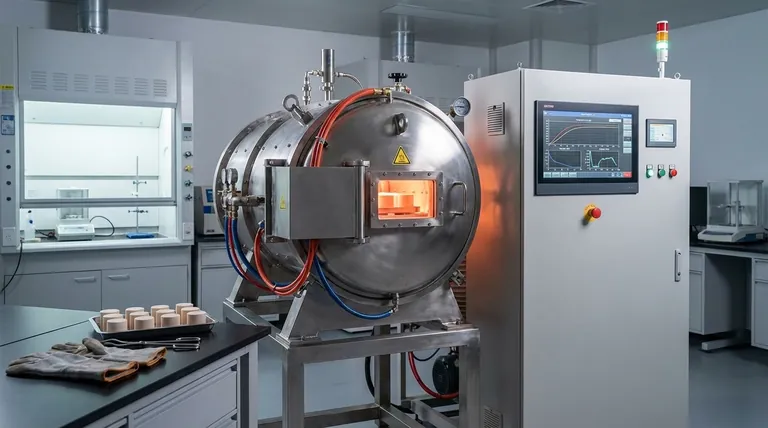
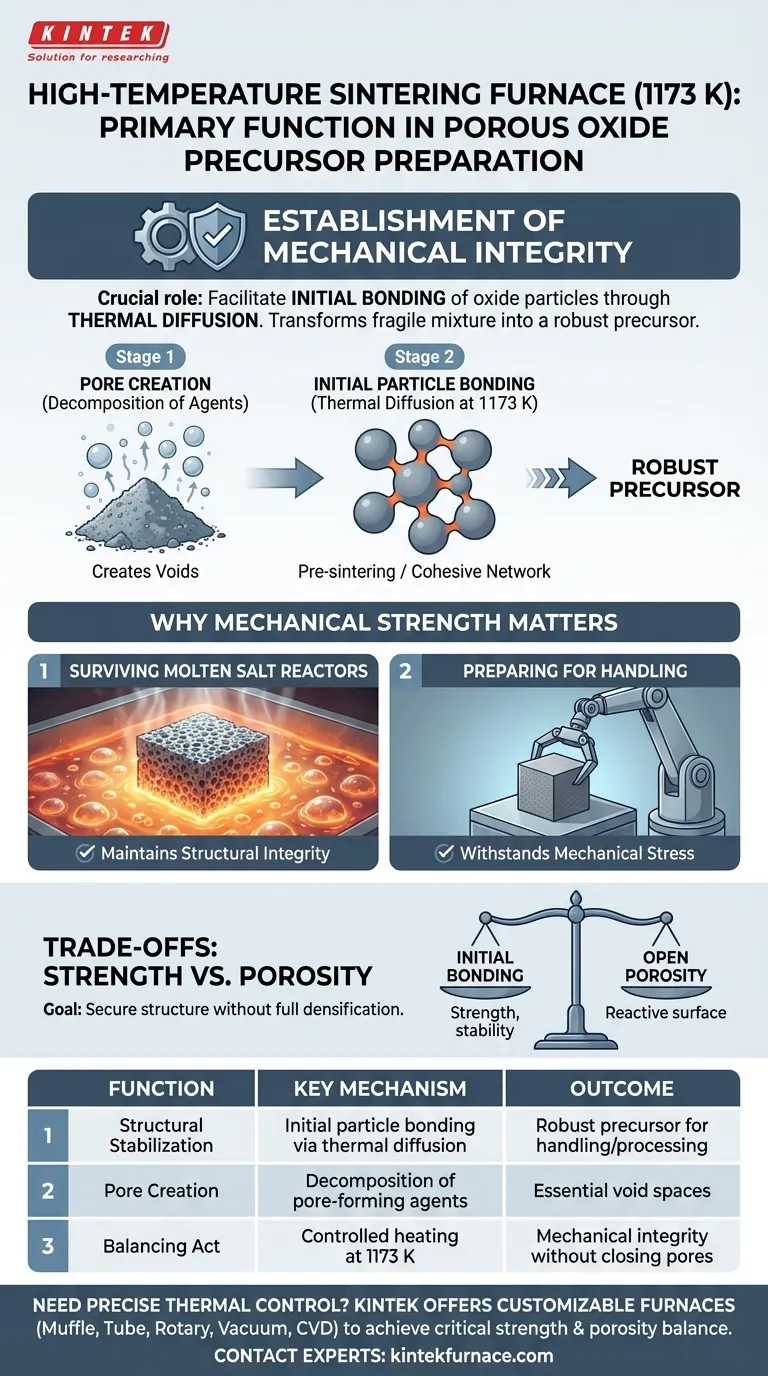
The primary function is the establishment of mechanical integrity. While the furnace at 1173 K does decompose pore-forming agents to create voids, its most critical role is to facilitate the initial bonding of oxide particles through thermal diffusion. This process transforms a fragile mixture into a robust precursor capable of surviving harsh downstream environments.

The core objective at this temperature is not full densification, but rather structural stabilization. The heat treatment imparts just enough mechanical strength to maintain the porous shape without closing off the essential void spaces.
What is the primary function of a high-temperature sintering furnace operating at 1173 K in the preparation of porous oxide precursors? Achieve Structural Integrity for Your Precursors

The Mechanism of Precursor Formation

Beyond Pore Creation

It is a common misconception that the furnace is used solely to remove the pore-forming agent.

While the heat does decompose these agents to generate the desired porous structure, this is only the first step. If the process stopped here, the remaining oxide skeleton would be too fragile to handle.

Initial Particle Bonding

The defining function at 1173 K is thermal diffusion.

At this temperature, the oxide particles begin to bond with one another. This "pre-sintering" initiates the growth of necks between particles, creating a cohesive network rather than a loose pile of dust.

Why Mechanical Strength Matters

Surviving Molten Salt Reactors

The references highlight a specific downstream application: molten salt electrolysis.

The precursor must possess sufficient strength to maintain its structural integrity when submerged in a molten salt reactor. Without the bonding achieved at 1173 K, the porous oxide would likely disintegrate upon contact with the reactive, turbulent salt melt.

Preparing for Handling

This heating stage serves as a bridge between raw compaction and final usage.

Whether the next step involves high-pressure hot re-pressing or direct electrolysis, the "green compact" (the pressed powder) requires preliminary bonding to withstand mechanical stress. The furnace ensures the material is robust enough to be moved and processed without crumbling.

Understanding the Trade-offs

Strength vs. Porosity

There is a delicate balance to strike during this heat treatment phase.

The goal is to achieve initial bonding without triggering full sintering. If the temperature were significantly higher or maintained too long, the material might densify completely, closing the pores you worked to create.

Conversely, if the bonding is insufficient, the precursor will fail mechanically. The 1173 K operating point is selected to secure the structure while preserving the open porosity required for chemical interaction.

Making the Right Choice for Your Goal

To optimize your preparation of porous oxide precursors, consider the following regarding the sintering temperature:

  • If your primary focus is Structural Survival: Ensure the residence time at 1173 K is sufficient to maximize thermal diffusion, preventing disintegration in the electrolysis reactor.
  • If your primary focus is Pore Connectivity: Monitor the bonding process to ensure particle necking does not advance to the point of closing off the porous channels required for reaction efficiency.

The furnace ultimately acts as a stabilizer, locking in the porous architecture so it can perform its function in the electrolytic cell.

Summary Table:

Function Key Mechanism Outcome
Structural Stabilization Initial particle bonding via thermal diffusion Robust precursor capable of handling and downstream processing
Pore Creation Decomposition of pore-forming agents Generation of essential void spaces and porous architecture
Balancing Act Controlled heating at 1173 K Achieves mechanical integrity without closing off pores

Need a furnace that delivers precise thermal control for your porous precursor development?

Backed by expert R&D and manufacturing, KINTEK offers Muffle, Tube, Rotary, Vacuum, and CVD systems, and other lab high-temp furnaces, all customizable for unique needs like achieving the critical balance between mechanical strength and porosity. Our furnaces provide the reliable performance required for applications from materials research to molten salt electrolysis.

Contact our experts today to discuss how a KINTEK furnace can stabilize your process and enhance your results.

Visual Guide
What is the primary function of a high-temperature sintering furnace operating at 1173 K in the preparation of porous oxide precursors? Achieve Structural Integrity for Your Precursors Visual Guide

Related Products

People Also Ask

Related Products

Molybdenum Vacuum Heat Treat Furnace

Molybdenum Vacuum Heat Treat Furnace

High-performance molybdenum vacuum furnace for precise 1400°C heat treatment. Ideal for sintering, brazing, and crystal growth. Durable, efficient, and customizable.

1400℃ Muffle Oven Furnace for Laboratory

1400℃ Muffle Oven Furnace for Laboratory

KT-14M Muffle Furnace: Precision 1400°C heating with SiC elements, PID control, and energy-efficient design. Ideal for labs.

Vacuum Heat Treat Sintering Furnace Molybdenum Wire Vacuum Sintering Furnace

Vacuum Heat Treat Sintering Furnace Molybdenum Wire Vacuum Sintering Furnace

KINTEK's Vacuum Molybdenum Wire Sintering Furnace excels in high-temperature, high-vacuum processes for sintering, annealing, and material research. Achieve precise 1700°C heating with uniform results. Custom solutions available.

1200℃ Split Tube Furnace Laboratory Quartz Tube Furnace with Quartz Tube

1200℃ Split Tube Furnace Laboratory Quartz Tube Furnace with Quartz Tube

Discover KINTEK's 1200℃ Split Tube Furnace with quartz tube for precise high-temperature lab applications. Customizable, durable, and efficient. Get yours now!

1400℃ High Temperature Laboratory Tube Furnace with Quartz and Alumina Tube

1400℃ High Temperature Laboratory Tube Furnace with Quartz and Alumina Tube

KINTEK's Tube Furnace with Alumina Tube: Precision high-temperature processing up to 2000°C for labs. Ideal for material synthesis, CVD, and sintering. Customizable options available.

1700℃ High Temperature Laboratory Tube Furnace with Quartz or Alumina Tube

1700℃ High Temperature Laboratory Tube Furnace with Quartz or Alumina Tube

KINTEK's Tube Furnace with Alumina Tube: Precision heating up to 1700°C for material synthesis, CVD, and sintering. Compact, customizable, and vacuum-ready. Explore now!

Laboratory Muffle Oven Furnace with Bottom Lifting

Laboratory Muffle Oven Furnace with Bottom Lifting

Boost lab efficiency with KT-BL Bottom Lifting Furnace: precise 1600℃ control, superior uniformity, and enhanced productivity for material science and R&D.

1400℃ Controlled Inert Nitrogen Atmosphere Furnace

1400℃ Controlled Inert Nitrogen Atmosphere Furnace

KT-14A Controlled Atmosphere Furnace for labs & industry. 1400°C max temp, vacuum sealing, inert gas control. Customizable solutions available.

2200 ℃ Tungsten Vacuum Heat Treat and Sintering Furnace

2200 ℃ Tungsten Vacuum Heat Treat and Sintering Furnace

2200°C Tungsten Vacuum Furnace for high-temperature materials processing. Precise control, superior vacuum, customizable solutions. Ideal for research & industrial applications.

1700℃ High Temperature Muffle Oven Furnace for Laboratory

1700℃ High Temperature Muffle Oven Furnace for Laboratory

KT-17M Muffle Furnace: High-precision 1700°C lab furnace with PID control, energy efficiency, and customizable sizes for industrial & research applications.

1700℃ Controlled Inert Nitrogen Atmosphere Furnace

1700℃ Controlled Inert Nitrogen Atmosphere Furnace

KT-17A Controlled Atmosphere Furnace: Precise 1700°C heating with vacuum & gas control. Ideal for sintering, research & material processing. Explore now!

600T Vacuum Induction Hot Press Vacuum Heat Treat and Sintering Furnace

600T Vacuum Induction Hot Press Vacuum Heat Treat and Sintering Furnace

600T Vacuum Induction Hot Press Furnace for precise sintering. Advanced 600T pressure, 2200°C heating, vacuum/atmosphere control. Ideal for research & production.

Laboratory Quartz Tube Furnace RTP Heating Tubular Furnace

Laboratory Quartz Tube Furnace RTP Heating Tubular Furnace

KINTEK's RTP Rapid Heating Tube Furnace delivers precise temperature control, rapid heating up to 100°C/sec, and versatile atmosphere options for advanced lab applications.

9MPa Air Pressure Vacuum Heat Treat and Sintering Furnace

9MPa Air Pressure Vacuum Heat Treat and Sintering Furnace

Achieve superior ceramic densification with KINTEK's advanced air pressure sintering furnace. High-pressure up to 9MPa, precise 2200℃ control.

1800℃ High Temperature Muffle Oven Furnace for Laboratory

1800℃ High Temperature Muffle Oven Furnace for Laboratory

KINTEK Muffle Furnaces: Precision 1800°C heating for labs. Energy-efficient, customizable, with PID control. Ideal for sintering, annealing, and research.

Vacuum Heat Treat Sintering Furnace with Pressure for Vacuum Sintering

Vacuum Heat Treat Sintering Furnace with Pressure for Vacuum Sintering

KINTEK's Vacuum Pressure Sintering Furnace offers 2100℃ precision for ceramics, metals, and composites. Customizable, high-performance, and contamination-free. Get a quote now!

High Pressure Laboratory Vacuum Tube Furnace Quartz Tubular Furnace

High Pressure Laboratory Vacuum Tube Furnace Quartz Tubular Furnace

KINTEK High Pressure Tube Furnace: Precision heating up to 1100°C with 15Mpa pressure control. Ideal for sintering, crystal growth, and lab research. Customizable solutions available.

2200 ℃ Graphite Vacuum Heat Treat Furnace

2200 ℃ Graphite Vacuum Heat Treat Furnace

2200℃ Graphite Vacuum Furnace for high-temperature sintering. Precise PID control, 6*10⁻³Pa vacuum, durable graphite heating. Ideal for research & production.

Vacuum Heat Treat Furnace with Ceramic Fiber Liner

Vacuum Heat Treat Furnace with Ceramic Fiber Liner

KINTEK's Vacuum Furnace with Ceramic Fiber Lining offers precise high-temperature processing up to 1700°C, ensuring uniform heat distribution and energy efficiency. Ideal for labs and production.

Small Vacuum Heat Treat and Tungsten Wire Sintering Furnace

Small Vacuum Heat Treat and Tungsten Wire Sintering Furnace

Compact vacuum tungsten wire sintering furnace for labs. Precise, mobile design with superior vacuum integrity. Ideal for advanced material research. Contact us!


Leave Your Message


















