The single-stage artificial aging process (T6) strengthens AA7050 aluminum alloy wire by subjecting the material to a sustained, constant temperature, typically 120°C for 24 hours. This controlled thermal exposure triggers the uniform precipitation of microscopic particles that reinforce the alloy's internal structure.
The T6 process is designed to achieve peak mechanical strength. It accomplishes this by saturating the alloy matrix with dispersed $\eta'$ phases, which create a "pinning effect" that physically prevents the metal from deforming under stress.
The Mechanism of Strengthening
To understand why the T6 state delivers such high strength, we must look at the microscopic changes occurring during the heating cycle.
Controlled Thermal Exposure
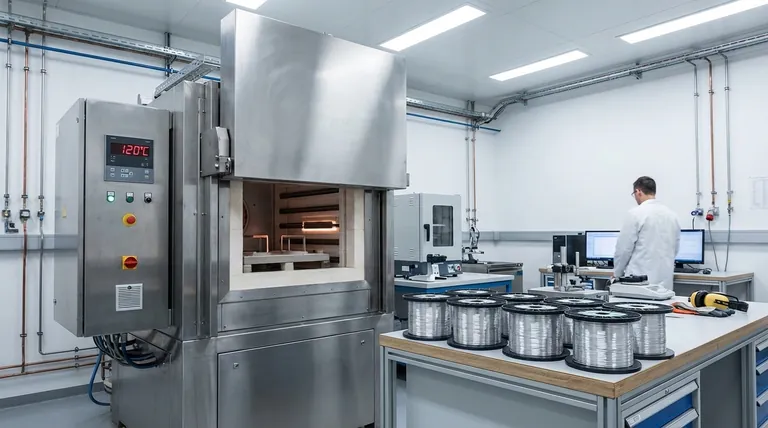
The process relies on precision. The AA7050 wire is placed in a drying oven or aging furnace where the temperature is strictly maintained.
Standard parameters usually involve holding the alloy at 120 degrees Celsius for 24 hours. This specific combination of time and temperature provides the energy required to activate the precipitation hardening mechanism without overheating the material.
Formation of the $\eta'$ Phase
During this 24-hour window, the supersaturated solid solution within the alloy begins to decompose.
This leads to the precipitation of a vast number of nanometer-scale $\eta'$ phases. These are not random defects; they are specific, hardened particles that disperse evenly throughout the aluminum matrix.
The Dislocation Pinning Effect
The ultimate source of the wire's strength is the interaction between these new $\eta'$ phases and the metal's natural defects, known as dislocations.
Under normal conditions, metal bends or breaks because these dislocations move through the crystal lattice. However, the dispersed $\eta'$ phases act as barriers. They effectively block dislocation movement, creating a "pinning effect" that makes the material significantly harder to deform.
Understanding the Trade-offs
While the T6 state offers maximum strength, it is essential to recognize the limitations inherent in this single-stage process compared to multi-stage alternatives like T73.
Strength vs. Corrosion Resistance
The T6 process prioritizes mechanical strength above all else. However, the continuous distribution of precipitates that provides this strength can make the alloy more susceptible to environmental factors.
In contrast, the T73 state uses a two-stage process (often finishing at higher temperatures like 175°C). This causes the precipitates to coarsen and form a discontinuous distribution.
The Cost of Maximum Hardness
Choosing T6 means accepting a compromise.
While T73 improves stress corrosion resistance and fracture toughness—critical for safety-critical aerospace fasteners—it results in a minor reduction in strength compared to T6. The T6 state remains the superior choice when raw tensile strength is the primary engineering requirement.
Making the Right Choice for Your Goal
Selecting the correct aging process depends entirely on the specific demands of your application.
- If your primary focus is Peak Strength: Utilize the T6 single-stage process (120°C for 24 hours) to maximize dislocation pinning and achieve the highest possible tensile limits.
- If your primary focus is Environmental Durability: Consider the T73 two-stage process to sacrifice a small amount of strength in exchange for significantly improved stress corrosion resistance and fracture toughness.
Ultimately, the T6 state represents the upper limit of the alloy's load-bearing capacity through precise, nanometer-scale structural reinforcement.
Summary Table:
| Feature | Single-Stage Aging (T6) | Two-Stage Aging (T73) |
|---|---|---|
| Temperature/Time | 120°C for 24 hours | Two stages (e.g., up to 175°C) |
| Primary Mechanism | Dense η' phase precipitation | Coarsened, discontinuous precipitates |
| Main Advantage | Peak mechanical & tensile strength | High stress corrosion resistance |
| Key Limitation | Lower corrosion resistance | Minor reduction in raw strength |
| Best For | High load-bearing applications | Aerospace fasteners/Safety-critical components |
Maximize Your Material Strength with KINTEK Precision Aging Solutions
Achieving the perfect T6 or T73 state requires absolute thermal precision. Backed by expert R&D and manufacturing, KINTEK offers high-performance drying ovens, muffle furnaces, and vacuum systems designed to maintain the strict temperature stability needed for advanced precipitation hardening. Whether you are treating AA7050 wire for peak strength or environmental durability, our customizable lab high-temp furnaces ensure uniform heating every time.
Ready to optimize your alloy processing? Contact us today to find your custom furnace solution!
References
- Xinyu Gao, Baiqing Xiong. Effects of Different Heating and Cooling Rates during Solution Treatment on Microstructure and Properties of AA7050 Alloy Wires. DOI: 10.3390/ma17020310
This article is also based on technical information from Kintek Furnace Knowledge Base .
Related Products
- Small Vacuum Heat Treat and Tungsten Wire Sintering Furnace
- 1700℃ High Temperature Laboratory Tube Furnace with Alumina Tube
- Multi Zone Laboratory Quartz Tube Furnace Tubular Furnace
- Ultra-High Vacuum Flange Aviation Plug Glass Sintered Airtight Circular Connector for KF ISO CF
- 1400℃ High Temperature Laboratory Tube Furnace with Alumina Tube
People Also Ask
- How does vacuum sintering improve dimensional tolerances? Achieve Uniform Shrinkage and Precision
- What are the key components of a vacuum sintering furnace? Essential Parts for Precision Material Processing
- What is the purpose of setting a mid-temperature dwell stage? Eliminate Defects in Vacuum Sintering
- What are the main structural components of a vacuum sintering furnace? Unlock Precision in High-Temperature Processing
- What are the main types of sintering furnaces? Find the Perfect Match for Your Materials