
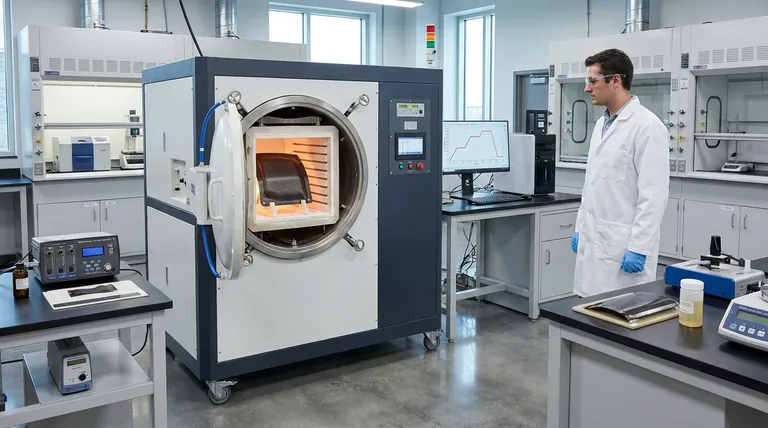
Programmable heating equipment is essential for composite curing because it allows for the precise regulation of heating rates (ramps) and specific temperature maintenance periods (isothermal holds). Rather than simply applying heat, this equipment enables you to dictate the exact speed of temperature increase—such as 1 °C/min or 5 °C/min—which is critical for synchronizing the material's chemical reaction with its physical formation.
The core value of programmable heating lies in its ability to decouple temperature application from time. By strictly controlling the thermal profile, you optimize the cross-linking kinetics of the resin and minimize thermal gradients, resulting in a composite with superior molecular uniformity and mechanical strength.
The Physics of Controlled Curing
Optimizing Reaction Kinetics
The curing of composite materials, particularly those using epoxy resins, is a complex chemical process driven by cross-linking reaction kinetics.
Programmable equipment allows you to set specific heating rates. This control ensures the reaction proceeds at a pace that matches the resin's rheological changes, preventing the reaction from accelerating too quickly or stalling.
The Function of Isothermal Holds
A linear increase in temperature is rarely sufficient for high-performance composites. The process requires isothermal holding stages, where the temperature is held constant (e.g., at 60 °C or 80 °C) for a set duration.
These stages allow the chemical bonds between epoxy groups and hardeners to fully form throughout the material thickness before higher temperatures are applied.
Reducing Thermal Gradients
When a material is heated too rapidly, the outer surface often heats up faster than the core. This creates thermal gradients across the part.
Programmable ramping minimizes this disparity. By raising the temperature slowly and incrementally, the equipment ensures the entire cross-section of the composite heats uniformly.
Material Performance Outcomes
Enhancing Molecular Uniformity
The consistency of the thermal environment directly dictates the structure of the polymer network.
Precise thermal control leads to improved molecular network uniformity. A uniform network results in predictable material behavior and eliminates weak points within the composite matrix.
Improving Mechanical Properties
There is a direct correlation between the precision of the cure cycle and the mechanical performance of the final product.
Properly cured composites exhibit higher flexural strength and modulus. By ensuring the resin system reaches its full potential, the composite can better resist deformation under load.
Understanding the Risks and Trade-offs
Managing Internal Residual Stress
One of the primary dangers in composite curing is the development of internal residual stresses.
These stresses arise when different parts of the composite cure or expand at different rates. If the heating equipment cannot maintain a stable thermal field, the material may lock in these stresses, leading to immediate warping or eventual failure.
Preventing Micro-Structural Defects
Without the "staged heating" provided by programmable units, the material is susceptible to physical defects.
Rapid or uneven heating can cause the formation of micro-cracks or voids. A stable, programmed environment is required to keep the material dense and defect-free.
Making the Right Choice for Your Goal
To maximize the quality of your composite materials, align your heating program with your specific performance requirements.
- If your primary focus is mechanical strength: Prioritize slow heating rates (e.g., 1 °C/min) to minimize stress and maximize molecular alignment.
- If your primary focus is dimensional stability: Utilize extended isothermal holding stages to ensure uniform cross-linking and prevent warping.
- If your primary focus is process speed: Increase heating rates carefully, ensuring you do not exceed the thermal conductivity limits of the material to avoid gradients.
Ultimately, programmable heating turns the curing process from a variable into a constant, ensuring every chemical bond contributes to the structural integrity of the final part.
Summary Table:
| Key Feature | Functional Benefit | Impact on Composite Quality |
|---|---|---|
| Precise Ramping | Controls heating speed (e.g., 1°C/min) | Synchronizes chemical reaction with physical formation |
| Isothermal Holds | Maintains constant temperature stages | Ensures full cross-linking and molecular uniformity |
| Thermal Gradient Control | Minimizes internal temperature disparities | Eliminates micro-cracks, voids, and residual stress |
| Predictable Cooling | Manages material contraction rates | Prevents warping and ensures dimensional stability |
Elevate Your Material Performance with KINTEK
Achieve uncompromising precision in your composite curing cycles with KINTEK’s advanced thermal solutions. Backed by expert R&D and world-class manufacturing, we provide high-performance Muffle, Tube, Rotary, Vacuum, and CVD systems tailored for researchers and manufacturers who demand excellence.
Whether you need to eliminate internal residual stress or maximize flexural strength, our lab high-temperature furnaces are fully customizable to meet your unique thermal profile requirements.
Ready to turn your curing process into a repeatable science?
Contact KINTEK experts today to find the perfect programmable system for your application.
References
- Veena Phunpeng, Wipada Boransan. Recycled PET Sandwich Cores, Waste-Derived Carbon Additive, and Cure-Rate Control: FTIR/SEM Study of Flexural Performance in Flax Fiber-Reinforced Composites. DOI: 10.3390/fib13100142
This article is also based on technical information from Kintek Furnace Knowledge Base .
Related Products
- Multi Heating Zones CVD Tube Furnace Machine for Chemical Vapor Deposition Equipment
- Electric Rotary Kiln Continuous Working Small Rotary Furnace Kiln for Pyrolysis Plant Heating
- Silicon Carbide SiC Thermal Heating Elements for Electric Furnace
People Also Ask
- What is the function of a multi-zone tube furnace in CVD synthesis? Master 2D In2Se3 Nanosheet Precision
- What role do multi zone tube furnaces play in new energy research? Unlock Precise Thermal Control for Innovation
- What environmental protection applications utilize multi zone tube furnaces? Unlock Precision in Waste Treatment and Green Tech
- What temperature-related capabilities make multi zone tube furnaces valuable for research? Unlock Precision Thermal Control
- Why are multi zone tube furnaces particularly useful for nanomaterial research? Unlock Precise Thermal Control for Advanced Synthesis


