
Thermogravimetric Analysis (TG-DTG) provides a quantitative profile of the thermal stability and phase composition of Alkali-Activated Slag Cement (AASC). By subjecting samples to a controlled heating rate—typically 10 °C per minute under a nitrogen atmosphere—the equipment records precise mass loss data. This process distinguishes between the evaporation of free water, the dehydration of minerals like ettringite, and the decomposition of stable phases such as hydrotalcite or calcium hydroxide.
TG-DTG does not merely measure weight loss; it acts as a diagnostic tool to quantify specific hydration products based on their unique decomposition temperatures. This allows for an exact assessment of how different additives influence the total volume of hydration products within the cement matrix.
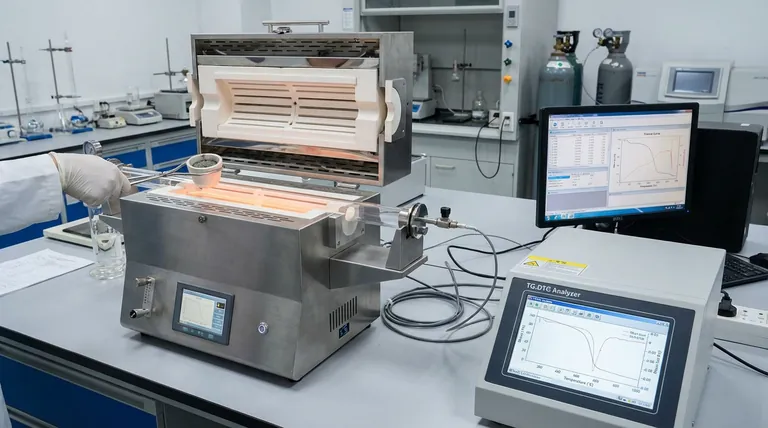
The Mechanics of Thermal Analysis
Controlled Environmental Conditions
To ensure accuracy, AASC samples are heated in a nitrogen atmosphere. This inert environment prevents unwanted oxidation reactions from skewing the results.
The heating rate is strictly controlled, often at 10 °C per minute. This steady rise allows for the distinct separation of thermal events, ensuring that rapid decomposition does not blur the data.
Quantifying Mass Loss
The core output of the analysis is a record of weight changes over time and temperature. These changes correspond directly to the release of volatile components or the breakdown of chemical bonds.
Deciphering Decomposition Stages
Low-Temperature Range (40–220 °C)
Significant mass loss occurs in the lower temperature bracket of 40–220 °C.
This range is primarily associated with the evaporation of free water trapped within the pore structure.
Crucially, this temperature window also captures the dehydration of ettringite. Distinguishing between free water and chemically bound water in this phase is essential for understanding early-age properties.
Mid-Temperature Range (260–300 °C)
As temperatures rise to the 260–300 °C range, the analysis reveals the stability of more durable phases.
This window allows for the quantitative distinction of hydrotalcite decomposition.
It also identifies the breakdown of calcium hydroxide. The presence and quantity of these phases are key indicators of the cement's reaction progress and long-term stability.
Understanding Analytical Boundaries
Resolution of Overlapping Phases
While TG-DTG provides detailed ranges, distinct thermal events can sometimes overlap.
For example, the loss of free water may transition seamlessly into the dehydration of hydration products.
Dependence on Heating Rate
The clarity of the decomposition peaks is heavily dependent on the heating rate (e.g., 10 °C/min). Deviating from this standard can shift the temperature ranges, making comparisons with established data difficult.
Applying TG-DTG Data to Material Evaluation
Measuring Hydration Product Volume
The total mass loss within specific ranges serves as a proxy for the volume of hydration products.
By summing these losses, you can calculate the extent of the reaction. A higher volume of hydration products generally correlates with better mechanical development.
Assessing Additive Influence
TG-DTG is vital for comparative studies. It provides the data needed to assess how additives alter the microstructure.
You can observe if an additive suppresses the formation of calcium hydroxide or promotes the growth of hydrotalcite by monitoring shifts in their respective temperature windows.
Interpreting Results for Your Project
To effectively utilize TG-DTG data for your Alkali-Activated Slag Cement projects, focus on these specific analytical goals:
- If your primary focus is early-age curing: Monitor the mass loss in the 40–220 °C range to quantify the ratio of free water to early hydration products like ettringite.
- If your primary focus is structural stability: Analyze the 260–300 °C window to measure the formation of robust phases like hydrotalcite and calcium hydroxide.
By isolating these thermal events, you transform raw weight-loss data into a precise metric for the chemical maturity of your cement paste.
Summary Table:
| Temperature Range | Phase Identification | Thermal Event |
|---|---|---|
| 40–220 °C | Free Water & Ettringite | Evaporation and dehydration of early-age products |
| 260–300 °C | Hydrotalcite & Calcium Hydroxide | Decomposition of stable hydration phases |
| Total Range | Hydration Product Volume | Quantitative assessment of chemical maturity |
Optimize Your Material Research with KINTEK
Precision is paramount when analyzing the thermal stability of complex materials like Alkali-Activated Slag Cement. Backed by expert R&D and manufacturing, KINTEK offers a wide range of high-performance lab equipment, including Muffle, Tube, Rotary, Vacuum, and CVD systems. Whether you are quantifying hydration products or testing structural stability, our customizable high-temperature furnaces provide the uniform heating and atmospheric control required for accurate TG-DTG results.
Ready to enhance your lab’s analytical capabilities? Contact us today to find the perfect furnace for your research needs!
References
- Juan He, Xuefeng Song. Effect of Slaked Lime on the Properties of Sodium Sulfate-Activated Alkali-Activated Slag Cement. DOI: 10.3390/pr12010184
This article is also based on technical information from Kintek Furnace Knowledge Base .
Related Products
- Multi Heating Zones CVD Tube Furnace Machine for Chemical Vapor Deposition Equipment
- Vertical Laboratory Quartz Tube Furnace Tubular Furnace
- High Temperature Muffle Oven Furnace for Laboratory Debinding and Pre Sintering
- 1700℃ High Temperature Muffle Oven Furnace for Laboratory
- Multi Zone Laboratory Quartz Tube Furnace Tubular Furnace
People Also Ask
- What is the function of a multi-zone tube furnace in CVD synthesis? Master 2D In2Se3 Nanosheet Precision
- What temperature-related capabilities make multi zone tube furnaces valuable for research? Unlock Precision Thermal Control
- What role do multi zone tube furnaces play in new energy research? Unlock Precise Thermal Control for Innovation
- Why are multi zone tube furnaces particularly useful for nanomaterial research? Unlock Precise Thermal Control for Advanced Synthesis
- What environmental protection applications utilize multi zone tube furnaces? Unlock Precision in Waste Treatment and Green Tech



















