
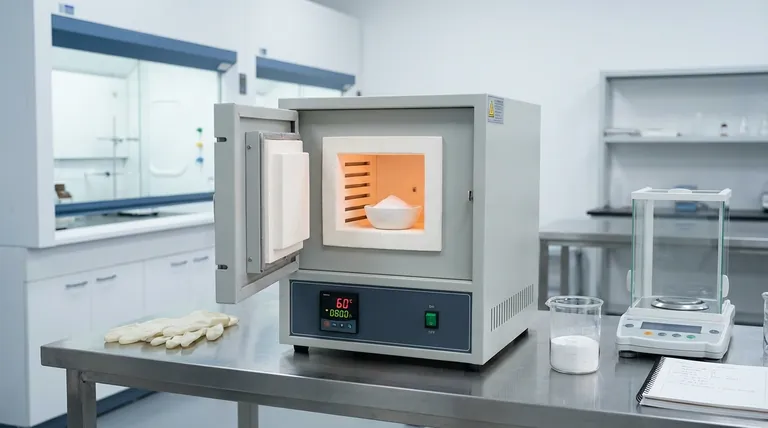
Pre-treating nanopowders is a critical quality control measure designed to eliminate moisture before it ruins your composite. Specifically, subjecting materials like fumed silica or halloysite nanotubes to an industrial oven (typically at 60°C for 8 hours) removes both environmental humidity on the surface and "interlayer" moisture trapped within the particle structure.
The Core Insight Nanoparticles act as moisture sponges due to their exceptionally high surface area. Failing to remove this trapped water leads to a compromised chemical cure, internal structural voids, and a weak bond between the filler and the resin matrix.
The Physics and Chemistry of the Problem
The Surface Area Trap
Nanopowders are defined by their massive surface-area-to-volume ratio. While this feature improves composite properties, it also makes the particles highly hygroscopic.
They naturally adsorb moisture from the surrounding environment. Without heat treatment, you are essentially introducing thousands of microscopic water reservoirs into your resin mix.
Interlayer Moisture
Beyond surface humidity, complex structures like nanotubes can hold water within their layers or pores. Simple air drying is often insufficient to release this trapped liquid.
Industrial heating provides the thermal energy required to drive this stubborn moisture out of the particle's internal architecture.
How Moisture Sabotages Epoxy Composites
Interference with Curing
Water is not chemically inert in this context. It can actively interfere with the polymerization reaction between the epoxy resin and the hardener.
This leads to an incomplete cure, resulting in a matrix that may remain soft or possess lower thermal and mechanical stability than intended.
Formation of Void Defects
Epoxy curing is an exothermic process, meaning it generates heat. If moisture remains in the powder, this heat can convert the water into vapor.
This trapped vapor creates bubbles or "voids" within the hardened composite. These voids act as stress concentrators, significantly lowering the material's strength and fatigue life.
Weakened Interfacial Bonding
For a nanocomposite to work, the resin must grip the nanoparticle tightly. Moisture creates a barrier layer between the particle surface and the resin.
By removing this water, you allow for direct contact between the resin and the filler, ensuring strong interfacial bonding and effective load transfer.
Common Pitfalls and Process Distinctions
Pre-treatment vs. Post-impregnation
It is vital to distinguish between drying the raw powder and removing solvents later in the process.
While powder pre-treatment targets moisture, subsequent steps (like vacuum oven processing) are often required after resin impregnation to remove solvents like acetone. Do not assume one step covers both needs; they target different volatiles at different stages.
The Cost of Skipping
Skipping the 8-hour drying cycle may seem like a time-saver, but it introduces high variability.
If your lab humidity changes from day to day, your composite properties will fluctuate unpredictably unless you normalize the powder via oven treatment.
Making the Right Choice for Your Goal
To ensure consistent, high-performance composites, apply the following guidelines:
- If your primary focus is Mechanical Strength: Ensure the full 8-hour heating cycle is completed to maximize interfacial bonding and load transfer.
- If your primary focus is Defect Reduction: Prioritize pre-treatment to eliminate moisture-induced void formation, which is the leading cause of internal structural failure.
- If your primary focus is Process Consistency: Treat this step as mandatory, regardless of ambient humidity, to eliminate environmental variables from your production line.
Eliminating moisture at the start is the only way to guarantee the resin chemistry performs exactly as engineered.
Summary Table:
| Factor | Impact of Moisture on Nanocomposites | Benefit of Oven Pre-treatment (60°C/8h) |
|---|---|---|
| Chemical Cure | Interferes with resin-hardener polymerization | Ensures complete cure and thermal stability |
| Structural Integrity | Causes bubbles and void-based stress concentrators | Eliminates vapor-induced defects and fatigue |
| Interfacial Bonding | Acts as a barrier between resin and particle | Enables direct contact for effective load transfer |
| Process Stability | Causes property fluctuations due to humidity | Normalizes material quality across production lots |
Maximize Your Material Performance with KINTEK
Don't let moisture compromise your R&D or industrial production. Backed by expert R&D and manufacturing, KINTEK offers high-precision Muffle, Tube, Rotary, Vacuum, and CVD systems, as well as specialized lab high-temp furnaces, all fully customizable for your unique nanopowder processing needs. Whether you are aiming for defect reduction or superior mechanical strength, our thermal solutions ensure your chemistry performs exactly as engineered.
Contact KINTEK Today for a Custom Solution
References
- Mertol Tüfekci, Loïc Salles. Nonlinear behaviour of epoxy and epoxy-based nanocomposites: an integrated experimental and computational analysis. DOI: 10.1080/15397734.2023.2293763
This article is also based on technical information from Kintek Furnace Knowledge Base .
Related Products
- High Temperature Muffle Oven Furnace for Laboratory Debinding and Pre Sintering
- 1200℃ Muffle Oven Furnace for Laboratory
- Dental Porcelain Zirconia Sintering Ceramic Vacuum Press Furnace
- 1400℃ Muffle Oven Furnace for Laboratory
- 1700℃ High Temperature Muffle Oven Furnace for Laboratory
People Also Ask
- What thermal phenomena occur during polymer binder burnout in ceramic green bodies? Lab Furnace Guide
- What role does a high-temperature muffle furnace play in STFO synthesis? Achieve Pure Perovskite Results
- Why is controlled heat treatment in a muffle furnace necessary for calcined clay? Achieve Optimal Pozzolanic Activity
- How does a high-temperature muffle furnace facilitate the formation of LaNbxAl1−xO3+δ perovskite structures? Key Roles
- What role does a high-temperature muffle furnace play in the formation of biochar catalysts? Master Catalyst Synthesis








