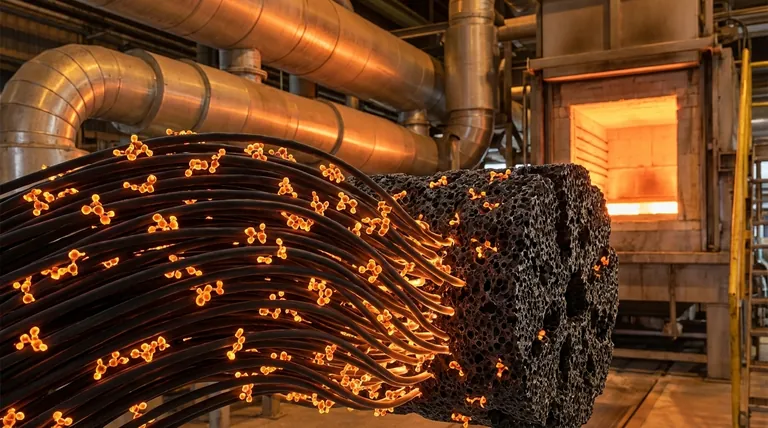
Carbon nanotubes (CNTs) significantly outperform activated carbon by providing approximately three times the adsorption capacity for dioxins. This superior performance is primarily determined by the unique, curved surface geometry of the nanotubes, which generates a stronger physical contact force with dioxin molecules compared to the flatter or smoother surfaces found in traditional activated carbon.
While standard activated carbon relies on general porosity, the specific curved structure of Carbon Nanotubes enhances the molecular grip on dioxins, offering superior toxicity control and structural durability in harsh industrial environments.
The Mechanics of Enhanced Adsorption
The Advantage of Curvature
The fundamental difference lies in geometry. The curved surface structure of carbon nanotubes creates a more effective interface for capturing dioxin molecules.
Unlike the irregular or smooth surfaces of activated carbon, the curvature of a CNT maximizes the contact force between the adsorbent and the toxin. This structural "fit" allows the nanotubes to hold onto dioxin molecules more tightly and efficiently.
Superior Capacity
This geometric advantage translates directly into volume. CNTs exhibit roughly three times the adsorption capacity of activated carbon.
For industrial operations like waste incineration, this means a smaller volume of adsorbent can capture a significantly larger load of toxins. This leads to more thorough purification of flue gas streams where space and efficiency are critical.
Durability and Operational Benefits
Resistance to Oxidation
Flue gas environments are chemically harsh and hot. CNTs possess strong oxidation resistance due to their robust one-dimensional structure.
This ensures the material maintains its integrity during the adsorption process, rather than degrading quickly like some lower-grade porous materials might under similar stress.
Regeneration and Reuse
A critical operational advantage of CNTs is their ability to be recycled. Because of their thermal stability, they can undergo high-temperature treatment to strip away captured contaminants.
This allows for the cyclic reuse of the adsorbent, turning what is often a disposable consumable (in the case of activated carbon) into a reusable asset.
Understanding the Trade-offs
The Need for Surface Modification
While raw CNTs are powerful, optimal performance often requires fine-tuning. Surface modifications, such as chemical or thermal treatments, are frequently necessary to maximize adsorption.
These treatments add specific surface functional groups that target particular organic substances, such as benzene or dioxin. This adds a layer of complexity to the manufacturing process compared to standard carbon.
Pore Structure Dependencies
The effectiveness of CNTs is also reliant on highly developed pore structures. If the synthesis of the nanotubes does not yield abundant pores and functional groups, the theoretical maximum adsorption may not be reached.
Making the Right Choice for Your Goal
To decide if transitioning to Carbon Nanotubes is right for your filtration system, consider your primary operational constraints:
- If your primary focus is Maximum Removal Efficiency: Prioritize CNTs, as their curved structure delivers 3x the holding capacity for dioxins compared to activated carbon.
- If your primary focus is Long-Term Lifecycle Costs: Choose CNTs for their oxidation resistance and ability to be regenerated and reused in high-temperature cycles.
By leveraging the unique geometry and durability of Carbon Nanotubes, you move from simple filtration to a highly efficient, regenerative system for toxicity control.
Summary Table:
| Feature | Activated Carbon | Carbon Nanotubes (CNTs) |
|---|---|---|
| Adsorption Capacity | Standard | ~3x Higher than Activated Carbon |
| Surface Geometry | Flat/Irregular | Unique Curved Structure (Stronger Grip) |
| Oxidation Resistance | Moderate | High (One-dimensional structure) |
| Longevity | Often Disposable | Regenerable & Reusable |
| Primary Benefit | Low initial cost | Maximum efficiency & durability |
Upgrade Your Filtration Efficiency with KINTEK
Maximize your industrial purity and operational lifespan with advanced material solutions. At KINTEK, we bridge the gap between cutting-edge research and practical application. Backed by expert R&D and manufacturing, KINTEK offers a comprehensive range of lab equipment including Muffle, Tube, Rotary, Vacuum, and CVD systems, all of which are fully customizable to support your specific adsorption studies or high-temperature material processing needs.
Don't settle for standard performance. Contact KINTEK today to discover how our specialized high-temperature furnaces and expertise can optimize your carbon material research and industrial filtration goals.
Visual Guide

References
- Reena Reena. Role of nanomaterials in the environment. DOI: 10.33545/26648776.2025.v7.i2b.100
This article is also based on technical information from Kintek Furnace Knowledge Base .
Related Products
- Multi Heating Zones CVD Tube Furnace Machine for Chemical Vapor Deposition Equipment
- Custom Made Versatile CVD Tube Furnace Chemical Vapor Deposition CVD Equipment Machine
- Vertical Laboratory Quartz Tube Furnace Tubular Furnace
- Slide PECVD Tube Furnace with Liquid Gasifier PECVD Machine
- Small Vacuum Heat Treat and Tungsten Wire Sintering Furnace
People Also Ask
- What is the function of a multi-zone tube furnace in CVD synthesis? Master 2D In2Se3 Nanosheet Precision
- Why are multi zone tube furnaces particularly useful for nanomaterial research? Unlock Precise Thermal Control for Advanced Synthesis
- What role do multi zone tube furnaces play in new energy research? Unlock Precise Thermal Control for Innovation
- What environmental protection applications utilize multi zone tube furnaces? Unlock Precision in Waste Treatment and Green Tech
- What temperature-related capabilities make multi zone tube furnaces valuable for research? Unlock Precision Thermal Control