
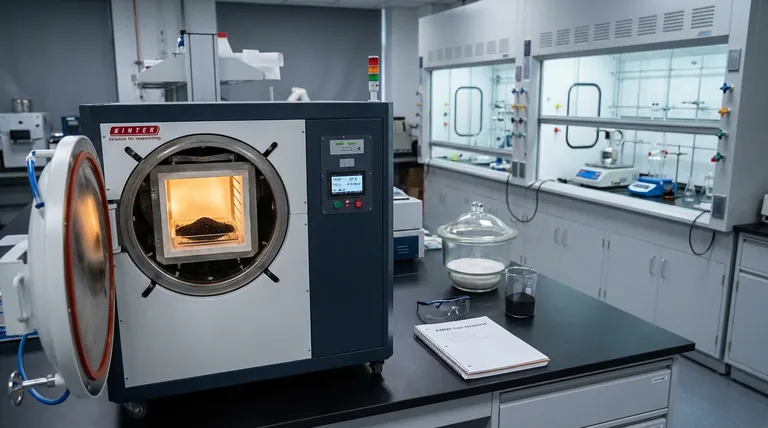
The fundamental purpose of using a vacuum drying oven for Pd/BPC (Palladium/Bamboo-based Porous Carbon) catalysts is to facilitate the deep removal of moisture and solvents at significantly reduced temperatures. This process is critical for preventing the high-temperature oxidation of palladium nanoparticles and inhibiting thermal aggregation, thereby preserving the catalyst's high active surface area.
Core Takeaway Vacuum drying decouples the evaporation process from high thermal stress, allowing for the preservation of delicate metal nanostructures. By lowering the boiling point of solvents, it "locks in" the dispersion of palladium particles without subjecting them to the heat that causes sintering or chemical degradation.
Mechanisms of Catalyst Preservation
Lowering the Thermal Threshold
The vacuum environment reduces the ambient pressure surrounding the catalyst precursors. This physical change drastically lowers the boiling point of water and organic solvents trapped within the porous BPC structure.
By enabling evaporation at lower temperatures (often around 40–60°C), the process removes volatile components without exposing the material to the harsh thermal conditions required by standard air drying.
Preventing Particle Aggregation
One of the primary dangers during post-treatment is thermal aggregation, also known as sintering. When palladium nanoparticles are exposed to high heat, they tend to migrate and merge into larger clusters.
Vacuum drying mitigates this by keeping the temperature below the threshold where metal mobility becomes significant. This ensures the Pd particles remain small and highly dispersed, which is directly correlated to superior catalytic activity.
Inhibiting Oxidation
Palladium is susceptible to oxidation, particularly when heated in the presence of air and moisture. High-temperature oxidation can alter the chemical state of the active metal, rendering it less effective for specific reactions.
The vacuum oven minimizes the presence of oxygen while keeping temperatures low, effectively maintaining the palladium in its desired metallic or oxide state without uncontrolled degradation.
Ensuring Structural Integrity
Preserving Distribution Homogeneity
During standard drying, solvent evaporation can create capillary forces that drag dissolved metal salts from the inner pores to the outer surface of the support. This phenomenon often results in an uneven "eggshell" distribution.
Vacuum drying accelerates solvent evaporation rates at low temperatures, minimizing the time available for these migration forces to act. This "freezes" the metal components in place, ensuring a uniform distribution throughout the BPC support.
Protecting the Porous Support
Bamboo-based Porous Carbon (BPC) relies on a complex network of pores to provide a high surface area. Excessive heat or rapid expansion of trapped steam during high-temperature drying can cause these delicate structures to collapse.
Vacuum drying gently removes physically adsorbed molecules from these pores. This prevents structural collapse and ensures the pore channels remain open and accessible for reactants in the final application.
Risks of Conventional Drying Methods
While vacuum drying adds a layer of equipment complexity, skipping this step in favor of conventional methods introduces significant risks to catalyst quality.
The Pitfalls of Air Drying
Standard air drying requires higher temperatures to remove solvents, which accelerates Ostwald ripening (particle growth). This leads to a dramatic loss of active surface area, wasting the expensive palladium metal.
Furthermore, without the reduced pressure, moisture removal is often incomplete in deep pores. Residual solvent can block active sites or react unpredictably during subsequent activation steps, leading to poor reproducibility in catalyst performance.
Making the Right Choice for Your Goal
To optimize your Pd/BPC catalyst post-treatment, align your drying parameters with your specific performance targets:
- If your primary focus is maximizing active sites: Prioritize vacuum levels that allow drying below 60°C to prevent even minor thermal aggregation of Pd nanoparticles.
- If your primary focus is pore accessibility: Ensure the drying duration is sufficient (often 12+ hours) to fully evacuate deep-pore solvents without collapsing the carbon framework.
By controlling pressure to lower thermal stress, you transform the drying phase from a potential failure point into a step that solidifies catalyst performance.
Summary Table:
| Feature | Vacuum Drying Benefit | Impact on Pd/BPC Catalyst |
|---|---|---|
| Temperature | Lowered boiling point (40–60°C) | Prevents thermal aggregation/sintering of Pd particles. |
| Atmosphere | Reduced oxygen presence | Inhibits uncontrolled oxidation of active metal sites. |
| Pore Integrity | Gentle moisture removal | Prevents collapse of bamboo-based porous carbon (BPC). |
| Distribution | Rapid evaporation | Ensures uniform metal distribution; prevents 'eggshell' effect. |
| Solvent Removal | Deep pore evacuation | Removes residual solvents that block active catalytic sites. |
Maximize Your Catalyst Performance with KINTEK
Precise thermal management is the difference between a high-activity catalyst and a wasted resource. Backed by expert R&D and manufacturing, KINTEK offers specialized Vacuum, Muffle, Tube, and CVD systems tailored for sensitive laboratory applications. Our high-temp furnaces are fully customizable to meet the unique needs of your Pd/BPC research and production.
Ready to lock in superior dispersion and active surface area? Contact KINTEK today to find your custom vacuum drying solution.
References
- Hui Liu, Qingshan Zhao. A Palladium Catalyst Supported on Boron-Doped Porous Carbon for Efficient Dehydrogenation of Formic Acid. DOI: 10.3390/nano14060549
This article is also based on technical information from Kintek Furnace Knowledge Base .
Related Products
- Vacuum Heat Treat Sintering and Brazing Furnace
- Vacuum Heat Treat Sintering Furnace Molybdenum Wire Vacuum Sintering Furnace
- Dental Porcelain Zirconia Sintering Ceramic Vacuum Press Furnace
- Molybdenum Vacuum Heat Treat Furnace
- Vacuum Hot Press Furnace Machine Heated Vacuum Press
People Also Ask
- What is one of the most important uses of vacuum heat treating furnaces in aerospace? Achieve Superior Strength in Aircraft Alloys
- What are the benefits of using vacuum heat treating furnaces for metal alloys? Achieve Superior Metal Properties and Performance
- How does vacuum heat treating affect the grain structure of metal alloys? Achieve Precise Microstructure Control
- What is the temperature of a vacuum furnace brazing? Optimize Your Joint Strength and Cleanliness
- What are the steps involved in a typical vacuum brazing treatment? Master the Process for Strong, Clean Joints












