
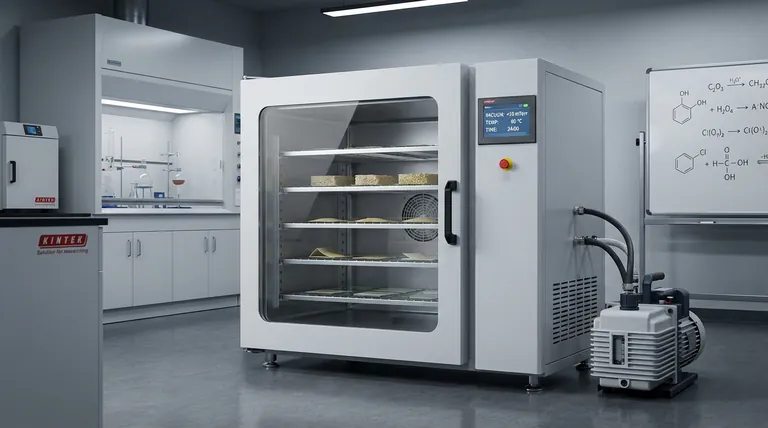
Vacuum drying provides a critical safeguard for the structural and chemical integrity of BiVO4/COF composite photoanodes. Unlike standard ovens, a vacuum drying oven lowers the ambient pressure to facilitate the rapid evaporation of residual solvents—specifically DMF, acetone, and methanol—at significantly reduced temperatures (approximately 80 °C).
Core Takeaway The primary advantage of vacuum drying is the preservation of the Covalent Organic Framework (COF) structure. By removing solvents at low temperatures in an oxygen-depleted environment, you prevent the collapse of internal pores and oxidative degradation, ensuring the maximum number of active sites remain available for photoelectrochemical reactions.
Preserving Microstructural Integrity
Preventing Pore Collapse
Standard ovens typically rely on high temperatures to drive off solvents. For porous materials like COFs, the capillary forces exerted during high-temperature evaporation can cause the delicate internal pore structure to collapse.
Vacuum drying mitigates this by lowering the boiling point of the solvents. This allows moisture and solvents to leave the material gently, preserving the specific surface area and the internal porous architecture necessary for efficient ion transport.
Protecting Organic Components
BiVO4 is relatively stable, but the organic components within the COF are sensitive to heat and oxygen.
In a standard oven, high temperatures combined with ambient air can lead to oxidative degradation of these organic parts. Vacuum drying removes the oxygen from the equation, ensuring the chemical composition of the hybrid photoanode remains stable.
Efficiency in Solvent Removal
Targeting High-Boiling Point Solvents
Solvents used in synthesis, such as Dimethylformamide (DMF), have high boiling points. Removing them in a standard oven would require temperatures that could damage the composite.
Under vacuum, the boiling point of DMF drops significantly. This allows you to achieve complete drying at a safe 80 °C, effectively removing stubborn residues without subjecting the material to destructive thermal stress.
Enhancing Material Purity
The vacuum environment accelerates the evaporation rate of not just DMF, but also acetone and methanol.
By ensuring these solvents are thoroughly evacuated from the internal pores, the process prevents the blockage of active sites. This results in a cleaner, more active final material compared to one dried at atmospheric pressure where solvent entrapment is more likely.
Understanding the Trade-offs
Process Speed vs. Material Quality
While vacuum drying is superior for material quality, it is generally a slower, batch-oriented process compared to continuous conveyor-belt standard ovens.
If you strictly prioritize throughput over performance, a vacuum oven creates a bottleneck. However, for high-performance photoanodes, this "inefficiency" is actually a necessary quality control step.
Equipment Complexity
Vacuum drying requires maintaining a sealed system and operating a vacuum pump.
This introduces variables such as seal integrity and pump maintenance that do not exist with standard convection ovens. Failure to maintain the vacuum can lead to inconsistent drying results or unexpected oxidation if air leaks in at elevated temperatures.
Making the Right Choice for Your Goal
To maximize the performance of your BiVO4/COF photoanodes, consider your specific fabrication priorities:
- If your primary focus is Maximizing Photocurrent Density: Use the vacuum oven to ensure the highest specific surface area and accessible active sites.
- If your primary focus is Chemical Stability: Use the vacuum oven to prevent the oxidation of the organic COF linkers during the drying phase.
- If your primary focus is Removing High-Boiling Solvents (DMF): Use the vacuum oven to volatilize these solvents without exceeding the thermal tolerance of the composite.
Vacuum drying is not merely a method of moisture removal; it is a vital preservation technique that defines the final efficiency of your composite photoanode.
Summary Table:
| Feature | Vacuum Drying Oven | Standard Convection Oven |
|---|---|---|
| Drying Mechanism | Low pressure / Low temperature | Ambient pressure / High temperature |
| Pore Structure | Preserves delicate COF pores | Risk of capillary-force collapse |
| Oxygen Levels | Oxygen-depleted (Prevents oxidation) | High (Potential for organic degradation) |
| Solvent Removal | Highly efficient for high-boiling DMF | Difficult without excessive heat |
| Best For | High-performance porous composites | Bulk materials with high thermal stability |
Elevate Your Research with Precision Drying Solutions
Don't let pore collapse or oxidative degradation compromise your experimental results. KINTEK provides industry-leading vacuum drying systems designed to protect delicate hybrid materials like BiVO4/COF composites.
Backed by expert R&D and manufacturing, KINTEK offers Muffle, Tube, Rotary, Vacuum, CVD systems, and other lab high-temp furnaces, all customizable for your unique research needs. Ensure your photoanodes reach their maximum photocurrent potential with our high-precision equipment.
Ready to optimize your material performance? Contact our technical experts today to find the perfect drying solution!
References
- Anni Guo, Bowei Wang. Modified photoanode by <i>in situ</i> growth of covalent organic frameworks on BiVO<sub>4</sub> for oxygen evolution reaction. DOI: 10.1039/d4ra00899e
This article is also based on technical information from Kintek Furnace Knowledge Base .
Related Products
- Vacuum Heat Treat Sintering and Brazing Furnace
- Vacuum Heat Treat Sintering Furnace Molybdenum Wire Vacuum Sintering Furnace
- Dental Porcelain Zirconia Sintering Ceramic Vacuum Press Furnace
- Molybdenum Vacuum Heat Treat Furnace
- Vacuum Hot Press Furnace Machine Heated Vacuum Press
People Also Ask
- What are the benefits of using vacuum heat treating furnaces for metal alloys? Achieve Superior Metal Properties and Performance
- What is one of the most important uses of vacuum heat treating furnaces in aerospace? Achieve Superior Strength in Aircraft Alloys
- How does vacuum heat treating affect the grain structure of metal alloys? Achieve Precise Microstructure Control
- What is the temperature of a vacuum furnace brazing? Optimize Your Joint Strength and Cleanliness
- What are the steps involved in a typical vacuum brazing treatment? Master the Process for Strong, Clean Joints












