
The primary technical objectives are to induce recrystallization in the deformed structure and to lock in a specific high-temperature phase state. By subjecting cold-rolled CoCrFeMnNi alloys to precise thermal inputs at temperatures such as 700°C or 800°C, you reverse the effects of cold rolling. This is immediately followed by rapid water quenching to prevent the material from reverting to a lower-energy, multi-phase state during cooling.
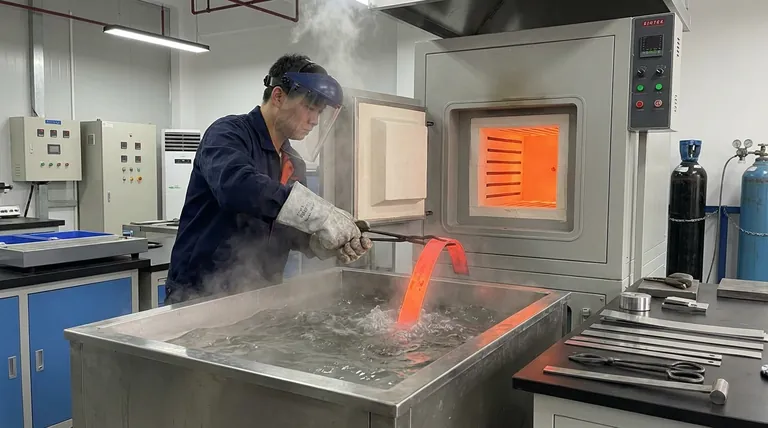
The process relies on a strict sequence: the furnace provides the energy required to reorganize the grain structure, while the water quench acts as a "thermal brake," freezing the desired microstructure before detrimental phases like the sigma phase can precipitate.
The Role of Precise Thermal Input
Inducing Recrystallization
The first objective of the laboratory furnace is to address the mechanical deformation caused by cold rolling.
By applying controlled heat, you provide the energy necessary for the alloy to undergo recrystallization. This reorganizes the deformed grains into a new, strain-free grain structure.
Promoting Phase Transformations
Beyond structural repair, the furnace allows you to target specific phase equilibria.
Operating at precise temperatures, such as 700°C or 800°C, drives the alloy toward specific phase transformations that are only stable at these elevated thermal states.
The Criticality of Water Quenching
Freezing the Equilibrium Microstructure
The objective of the quenching phase is preservation.
Rapid water quenching "freezes" the equilibrium microstructure that was established in the furnace. This captures the high-temperature state of the material at room temperature, which is essential for studying or utilizing that specific structure.
Preventing Unintended Phase Transitions
The most critical technical reason for rapid quenching is to bypass the kinetics of slow cooling.
If the alloy cools slowly, it may undergo unintended secondary phase transformations, causing the material to shift away from the desired single-phase state.
Understanding the Risks of Slow Cooling
The Precipitation of Sigma Phase
The primary risk associated with insufficient cooling rates is the formation of the sigma phase.
This secondary phase is generally unwanted in these alloys. Slow cooling gives the material enough time to precipitate the sigma phase, which can compromise the properties achieved during annealing.
Loss of Single-Phase States
The unique properties of CoCrFeMnNi alloys often depend on maintaining a single-phase solid solution.
Without the rapid intervention of water quenching, the alloy naturally tends to transition out of this single-phase state as it cools, altering the material's fundamental characteristics.
Making the Right Choice for Your Goal
To optimize the treatment of CoCrFeMnNi alloys, align your process parameters with your specific metallurgical targets:
- If your primary focus is structural restoration: Ensure your furnace is calibrated to deliver precise input at temperatures like 700°C or 800°C to fully drive recrystallization.
- If your primary focus is avoiding embrittlement: Prioritize the speed of the transfer to the water quench to ensure no time is allowed for the precipitation of the sigma phase.
Success in this process is defined by the speed at which you can transition from high-temperature equilibrium to room-temperature stability.
Summary Table:
| Process Step | Technical Objective | Key Mechanism |
|---|---|---|
| Laboratory Annealing | Structural Restoration | Induces recrystallization to remove cold-rolling strain and reorganize grains. |
| High-Temp Equilibrium | Phase Transformation | Targets specific stable phase states at precise temperatures (e.g., 700°C - 800°C). |
| Water Quenching | Microstructure Preservation | "Freezes" the high-temperature state to prevent cooling-related phase shifts. |
| Rapid Cooling | Phase Prevention | Bypasses the kinetics of slow cooling to avoid brittle sigma phase formation. |
Elevate Your Material Research with KINTEK Precision
Achieving the perfect single-phase state in CoCrFeMnNi alloys requires rigorous thermal accuracy and reliability. KINTEK provides industry-leading lab high-temp furnaces—including Muffle, Tube, and Vacuum systems—specifically designed to meet the strict recrystallization requirements of advanced metallurgy.
Backed by expert R&D and manufacturing, our systems are fully customizable to ensure your specific research needs are met with precision. Don't let unintended phase transformations compromise your results.
Contact KINTEK today to find the ideal thermal solution for your lab!
References
- Tae Hyeong Kim, Jae Wung Bae. Suppressed Plastic Anisotropy via Sigma-Phase Precipitation in CoCrFeMnNi High-Entropy Alloys. DOI: 10.3390/ma17061265
This article is also based on technical information from Kintek Furnace Knowledge Base .
Related Products
- 1400℃ Controlled Inert Nitrogen Atmosphere Furnace
- Controlled Inert Nitrogen Hydrogen Atmosphere Furnace
- 1200℃ Controlled Inert Nitrogen Atmosphere Furnace
- 1400℃ High Temperature Laboratory Tube Furnace with Alumina Tube
- Vertical Laboratory Quartz Tube Furnace Tubular Furnace
People Also Ask
- How does oxygen partial pressure control affect ceramic sintering? Master Defect Chemistry
- Why is thorough binder burnout necessary before sintering advanced ceramics? Ensure Peak Density & Zero Defects
- Why is controlled-atmosphere heating required for functional ceramics and sensors? Master Defect Engineering
- How do controlled-atmosphere furnaces support polymer pyrolysis? Master SiC & Si3N4 Ceramic Conversion
- How does real-time dilatometric analysis in a controlled-atmosphere furnace optimize PZT ceramic sintering?



















