
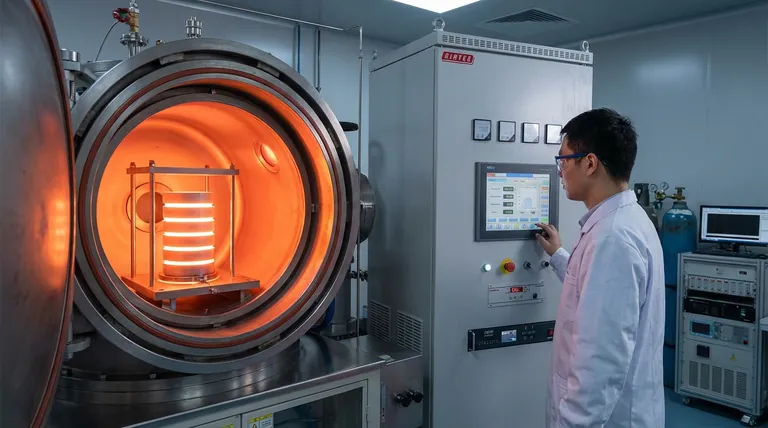
High-temperature homogenization annealing is a critical preparatory step designed to uniformize the alloy's internal structure before mechanical deformation. By subjecting the Ti-5Al-2.5Sn-0.2C alloy to sustained heat in a vacuum, you actively promote chemical diffusion to eliminate segregation while simultaneously preventing the absorption of embrittling atmospheric gases.
The primary goal is to transform a heterogeneous as-cast structure into a uniform, ductile feedstock. This process dissolves stress-concentrating features and safeguards the material against environmental contamination, ensuring it can withstand the rigors of hot working without failure.
Achieving Microstructural Uniformity
Promoting Elemental Diffusion
In its as-cast state, the Ti-5Al-2.5Sn-0.2C alloy often suffers from elemental segregation, where chemical components are unevenly distributed.
High-temperature annealing creates an environment that accelerates atomic mobility.
By maintaining temperatures such as 900°C for 24 hours, the process drives the diffusion of chemical components, resulting in a chemically uniform matrix.
Addressing Irregular Carbides
The inclusion of 0.2% carbon in this specific alloy leads to the formation of carbides.
In the initial structure, these carbides may exist in irregular morphologies that can act as initiation points for cracking during deformation.
Homogenization facilitates the partial dissolution or morphological transformation of these irregular carbides, reducing their negative impact on workability.
The Role of the Vacuum Environment
Preventing Gas Absorption
Titanium alloys are highly reactive at elevated temperatures and have a strong affinity for atmospheric gases.
Without protection, the alloy would rapidly absorb oxygen, nitrogen, and hydrogen.
Eliminating Embrittlement
The absorption of these impurity gases leads to severe material embrittlement, drastically reducing ductility.
A vacuum furnace provides an inert environment that effectively blocks these contaminants.
This ensures the material retains the necessary toughness to undergo hot working without fracturing.
Understanding the Trade-offs
Process Intensity vs. Material Quality
This process requires significant energy and time (e.g., 24-hour cycles) to achieve full homogenization.
Cutting this cycle short to save resources can leave residual segregation, leading to inconsistent mechanical properties in the final product.
Managing Grain Structure
While high temperatures facilitate diffusion, prolonged exposure can induce grain growth.
However, in carbon-containing alloys, carbides can eventually serve a pinning function to inhibit excessive growth, though the primary focus at this stage is homogenization rather than final grain refinement.
Maximizing Process Efficacy
To ensure the best outcomes for your Ti-5Al-2.5Sn-0.2C alloy project, consider the following:
- If your primary focus is material ductility: Ensure the vacuum integrity is absolute to prevent even trace amounts of oxygen or hydrogen absorption, which cause immediate embrittlement.
- If your primary focus is structural consistency: Strictly adhere to the sustained temperature duration (e.g., 24 hours) to allow sufficient time for the complete diffusion of segregated elements and carbide transformation.
A precise homogenization cycle effectively "resets" the alloy's internal structure, converting a variable casting into a reliable foundation for high-performance manufacturing.
Summary Table:
| Key Process Factor | Purpose & Impact | Primary Benefit |
|---|---|---|
| Elemental Diffusion | Eliminates chemical segregation in as-cast structures | Ensures a chemically uniform matrix |
| Carbide Transformation | Dissolves or rounds irregular carbon features | Reduces cracking risk during deformation |
| Vacuum Environment | Blocks oxygen, nitrogen, and hydrogen absorption | Prevents material embrittlement |
| High-Temp Duration | Provides energy/time (e.g., 24h) for atomic mobility | Transforms heterogeneous structures into ductile feedstock |
Elevate Your Titanium Processing Precision with KINTEK
Don't let atmospheric contamination or structural segregation compromise your high-performance alloys. KINTEK’s advanced vacuum furnace technology is engineered to deliver the absolute integrity required for critical homogenization cycles.
Backed by expert R&D and manufacturing, we offer high-performance Muffle, Tube, Rotary, Vacuum, and CVD systems—all fully customizable to meet your specific temperature and dwell-time requirements. Whether you are processing Ti-5Al-2.5Sn-0.2C or other reactive metals, our systems ensure superior material ductility and structural consistency.
Ready to optimize your lab's high-temperature workflows? Contact us today to find your custom solution!
References
- Agnieszka Szkliniarz, W. Szkliniarz. Microstructure and Properties of Ti-5Al-2.5Sn Alloy with Higher Carbon Content. DOI: 10.3390/coatings15020224
This article is also based on technical information from Kintek Furnace Knowledge Base .
Related Products
- 2200 ℃ Tungsten Vacuum Heat Treat and Sintering Furnace
- Small Vacuum Heat Treat and Tungsten Wire Sintering Furnace
- Vacuum Heat Treat Sintering Furnace with Pressure for Vacuum Sintering
- Vacuum Heat Treat Sintering Furnace Molybdenum Wire Vacuum Sintering Furnace
- Molybdenum Vacuum Heat Treat Furnace
People Also Ask
- How does a tungsten-heated vacuum sintering furnace prepare (TbxY1-x)2O3 ceramics? Achieve 99%+ Density & Purity
- What wear-resistance enhancements are achieved by powder coating? The Role of Vacuum Sintering Furnaces
- How do compaction pressure and vacuum sintering optimize porous ceramics? Maximize Density & Toughness
- What role does a high-temperature vacuum sintering furnace play in the densification of WC-10(Ni, Ni/Co) alloys?
- What core role does a high-temperature vacuum sintering furnace play in Sm:YAG ceramics? Mastering Optical Clarity



















