
Elliptical mirrors function by leveraging precise geometric properties to concentrate radiant energy from a light source onto a specific target. In an optical Floating-Zone furnace, the heat source (such as a halogen filament) is placed at one focal point of the ellipse, while the material to be melted sits at the second. This arrangement allows for the efficient transfer of intense thermal energy without physical contact.
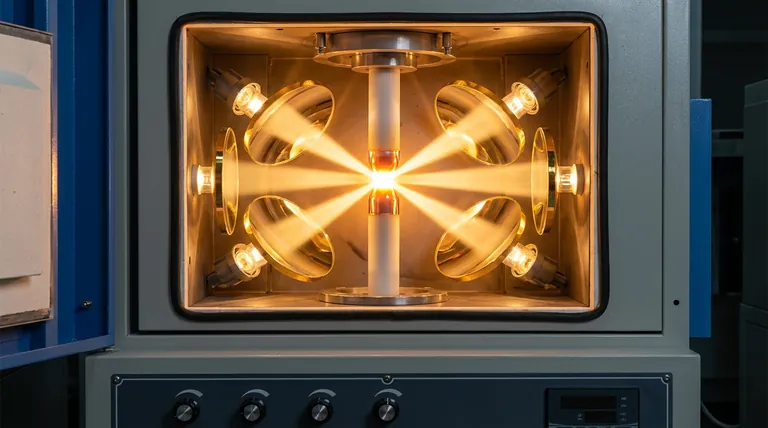
The core mechanism relies on dual or multi-elliptical configurations to converge radiant energy from multiple directions simultaneously. This intersection creates a uniform, high-temperature horizontal field that ensures the molten zone remains laterally stable during crystal growth.
The Geometry of Heat Concentration
The Focal Point Principle
The fundamental operation of these mirrors is based on the geometry of an ellipse. An ellipse possesses two distinct focal points.
Any light ray originating from the first focal point that strikes the elliptical surface is reflected directly to the second focal point.
Focusing the Energy
In the context of the furnace, a high-intensity lamp fits at the first focal point.
The mirrors capture the divergent light from this filament and redirect it.
This results in a highly concentrated point of heat at the second focal point, which is where the feed rod is positioned.
Creating the Horizontal Temperature Field
The Need for Multi-Directional Heating
A single elliptical mirror would only heat one side of the feed rod, creating an uneven thermal profile.
To counter this, optical Floating-Zone furnaces utilize dual or multi-elliptical designs.
Convergence and Uniformity
By arranging multiple mirrors around the central axis, the system directs radiant energy toward the center from various angles.
These beams of light converge at the center of the feed rod.
This overlapping convergence creates a uniform horizontal temperature field.
Ensuring Lateral Stability
This horizontal uniformity is not merely about heating efficiency; it is a structural requirement.
A uniform field is essential for maintaining the lateral stability of the molten zone.
It prevents the liquid material from becoming lopsided or spilling, which is critical for successful crystal growth.
Understanding the Engineering Constraints
Alignment Sensitivity
The efficiency of this system is entirely dependent on geometric precision.
If the halogen filament is slightly offset from the first focal point, the reflected energy will miss the target at the second focal point.
This misalignment degrades the uniformity of the horizontal field and can destabilize the molten zone.
Component Configuration
The shape and position of the heat source must match the optical design of the mirrors.
The system relies on the filament acting as a precise point source to ensure the resulting thermal field remains sharp and controlled.
Optimizing for Crystal Stability
To ensure the best results in optical Floating-Zone growth, you must align your equipment choices with the physics of the elliptical focus.
- If your primary focus is thermal uniformity: Prioritize multi-elliptical designs over dual-mirror setups to increase the number of convergence angles.
- If your primary focus is process stability: Ensure the heat source is perfectly centered at the first focal point to maintain the integrity of the horizontal field.
The precise convergence of light creates the stable thermal environment required to turn raw feed rods into high-quality crystals.
Summary Table:
| Feature | Description | Role in Floating-Zone Furnace |
|---|---|---|
| Geometry | Dual focal point ellipse | Concentrates energy from lamp to feed rod |
| Energy Source | Halogen filament | Placed at the first focal point as the heat origin |
| Mirror Configuration | Dual or Multi-elliptical | Ensures convergent heating from multiple angles |
| Thermal Field | Horizontal Uniformity | Maintains lateral stability of the molten zone |
| Critical Factor | Alignment Precision | Prevents lopsided zones and ensures crystal quality |
Elevate Your Material Research with KINTEK Precision
Achieving the perfect crystal requires absolute thermal stability and geometric precision. At KINTEK, we understand the physics of high-temperature environments. Backed by expert R&D and manufacturing, we offer a comprehensive range of lab high-temp systems, including Muffle, Tube, Rotary, Vacuum, and CVD furnaces, all fully customizable to meet your unique research needs.
Whether you are optimizing a floating-zone process or developing new materials, our systems provide the uniform heat distribution and reliable control you demand. Contact us today to discuss your custom solution and see how KINTEK can enhance your lab's efficiency.
References
- Naoki Kikugawa. Recent Progress of Floating-Zone Techniques for Bulk Single-Crystal Growth. DOI: 10.3390/cryst14060552
This article is also based on technical information from Kintek Furnace Knowledge Base .
Related Products
- Multi Zone Laboratory Quartz Tube Furnace Tubular Furnace
- Split Multi Heating Zone Rotary Tube Furnace Rotating Tube Furnace
- Multi Heating Zones CVD Tube Furnace Machine for Chemical Vapor Deposition Equipment
- Vertical Laboratory Quartz Tube Furnace Tubular Furnace
- Spark Plasma Sintering SPS Furnace
People Also Ask
- What environmental protection applications utilize multi zone tube furnaces? Unlock Precision in Waste Treatment and Green Tech
- Why are multi zone tube furnaces particularly useful for nanomaterial research? Unlock Precise Thermal Control for Advanced Synthesis
- What temperature-related capabilities make multi zone tube furnaces valuable for research? Unlock Precision Thermal Control
- What role do multi zone tube furnaces play in new energy research? Unlock Precise Thermal Control for Innovation
- What are the main applications of multi zone tube furnaces in university laboratories? Unlock Precision in Material Science and Energy Research

















