
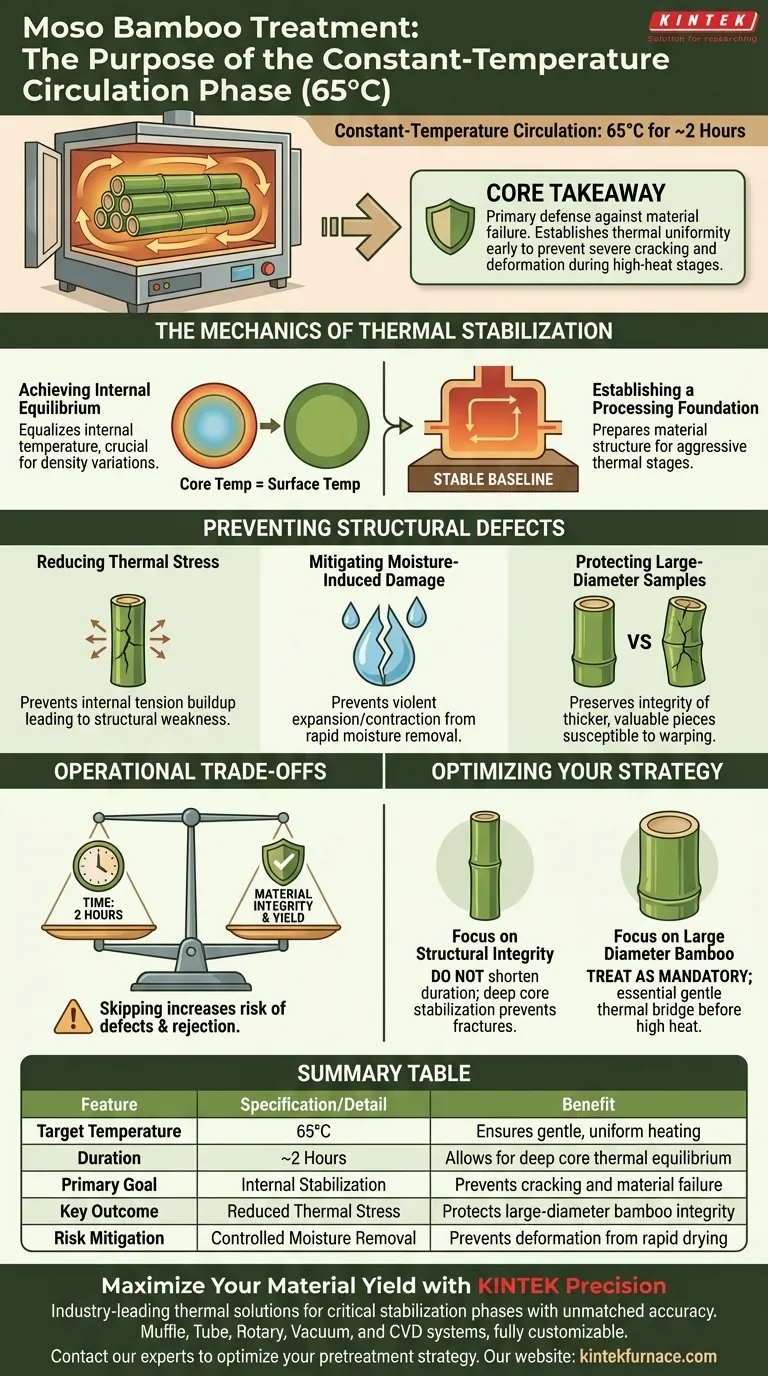
The constant-temperature circulation phase acts as a critical stabilization period where industrial furnaces maintain Moso Bamboo at 65°C for approximately two hours. This specific thermal plateau is designed to equalize the internal temperature of the bamboo samples before they are subjected to higher processing temperatures.
Core Takeaway This phase is the primary defense against material failure. By establishing thermal uniformity early, the process prevents the severe cracking and deformation that typically occur when large-diameter bamboo undergoes rapid moisture removal during later, high-heat stages.
The Mechanics of Thermal Stabilization
Achieving Internal Equilibrium
Bamboo is a material with significant density and thickness variations. This pretreatment phase ensures that the temperature at the core of the bamboo matches the surface temperature.
Establishing a Processing Foundation
Maintaining the furnace at 65°C for two hours creates a stable baseline. This uniformity prepares the material's physical structure for the more aggressive thermal stages that follow.
Preventing Structural Defects
Reducing Thermal Stress
When bamboo is heated unevenly, internal tension builds up rapidly. This "thermal stress" is a leading cause of structural weakness in the final product.
Mitigating Moisture-Induced Damage
Rapid moisture removal acts as a shock to the bamboo's cellular structure. By preheating the material gently, the system prevents the violent expansion or contraction that leads to splitting.
Protecting Large-Diameter Samples
Thicker bamboo poles are disproportionately susceptible to warping and cracking. This phase is specifically cited as a method to preserve the integrity of these larger, more valuable pieces.
Understanding the Operational Trade-offs
Time vs. Material Integrity
The primary trade-off in this phase is the allocation of processing time (two hours) against the risk of yield loss. While skipping this low-temperature hold might accelerate the production cycle, it drastically increases the probability of rejecting the final product due to defects.
The Limits of Stabilization
While effective, this phase is a preventative measure, not a cure. It establishes a foundation for improved physical properties, but it relies on the subsequent high-temperature stages being executed correctly to lock in those benefits.
Optimizing Your Treatment Strategy
To maximize the quality of Moso Bamboo products, consider how this phase aligns with your specific production goals:
- If your primary focus is Structural Integrity: Do not shorten the two-hour duration, as deep core stabilization is the only way to prevent internal fractures in the finished good.
- If your primary focus is Processing Large Diameter Bamboo: Treat the 65°C circulation phase as mandatory, as these samples cannot withstand high-heat drying without this gentle thermal bridge.
Effective pretreatment is not just about heating; it is about creating the thermal stability required for the bamboo to survive the drying process intact.
Summary Table:
| Feature | Specification/Detail | Benefit |
|---|---|---|
| Target Temperature | 65°C | Ensures gentle, uniform heating |
| Duration | Approximately 2 Hours | Allows for deep core thermal equilibrium |
| Primary Goal | Internal Stabilization | Prevents cracking and material failure |
| Key Outcome | Reduced Thermal Stress | Protects large-diameter bamboo integrity |
| Risk Mitigation | Controlled Moisture Removal | Prevents deformation from rapid drying |
Maximize Your Material Yield with KINTEK Precision
Don't let structural defects compromise your high-value Moso Bamboo production. KINTEK provides industry-leading thermal solutions designed to manage critical stabilization phases with unmatched accuracy.
Backed by expert R&D and manufacturing, we offer Muffle, Tube, Rotary, Vacuum, and CVD systems, all fully customizable to meet the unique thermal profiles of organic materials like bamboo. Whether you need precise low-temperature circulation or high-heat processing, KINTEK lab high-temp furnaces ensure your products survive the drying process intact and defect-free.
Ready to optimize your pretreatment strategy? Contact our experts today to discover how our custom furnace solutions can enhance your laboratory or industrial efficiency.
Visual Guide
References
- Yesun Kim, Se‐Yeong Park. Improvement of Moso Bamboo (Phyllostachys pubescens) Properties Using a Heat Treatment Process for Landscaping Materials and Evaluation of Its Durability against Biotic/Abiotic Factors. DOI: 10.3390/f15010101
This article is also based on technical information from Kintek Furnace Knowledge Base .
Related Products
- Molybdenum Vacuum Heat Treat Furnace
- Vacuum Heat Treat Sintering Furnace with Pressure for Vacuum Sintering
People Also Ask
- How does vacuum heat treating work in terms of temperature and time control? Master Precise Material Transformations
- What is the primary application of vacuum heat treating furnaces in aerospace? Enhance Component Performance with Precision
- Why are vacuum heat treating furnaces essential for aerospace? Ensure Superior Material Integrity for High-Stakes Applications
- What is the process of vacuum heat treating? Achieve Superior Metallurgical Properties
- How does a vacuum heat treating furnace improve the condition of metal alloys? Achieve Superior Metal Performance

