
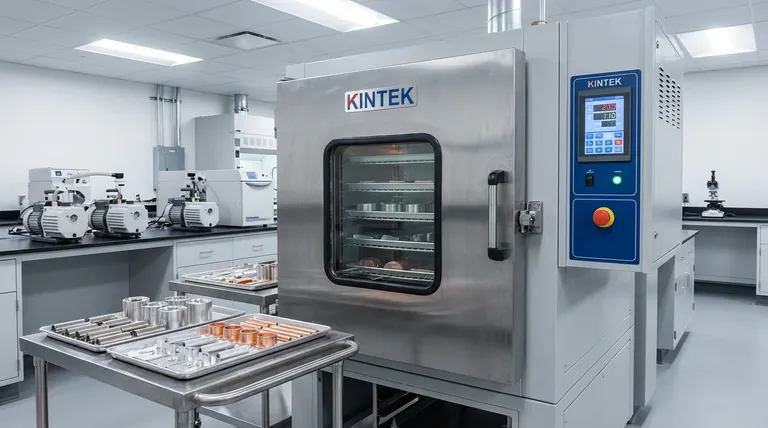
The primary role of a forced air drying oven in the preparation of Nickel-Aluminum Bronze (NAB) is to preheat and thoroughly dry high-purity metal components before they enter the melting phase. By maintaining the raw materials at a set temperature for an extended duration, the oven ensures the complete removal of residual moisture from the metal surfaces.
The integrity of the final alloy relies on a contaminant-free start. This drying process is the specific defense mechanism used to prevent moisture-induced defects, ensuring the internal structure of the casting remains solid and pore-free.
Preserving Alloy Purity
Eliminating Surface Moisture
Raw metal components often retain residual moisture on their surfaces that is not immediately visible. The forced air drying oven actively drives this moisture off by subjecting the materials to consistent heat over time.
This step is not merely about storage; it is an active purification process. It ensures that water vapor is fully evaporated rather than being carried into the furnace.
Protecting the Vacuum Environment
The subsequent processing step for NAB alloys is vacuum induction melting, a method designed to produce high-purity metals. Introduction of moisture into this vacuum environment is detrimental.
The drying oven acts as a gatekeeper. By removing moisture beforehand, it prevents the introduction of hydrogen and oxygen into the melt, which are the byproducts of water breakdown at high temperatures.
Preventing Structural Defects
Stopping Pore Formation
The presence of hydrogen and oxygen in the molten alloy is a primary cause of physical defects. As the metal solidifies, these trapped gases can form pores (porosity) within the casting.
By ensuring the raw materials are dry, the oven eliminates the source of these gases. This directly translates to a denser, higher-quality final casting.
Maintaining Liquid Consistency
To achieve the mechanical properties expected of NAB alloys, the liquid melt must remain pure. The drying process ensures that the chemistry of the alloy liquid is not altered by external contaminants.
The Consequence of Inadequate Preparation
The "Invisible" Threat
The trade-off in this process is time versus risk. It may be tempting to shorten the preheating duration to speed up production, but moisture is an invisible threat.
Compromising the Melt
If the drying step is rushed or skipped, even high-purity raw materials will result in a compromised product. The introduction of hydrogen or oxygen creates internal weaknesses that cannot be fixed once the casting is poured.
Making the Right Choice for Your Goal
To ensure the highest quality Nickel-Aluminum Bronze castings, apply the following principles:
- If your primary focus is structural integrity: Ensure the drying cycle is sufficiently long to guarantee the complete evaporation of all residual moisture.
- If your primary focus is defect reduction: View the drying oven as a critical quality control checkpoint to prevent hydrogen porosity in the final product.
Proper preparation of raw materials is the single most effective way to secure the quality of the final alloy.
Summary Table:
| Process Phase | Function of Forced Air Drying | Impact on Alloy Quality |
|---|---|---|
| Pre-Melting | Removes 100% of surface moisture/residue | Prevents hydrogen & oxygen contamination |
| Vacuum Prep | Protects the vacuum environment integrity | Reduces gas load on induction melting systems |
| Solidification | Eliminates source of gas bubbles | Ensures dense, pore-free internal casting structure |
| Quality Control | Maintains chemical consistency | Guarantees mechanical property standards |
Elevate Your Material Purity with KINTEK
Don't let moisture compromise your alloy integrity. Backed by expert R&D and manufacturing, KINTEK offers high-precision forced air drying ovens, Muffle, Tube, Rotary, Vacuum, and CVD systems—all fully customizable to meet the rigorous demands of Nickel-Aluminum Bronze production.
Our advanced thermal solutions ensure consistent temperature uniformity, protecting your melt from the invisible threats of hydrogen porosity and oxygen contamination. Whether you are scaling production or refining research, we provide the reliable equipment needed to secure the structural excellence of your materials.
Ready to optimize your lab's high-temperature processes?
Contact KINTEK Experts Today to discuss your unique needs!
References
- Yinxun Tan, Zhao Yizhi. Effect of Al/Ni Ratio on the Microstructure and Properties of Nickel–Aluminum Bronze Alloys. DOI: 10.3390/ma17061330
This article is also based on technical information from Kintek Furnace Knowledge Base .
Related Products
- High Temperature Muffle Oven Furnace for Laboratory Debinding and Pre Sintering
- 1400℃ Muffle Oven Furnace for Laboratory
- 1200℃ Muffle Oven Furnace for Laboratory
- 1700℃ High Temperature Muffle Oven Furnace for Laboratory
People Also Ask
- What thermal phenomena occur during polymer binder burnout in ceramic green bodies? Lab Furnace Guide
- Why is controlled heat treatment in a muffle furnace necessary for calcined clay? Achieve Optimal Pozzolanic Activity
- What role does a high-temperature muffle furnace play in STFO synthesis? Achieve Pure Perovskite Results
- How does a high-temperature muffle furnace facilitate the formation of LaNbxAl1−xO3+δ perovskite structures? Key Roles
- What role does a high-temperature muffle furnace play in the formation of biochar catalysts? Master Catalyst Synthesis



